

246
V. Vijayalekshmi et al.
studies. The selected isolates were screened for biosurfactant production using a
modified Mineral salt medium with trace elements such as FeSO 4 0.05 gL
−1 , H 3 BO 3
0.5 gL
−1 , MnSO 4 .4H 2 O 0.008 gL
−1 , C 2 H 7 NO 2 0.05 gL
−1 were dissolved in 250 ml
of distilled water to which 1 M phosphate buffer of pH 6.8 of 20 mlL
−1 with major
salts such as KNO 3 1 gL
−1 , H 14 MgO 11 S 1 gL
−1 , CaCl 2 H 12 O 6 0.1 gL
−1 , kerosene
20 mlL
−1 were added and finally made up to 1000 ml. Best screened isolates tested
for biosurfactant production used for further considered for mass production and
subjected to characterization studies. All the experiments were adequately replicated,
and the result values expressed in average or mean values.
2.3 Screening of Biosurfactant Producing Bacteria
2.3.1 Emulsification Index
Emulsification activity of the biosurfactant was checked, wherein 2 ml of kerosene
oil was added to 1 ml of cellfree extract that had been obtained by centrifugation
(Abd-alridha 2014). This mixture was then vortexed well for about 2–3 min at high
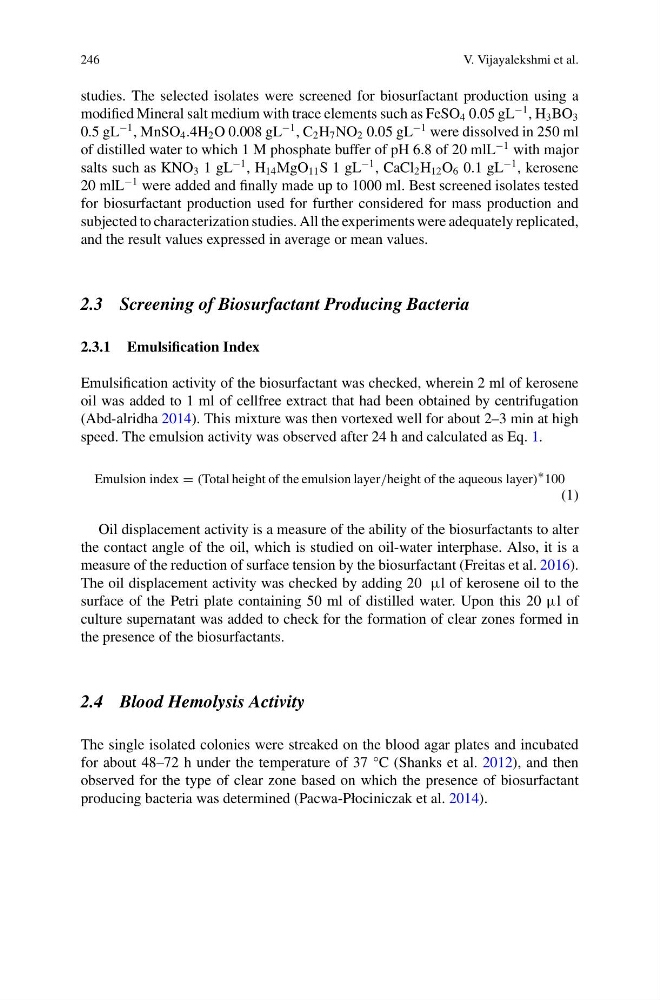
speed. The emulsion activity was observed after 24 h and calculated as Eq. 1.
Emulsion index = (Total height of the emulsion layer/height of the aqueous layer) ∗ 100
(1)
Oil displacement activity is a measure of the ability of the biosurfactants to alter
the contact angle of the oil, which is studied on oil-water interphase. Also, it is a
measure of the reduction of surface tension by the biosurfactant (Freitas et al. 2016).
The oil displacement activity was checked by adding 20 μl of kerosene oil to the
surface of the Petri plate containing 50 ml of distilled water. Upon this 20 μl of
culture supernatant was added to check for the formation of clear zones formed in
the presence of the biosurfactants.
2.4 Blood Hemolysis Activity
The single isolated colonies were streaked on the blood agar plates and incubated
for about 48–72 h under the temperature of 37 °C (Shanks et al. 2012), and then
observed for the type of clear zone based on which the presence of biosurfactant
producing bacteria was determined (Pacwa-Płociniczak et al. 2014).
V. Vijayalekshmi et al.
studies. The selected isolates were screened for biosurfactant production using a
modified Mineral salt medium with trace elements such as FeSO 4 0.05 gL
−1 , H 3 BO 3
0.5 gL
−1 , MnSO 4 .4H 2 O 0.008 gL
−1 , C 2 H 7 NO 2 0.05 gL
−1 were dissolved in 250 ml
of distilled water to which 1 M phosphate buffer of pH 6.8 of 20 mlL
−1 with major
salts such as KNO 3 1 gL
−1 , H 14 MgO 11 S 1 gL
−1 , CaCl 2 H 12 O 6 0.1 gL
−1 , kerosene
20 mlL
−1 were added and finally made up to 1000 ml. Best screened isolates tested
for biosurfactant production used for further considered for mass production and
subjected to characterization studies. All the experiments were adequately replicated,
and the result values expressed in average or mean values.
2.3 Screening of Biosurfactant Producing Bacteria
2.3.1 Emulsification Index
Emulsification activity of the biosurfactant was checked, wherein 2 ml of kerosene
oil was added to 1 ml of cellfree extract that had been obtained by centrifugation
(Abd-alridha 2014). This mixture was then vortexed well for about 2–3 min at high
speed. The emulsion activity was observed after 24 h and calculated as Eq. 1.
Emulsion index = (Total height of the emulsion layer/height of the aqueous layer) ∗ 100
(1)
Oil displacement activity is a measure of the ability of the biosurfactants to alter
the contact angle of the oil, which is studied on oil-water interphase. Also, it is a
measure of the reduction of surface tension by the biosurfactant (Freitas et al. 2016).
The oil displacement activity was checked by adding 20 μl of kerosene oil to the
surface of the Petri plate containing 50 ml of distilled water. Upon this 20 μl of
culture supernatant was added to check for the formation of clear zones formed in
the presence of the biosurfactants.
2.4 Blood Hemolysis Activity
The single isolated colonies were streaked on the blood agar plates and incubated
for about 48–72 h under the temperature of 37 °C (Shanks et al. 2012), and then
observed for the type of clear zone based on which the presence of biosurfactant
producing bacteria was determined (Pacwa-Płociniczak et al. 2014).