

Screening, Isolation and Molecular Characterization …
245
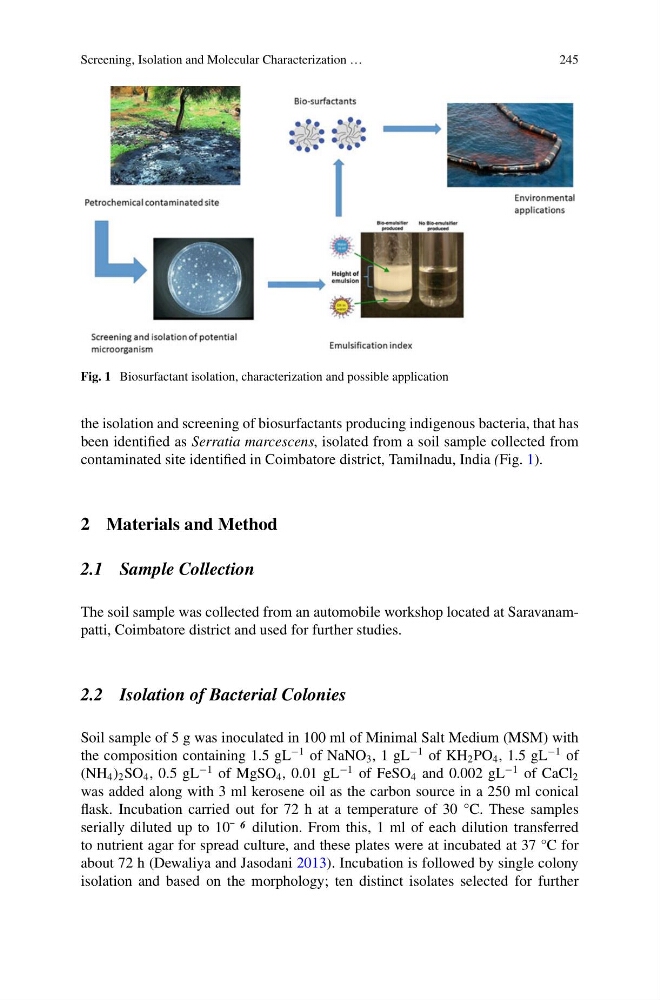
Fig. 1 Biosurfactant isolation, characterization and possible application
the isolation and screening of biosurfactants producing indigenous bacteria, that has
been identified as Serratia marcescens, isolated from a soil sample collected from
contaminated site identified in Coimbatore district, Tamilnadu, India (Fig. 1).
2 Materials and Method
2.1 Sample Collection
The soil sample was collected from an automobile workshop located at Saravanampatti, Coimbatore district and used for further studies.
2.2 Isolation of Bacterial Colonies
Soil sample of 5 g was inoculated in 100 ml of Minimal Salt Medium (MSM) with
the composition containing 1.5 gL
−1 of NaNO 3 , 1 gL
−1 of KH 2 PO 4 , 1.5 gL
−1 of
(NH 4 ) 2 SO 4 , 0.5 gL
−1 of MgSO 4 , 0.01 gL
−1 of FeSO 4 and 0.002 gL
−1 of CaCl 2
was added along with 3 ml kerosene oil as the carbon source in a 250 ml conical
flask. Incubation carried out for 72 h at a temperature of 30 °C. These samples
serially diluted up to 10¯ 6 dilution. From this, 1 ml of each dilution transferred
to nutrient agar for spread culture, and these plates were at incubated at 37 °C for
about 72 h (Dewaliya and Jasodani 2013). Incubation is followed by single colony
isolation and based on the morphology; ten distinct isolates selected for further
245
Fig. 1 Biosurfactant isolation, characterization and possible application
the isolation and screening of biosurfactants producing indigenous bacteria, that has
been identified as Serratia marcescens, isolated from a soil sample collected from
contaminated site identified in Coimbatore district, Tamilnadu, India (Fig. 1).
2 Materials and Method
2.1 Sample Collection
The soil sample was collected from an automobile workshop located at Saravanampatti, Coimbatore district and used for further studies.
2.2 Isolation of Bacterial Colonies
Soil sample of 5 g was inoculated in 100 ml of Minimal Salt Medium (MSM) with
the composition containing 1.5 gL
−1 of NaNO 3 , 1 gL
−1 of KH 2 PO 4 , 1.5 gL
−1 of
(NH 4 ) 2 SO 4 , 0.5 gL
−1 of MgSO 4 , 0.01 gL
−1 of FeSO 4 and 0.002 gL
−1 of CaCl 2
was added along with 3 ml kerosene oil as the carbon source in a 250 ml conical
flask. Incubation carried out for 72 h at a temperature of 30 °C. These samples
serially diluted up to 10¯ 6 dilution. From this, 1 ml of each dilution transferred
to nutrient agar for spread culture, and these plates were at incubated at 37 °C for
about 72 h (Dewaliya and Jasodani 2013). Incubation is followed by single colony
isolation and based on the morphology; ten distinct isolates selected for further