

150
M. Dexilin et al.
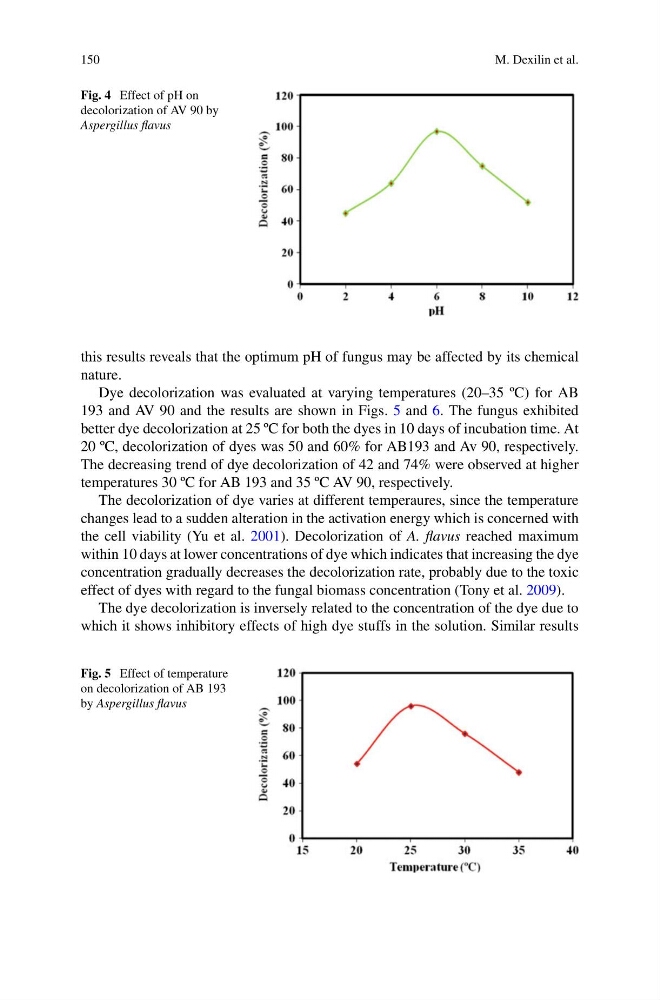
Fig. 4 Effect of pH on
decolorization of AV 90 by
Aspergillus flavus
this results reveals that the optimum pH of fungus may be affected by its chemical
nature.
Dye decolorization was evaluated at varying temperatures (20–35 ºC) for AB
193 and AV 90 and the results are shown in Figs. 5 and 6. The fungus exhibited
better dye decolorization at 25 ºC for both the dyes in 10 days of incubation time. At
20 ºC, decolorization of dyes was 50 and 60% for AB193 and Av 90, respectively.
The decreasing trend of dye decolorization of 42 and 74% were observed at higher
temperatures 30 ºC for AB 193 and 35 ºC AV 90, respectively.
The decolorization of dye varies at different temperaures, since the temperature
changes lead to a sudden alteration in the activation energy which is concerned with
the cell viability (Yu et al. 2001). Decolorization of A. flavus reached maximum
within 10 days at lower concentrations of dye which indicates that increasing the dye
concentration gradually decreases the decolorization rate, probably due to the toxic
effect of dyes with regard to the fungal biomass concentration (Tony et al. 2009).
The dye decolorization is inversely related to the concentration of the dye due to
which it shows inhibitory effects of high dye stuffs in the solution. Similar results
Fig. 5 Effect of temperature
on decolorization of AB 193
by Aspergillus flavus
M. Dexilin et al.
Fig. 4 Effect of pH on
decolorization of AV 90 by
Aspergillus flavus
this results reveals that the optimum pH of fungus may be affected by its chemical
nature.
Dye decolorization was evaluated at varying temperatures (20–35 ºC) for AB
193 and AV 90 and the results are shown in Figs. 5 and 6. The fungus exhibited
better dye decolorization at 25 ºC for both the dyes in 10 days of incubation time. At
20 ºC, decolorization of dyes was 50 and 60% for AB193 and Av 90, respectively.
The decreasing trend of dye decolorization of 42 and 74% were observed at higher
temperatures 30 ºC for AB 193 and 35 ºC AV 90, respectively.
The decolorization of dye varies at different temperaures, since the temperature
changes lead to a sudden alteration in the activation energy which is concerned with
the cell viability (Yu et al. 2001). Decolorization of A. flavus reached maximum
within 10 days at lower concentrations of dye which indicates that increasing the dye
concentration gradually decreases the decolorization rate, probably due to the toxic
effect of dyes with regard to the fungal biomass concentration (Tony et al. 2009).
The dye decolorization is inversely related to the concentration of the dye due to
which it shows inhibitory effects of high dye stuffs in the solution. Similar results
Fig. 5 Effect of temperature
on decolorization of AB 193
by Aspergillus flavus