

Optimization of Culture Conditions for Enhanced Decolorization …
149
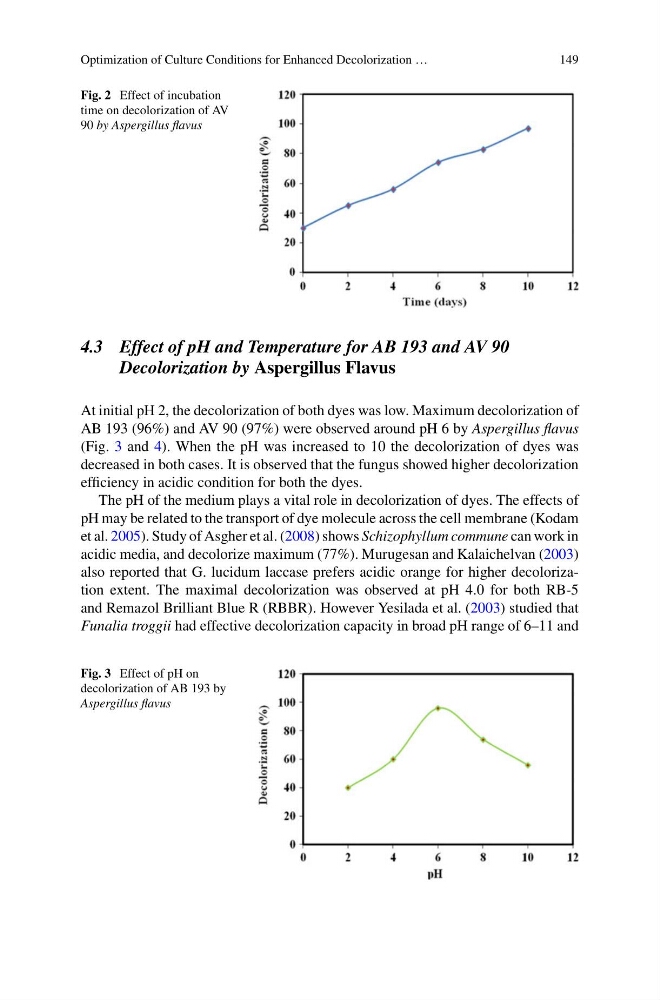
Fig. 2 Effect of incubation
time on decolorization of AV
90 by Aspergillus flavus
4.3 Effect of pH and Temperature for AB 193 and AV 90
Decolorization by Aspergillus Flavus
At initial pH 2, the decolorization of both dyes was low. Maximum decolorization of
AB 193 (96%) and AV 90 (97%) were observed around pH 6 by Aspergillus flavus
(Fig. 3 and 4). When the pH was increased to 10 the decolorization of dyes was
decreased in both cases. It is observed that the fungus showed higher decolorization
efficiency in acidic condition for both the dyes.
The pH of the medium plays a vital role in decolorization of dyes. The effects of
pH may be related to the transport of dye molecule across the cell membrane (Kodam
et al. 2005). Study of Asgher et al. (2008) shows Schizophyllum commune can work in
acidic media, and decolorize maximum (77%). Murugesan and Kalaichelvan (2003)
also reported that G. lucidum laccase prefers acidic orange for higher decolorization extent. The maximal decolorization was observed at pH 4.0 for both RB-5
and Remazol Brilliant Blue R (RBBR). However Yesilada et al. (2003) studied that
Funalia troggii had effective decolorization capacity in broad pH range of 6–11 and
Fig. 3 Effect of pH on
decolorization of AB 193 by
Aspergillus flavus
149
Fig. 2 Effect of incubation
time on decolorization of AV
90 by Aspergillus flavus
4.3 Effect of pH and Temperature for AB 193 and AV 90
Decolorization by Aspergillus Flavus
At initial pH 2, the decolorization of both dyes was low. Maximum decolorization of
AB 193 (96%) and AV 90 (97%) were observed around pH 6 by Aspergillus flavus
(Fig. 3 and 4). When the pH was increased to 10 the decolorization of dyes was
decreased in both cases. It is observed that the fungus showed higher decolorization
efficiency in acidic condition for both the dyes.
The pH of the medium plays a vital role in decolorization of dyes. The effects of
pH may be related to the transport of dye molecule across the cell membrane (Kodam
et al. 2005). Study of Asgher et al. (2008) shows Schizophyllum commune can work in
acidic media, and decolorize maximum (77%). Murugesan and Kalaichelvan (2003)
also reported that G. lucidum laccase prefers acidic orange for higher decolorization extent. The maximal decolorization was observed at pH 4.0 for both RB-5
and Remazol Brilliant Blue R (RBBR). However Yesilada et al. (2003) studied that
Funalia troggii had effective decolorization capacity in broad pH range of 6–11 and
Fig. 3 Effect of pH on
decolorization of AB 193 by
Aspergillus flavus