

Optimization of Culture Conditions for Enhanced Decolorization …
147
Table 1 Dye decolorization pattern of fungal isolates
Organisms
Acid blue 193 (AB 193)
Acid violet 90 (AV 90)
50 mg L −1
100 mg L −1 50 mg L −1
100 mg L −1
Fusarium oxysporum −
−
+
+
Rhizopus sp.
+
+
−
−
Aspergillus terreus
+
−
−
−
Aspergillus flavus
+
+
+
+
+ decolorization zone observed
−decolorization zone not observed
4 Results and Discussion
4.1 Screening and Selection of Dye Tolerant Fungi
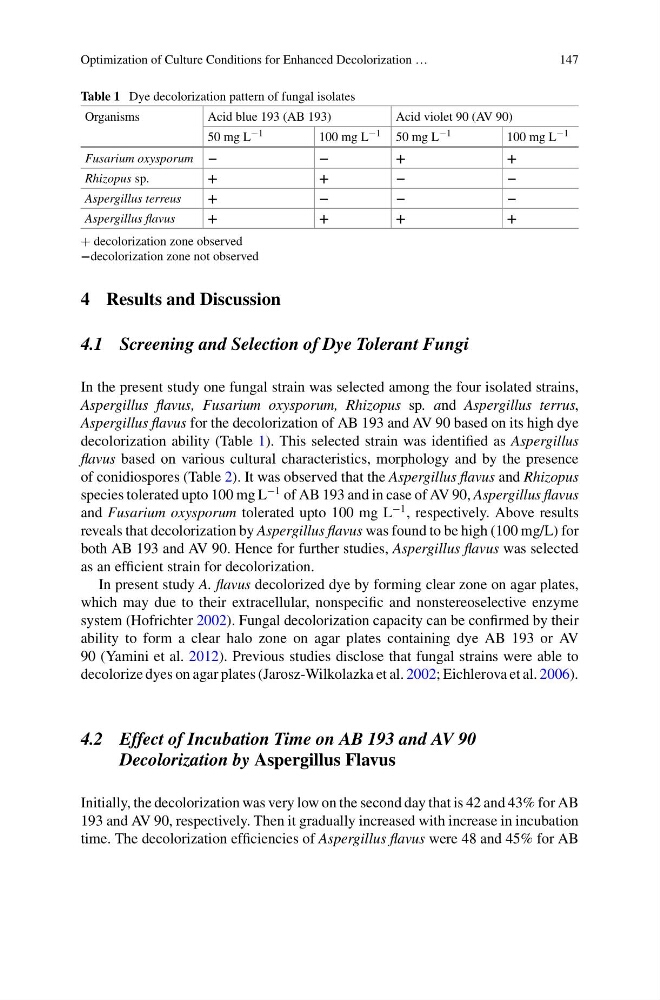
In the present study one fungal strain was selected among the four isolated strains,
Aspergillus flavus, Fusarium oxysporum, Rhizopus sp. and Aspergillus terrus,
Aspergillus flavus for the decolorization of AB 193 and AV 90 based on its high dye
decolorization ability (Table 1). This selected strain was identified as Aspergillus
flavus based on various cultural characteristics, morphology and by the presence
of conidiospores (Table 2). It was observed that the Aspergillus flavus and Rhizopus
species tolerated upto 100 mg L
−1 of AB 193 and in case of AV 90, Aspergillus flavus
and Fusarium oxysporum tolerated upto 100 mg L
−1 , respectively. Above results
reveals that decolorization by Aspergillus flavus was found to be high (100 mg/L) for
both AB 193 and AV 90. Hence for further studies, Aspergillus flavus was selected
as an efficient strain for decolorization.
In present study A. flavus decolorized dye by forming clear zone on agar plates,
which may due to their extracellular, nonspecific and nonstereoselective enzyme
system (Hofrichter 2002). Fungal decolorization capacity can be confirmed by their
ability to form a clear halo zone on agar plates containing dye AB 193 or AV
90 (Yamini et al. 2012). Previous studies disclose that fungal strains were able to
decolorize dyes on agar plates (Jarosz-Wilkolazka et al. 2002; Eichlerova et al. 2006).
4.2 Effect of Incubation Time on AB 193 and AV 90
Decolorization by Aspergillus Flavus
Initially, the decolorization was very low on the second day that is 42 and 43% for AB
193 and AV 90, respectively. Then it gradually increased with increase in incubation
time. The decolorization efficiencies of Aspergillus flavus were 48 and 45% for AB
147
Table 1 Dye decolorization pattern of fungal isolates
Organisms
Acid blue 193 (AB 193)
Acid violet 90 (AV 90)
50 mg L −1
100 mg L −1 50 mg L −1
100 mg L −1
Fusarium oxysporum −
−
+
+
Rhizopus sp.
+
+
−
−
Aspergillus terreus
+
−
−
−
Aspergillus flavus
+
+
+
+
+ decolorization zone observed
−decolorization zone not observed
4 Results and Discussion
4.1 Screening and Selection of Dye Tolerant Fungi
In the present study one fungal strain was selected among the four isolated strains,
Aspergillus flavus, Fusarium oxysporum, Rhizopus sp. and Aspergillus terrus,
Aspergillus flavus for the decolorization of AB 193 and AV 90 based on its high dye
decolorization ability (Table 1). This selected strain was identified as Aspergillus
flavus based on various cultural characteristics, morphology and by the presence
of conidiospores (Table 2). It was observed that the Aspergillus flavus and Rhizopus
species tolerated upto 100 mg L
−1 of AB 193 and in case of AV 90, Aspergillus flavus
and Fusarium oxysporum tolerated upto 100 mg L
−1 , respectively. Above results
reveals that decolorization by Aspergillus flavus was found to be high (100 mg/L) for
both AB 193 and AV 90. Hence for further studies, Aspergillus flavus was selected
as an efficient strain for decolorization.
In present study A. flavus decolorized dye by forming clear zone on agar plates,
which may due to their extracellular, nonspecific and nonstereoselective enzyme
system (Hofrichter 2002). Fungal decolorization capacity can be confirmed by their
ability to form a clear halo zone on agar plates containing dye AB 193 or AV
90 (Yamini et al. 2012). Previous studies disclose that fungal strains were able to
decolorize dyes on agar plates (Jarosz-Wilkolazka et al. 2002; Eichlerova et al. 2006).
4.2 Effect of Incubation Time on AB 193 and AV 90
Decolorization by Aspergillus Flavus
Initially, the decolorization was very low on the second day that is 42 and 43% for AB
193 and AV 90, respectively. Then it gradually increased with increase in incubation
time. The decolorization efficiencies of Aspergillus flavus were 48 and 45% for AB