

146
M. Dexilin et al.
3 Decolorization Experiments
3.1 Optimization of Incubation Time on Decolorization
of Azo Dyes
The isolated fungus was tested for its ability to decolorize AB 193 and AV 90
(100 mg L
−1 ). About 50 mL of C-limited Czapek-Dox medium was amended separately with the dyes and subsequently inoculated with 5 ml spore suspension (10
8
spore/ml) from a slant culture. The flasks were incubated at 30 ± 1 ºC for 12 days
on a rotary shaker (150 rpm) and the samples were withdrawn at 2 days intervals
and centrifuged at 10,000 rpm for 10 min. Supernatant collected was assessed for
the decolorization of AB 193 and AV90 in UV–Vis spectrophotometer (UV–Vis
1700, Shimadzu, Japan) at its maximum absorbence wave length of 586 and 526 nm,
respectively. Two control flasks (i) dye + medium without inoculum and (ii) medium
with inoculum without dye were maintained. The percentage decolorization was
calculated according to the following formula Bergsten-Torralba et al. (2009)
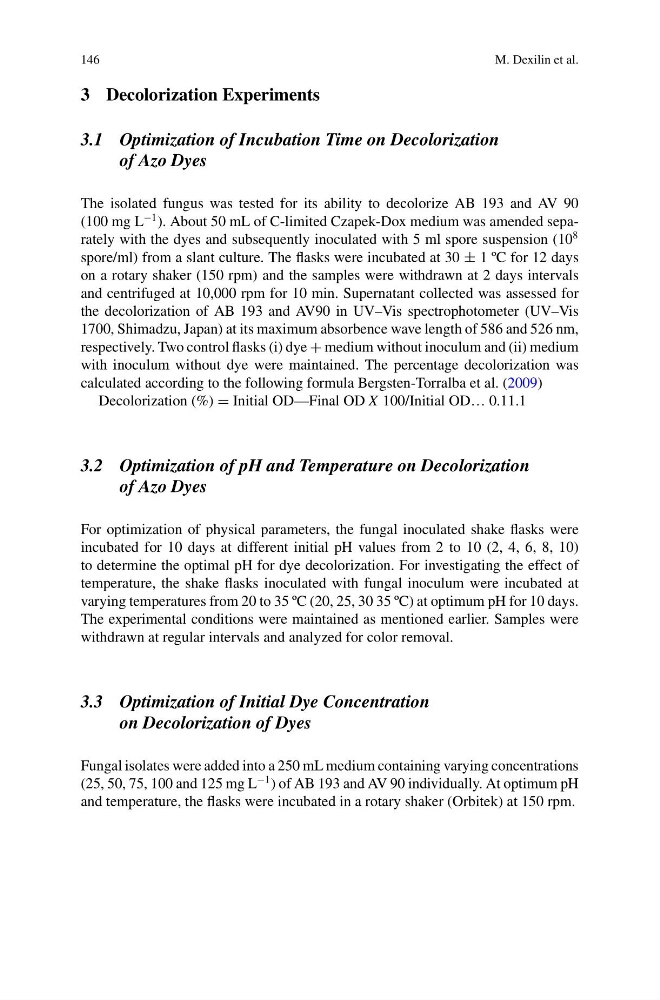
Decolorization (%) = Initial OD—Final OD X 100/Initial OD… 0.11.1
3.2 Optimization of pH and Temperature on Decolorization
of Azo Dyes
For optimization of physical parameters, the fungal inoculated shake flasks were
incubated for 10 days at different initial pH values from 2 to 10 (2, 4, 6, 8, 10)
to determine the optimal pH for dye decolorization. For investigating the effect of
temperature, the shake flasks inoculated with fungal inoculum were incubated at
varying temperatures from 20 to 35 ºC (20, 25, 30 35 ºC) at optimum pH for 10 days.
The experimental conditions were maintained as mentioned earlier. Samples were
withdrawn at regular intervals and analyzed for color removal.
3.3 Optimization of Initial Dye Concentration
on Decolorization of Dyes
Fungal isolates were added into a 250 mL medium containing varying concentrations
(25, 50, 75, 100 and 125 mg L
−1 ) of AB 193 and AV 90 individually. At optimum pH
and temperature, the flasks were incubated in a rotary shaker (Orbitek) at 150 rpm.
M. Dexilin et al.
3 Decolorization Experiments
3.1 Optimization of Incubation Time on Decolorization
of Azo Dyes
The isolated fungus was tested for its ability to decolorize AB 193 and AV 90
(100 mg L
−1 ). About 50 mL of C-limited Czapek-Dox medium was amended separately with the dyes and subsequently inoculated with 5 ml spore suspension (10
8
spore/ml) from a slant culture. The flasks were incubated at 30 ± 1 ºC for 12 days
on a rotary shaker (150 rpm) and the samples were withdrawn at 2 days intervals
and centrifuged at 10,000 rpm for 10 min. Supernatant collected was assessed for
the decolorization of AB 193 and AV90 in UV–Vis spectrophotometer (UV–Vis
1700, Shimadzu, Japan) at its maximum absorbence wave length of 586 and 526 nm,
respectively. Two control flasks (i) dye + medium without inoculum and (ii) medium
with inoculum without dye were maintained. The percentage decolorization was
calculated according to the following formula Bergsten-Torralba et al. (2009)
Decolorization (%) = Initial OD—Final OD X 100/Initial OD… 0.11.1
3.2 Optimization of pH and Temperature on Decolorization
of Azo Dyes
For optimization of physical parameters, the fungal inoculated shake flasks were
incubated for 10 days at different initial pH values from 2 to 10 (2, 4, 6, 8, 10)
to determine the optimal pH for dye decolorization. For investigating the effect of
temperature, the shake flasks inoculated with fungal inoculum were incubated at
varying temperatures from 20 to 35 ºC (20, 25, 30 35 ºC) at optimum pH for 10 days.
The experimental conditions were maintained as mentioned earlier. Samples were
withdrawn at regular intervals and analyzed for color removal.
3.3 Optimization of Initial Dye Concentration
on Decolorization of Dyes
Fungal isolates were added into a 250 mL medium containing varying concentrations
(25, 50, 75, 100 and 125 mg L
−1 ) of AB 193 and AV 90 individually. At optimum pH
and temperature, the flasks were incubated in a rotary shaker (Orbitek) at 150 rpm.