

Bioremediation Approaches for Degradation …
129
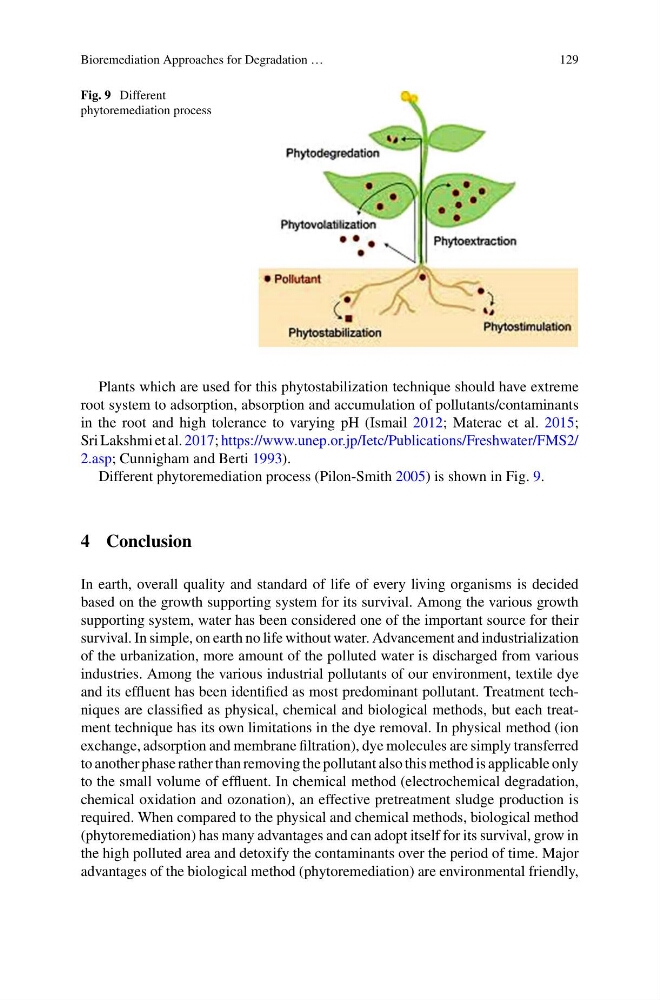
Fig. 9 Different
phytoremediation process
Plants which are used for this phytostabilization technique should have extreme
root system to adsorption, absorption and accumulation of pollutants/contaminants
in the root and high tolerance to varying pH (Ismail 2012; Materac et al. 2015;
Sri Lakshmi et al. 2017; https://www.unep.or.jp/Ietc/Publications/Freshwater/FMS2/
2.asp; Cunnigham and Berti 1993).
Different phytoremediation process (Pilon-Smith 2005) is shown in Fig. 9.
4 Conclusion
In earth, overall quality and standard of life of every living organisms is decided
based on the growth supporting system for its survival. Among the various growth
supporting system, water has been considered one of the important source for their
survival. In simple, on earth no life without water. Advancement and industrialization
of the urbanization, more amount of the polluted water is discharged from various
industries. Among the various industrial pollutants of our environment, textile dye
and its effluent has been identified as most predominant pollutant. Treatment techniques are classified as physical, chemical and biological methods, but each treatment technique has its own limitations in the dye removal. In physical method (ion
exchange, adsorption and membrane filtration), dye molecules are simply transferred
to another phase rather than removing the pollutant also this method is applicable only
to the small volume of effluent. In chemical method (electrochemical degradation,
chemical oxidation and ozonation), an effective pretreatment sludge production is
required. When compared to the physical and chemical methods, biological method
(phytoremediation) has many advantages and can adopt itself for its survival, grow in
the high polluted area and detoxify the contaminants over the period of time. Major
advantages of the biological method (phytoremediation) are environmental friendly,
129
Fig. 9 Different
phytoremediation process
Plants which are used for this phytostabilization technique should have extreme
root system to adsorption, absorption and accumulation of pollutants/contaminants
in the root and high tolerance to varying pH (Ismail 2012; Materac et al. 2015;
Sri Lakshmi et al. 2017; https://www.unep.or.jp/Ietc/Publications/Freshwater/FMS2/
2.asp; Cunnigham and Berti 1993).
Different phytoremediation process (Pilon-Smith 2005) is shown in Fig. 9.
4 Conclusion
In earth, overall quality and standard of life of every living organisms is decided
based on the growth supporting system for its survival. Among the various growth
supporting system, water has been considered one of the important source for their
survival. In simple, on earth no life without water. Advancement and industrialization
of the urbanization, more amount of the polluted water is discharged from various
industries. Among the various industrial pollutants of our environment, textile dye
and its effluent has been identified as most predominant pollutant. Treatment techniques are classified as physical, chemical and biological methods, but each treatment technique has its own limitations in the dye removal. In physical method (ion
exchange, adsorption and membrane filtration), dye molecules are simply transferred
to another phase rather than removing the pollutant also this method is applicable only
to the small volume of effluent. In chemical method (electrochemical degradation,
chemical oxidation and ozonation), an effective pretreatment sludge production is
required. When compared to the physical and chemical methods, biological method
(phytoremediation) has many advantages and can adopt itself for its survival, grow in
the high polluted area and detoxify the contaminants over the period of time. Major
advantages of the biological method (phytoremediation) are environmental friendly,