

Bioremediation Approaches for Degradation …
127
Fig. 7 Degradation of organic contaminant by phytodegradation
Phytoextraction
Phytoextraction is also named as phytoaccumulation and has largest economic opportunities in phytoremediation (Raskin et al. 1997). In this phytoextraction, toxic metal
pollutants from soil are uptake by plant roots, transferred and accumulated in the
above ground plant body parts. When the plant attained maximum growth and metal
accumulation, plants are harvested above the ground levels leads to perpetual elimination of metal from the site. By phytoextraction metals such as zinc, nickel and
copper can be eliminated (Ismail 2012; https://www.unep.or.jp/Ietc/Publications/Fre
shwater/FMS2/2.asp; Materac et al. 2015; Sri Lakshmi et al. 2017). Extraction of
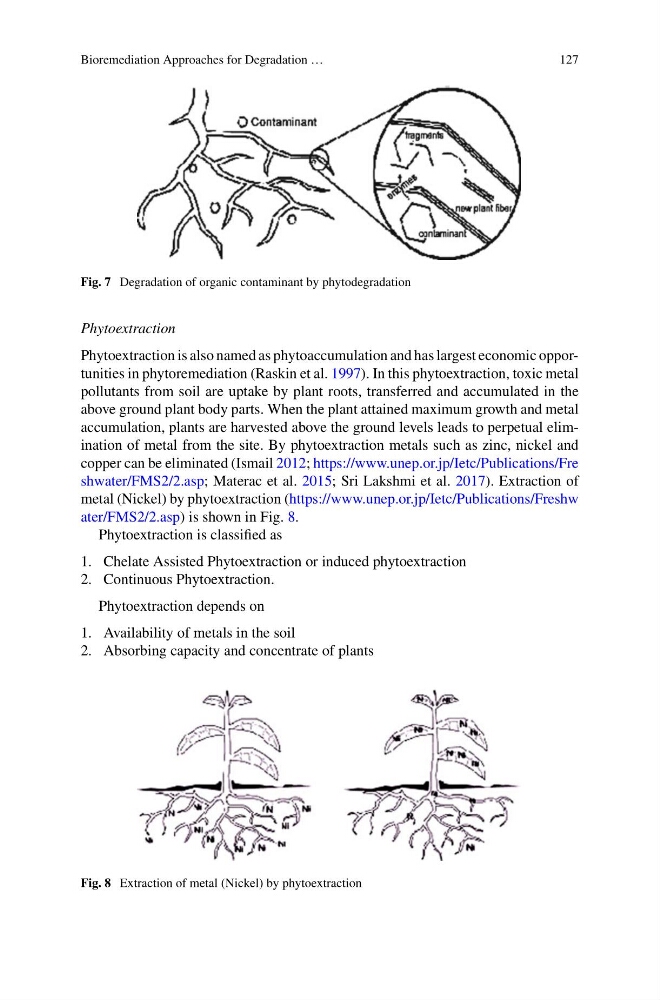
metal (Nickel) by phytoextraction (https://www.unep.or.jp/Ietc/Publications/Freshw
ater/FMS2/2.asp) is shown in Fig. 8.
Phytoextraction is classified as
1. Chelate Assisted Phytoextraction or induced phytoextraction
2. Continuous Phytoextraction.
Phytoextraction depends on
1. Availability of metals in the soil
2. Absorbing capacity and concentrate of plants
Fig. 8 Extraction of metal (Nickel) by phytoextraction
127
Fig. 7 Degradation of organic contaminant by phytodegradation
Phytoextraction
Phytoextraction is also named as phytoaccumulation and has largest economic opportunities in phytoremediation (Raskin et al. 1997). In this phytoextraction, toxic metal
pollutants from soil are uptake by plant roots, transferred and accumulated in the
above ground plant body parts. When the plant attained maximum growth and metal
accumulation, plants are harvested above the ground levels leads to perpetual elimination of metal from the site. By phytoextraction metals such as zinc, nickel and
copper can be eliminated (Ismail 2012; https://www.unep.or.jp/Ietc/Publications/Fre
shwater/FMS2/2.asp; Materac et al. 2015; Sri Lakshmi et al. 2017). Extraction of
metal (Nickel) by phytoextraction (https://www.unep.or.jp/Ietc/Publications/Freshw
ater/FMS2/2.asp) is shown in Fig. 8.
Phytoextraction is classified as
1. Chelate Assisted Phytoextraction or induced phytoextraction
2. Continuous Phytoextraction.
Phytoextraction depends on
1. Availability of metals in the soil
2. Absorbing capacity and concentrate of plants
Fig. 8 Extraction of metal (Nickel) by phytoextraction