

Bioremediation Approaches for Degradation …
121
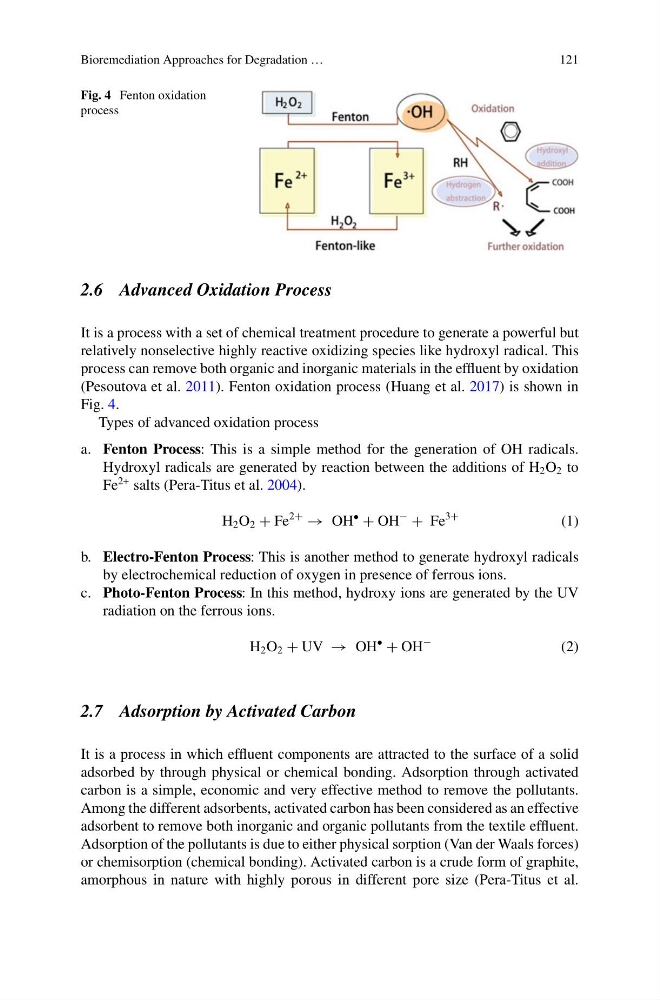
Fig. 4 Fenton oxidation
process
2.6 Advanced Oxidation Process
It is a process with a set of chemical treatment procedure to generate a powerful but
relatively nonselective highly reactive oxidizing species like hydroxyl radical. This
process can remove both organic and inorganic materials in the effluent by oxidation
(Pesoutova et al. 2011). Fenton oxidation process (Huang et al. 2017) is shown in
Fig. 4.
Types of advanced oxidation process
a. Fenton Process: This is a simple method for the generation of OH radicals.
Hydroxyl radicals are generated by reaction between the additions of H 2 O 2 to
Fe
2+ salts (Pera-Titus et al. 2004).
H 2 O 2 + Fe
2+
→ OH
•
+ OH
−
+ Fe
3+
(1)
b. Electro-Fenton Process: This is another method to generate hydroxyl radicals
by electrochemical reduction of oxygen in presence of ferrous ions.
c. Photo-Fenton Process: In this method, hydroxy ions are generated by the UV
radiation on the ferrous ions.
H 2 O 2 + UV → OH
•
+ OH
−
(2)
2.7 Adsorption by Activated Carbon
It is a process in which effluent components are attracted to the surface of a solid
adsorbed by through physical or chemical bonding. Adsorption through activated
carbon is a simple, economic and very effective method to remove the pollutants.
Among the different adsorbents, activated carbon has been considered as an effective
adsorbent to remove both inorganic and organic pollutants from the textile effluent.
Adsorption of the pollutants is due to either physical sorption (Van der Waals forces)
or chemisorption (chemical bonding). Activated carbon is a crude form of graphite,
amorphous in nature with highly porous in different pore size (Pera-Titus et al.
121
Fig. 4 Fenton oxidation
process
2.6 Advanced Oxidation Process
It is a process with a set of chemical treatment procedure to generate a powerful but
relatively nonselective highly reactive oxidizing species like hydroxyl radical. This
process can remove both organic and inorganic materials in the effluent by oxidation
(Pesoutova et al. 2011). Fenton oxidation process (Huang et al. 2017) is shown in
Fig. 4.
Types of advanced oxidation process
a. Fenton Process: This is a simple method for the generation of OH radicals.
Hydroxyl radicals are generated by reaction between the additions of H 2 O 2 to
Fe
2+ salts (Pera-Titus et al. 2004).
H 2 O 2 + Fe
2+
→ OH
•
+ OH
−
+ Fe
3+
(1)
b. Electro-Fenton Process: This is another method to generate hydroxyl radicals
by electrochemical reduction of oxygen in presence of ferrous ions.
c. Photo-Fenton Process: In this method, hydroxy ions are generated by the UV
radiation on the ferrous ions.
H 2 O 2 + UV → OH
•
+ OH
−
(2)
2.7 Adsorption by Activated Carbon
It is a process in which effluent components are attracted to the surface of a solid
adsorbed by through physical or chemical bonding. Adsorption through activated
carbon is a simple, economic and very effective method to remove the pollutants.
Among the different adsorbents, activated carbon has been considered as an effective
adsorbent to remove both inorganic and organic pollutants from the textile effluent.
Adsorption of the pollutants is due to either physical sorption (Van der Waals forces)
or chemisorption (chemical bonding). Activated carbon is a crude form of graphite,
amorphous in nature with highly porous in different pore size (Pera-Titus et al.