

Introduction of the Research Project EcoING …
549
4 Procedure for the Planning and Design of the Course
Due to the novelty and unique character of the Ecodesign learning factory, it is
not possible to simply rely on standardized learning environments. Rather, a new
concept must include the specific boundary conditions of the project, such as the
target group and learning outcomes, requirements of the stakeholders, time and financial resources. In addition to the planning and design, the implementation and the
evaluation regarding the defined objectives has to be a part of the approach applied in
the project. The scientific foundation for the conception of the learning environment
of the Ecodesign learning factory is laid down by the established concept of instructional design according to Seel (1999). Instructional design (or didactic design) was
created for the systematic development of efficient (multimedia) learning environments that are suitable for promoting the acquisition of competencies. These are
situation-specific models that focus on independent learning activities, an active role
of the learners and support cooperative or collaborative learning (Niegemann et al.
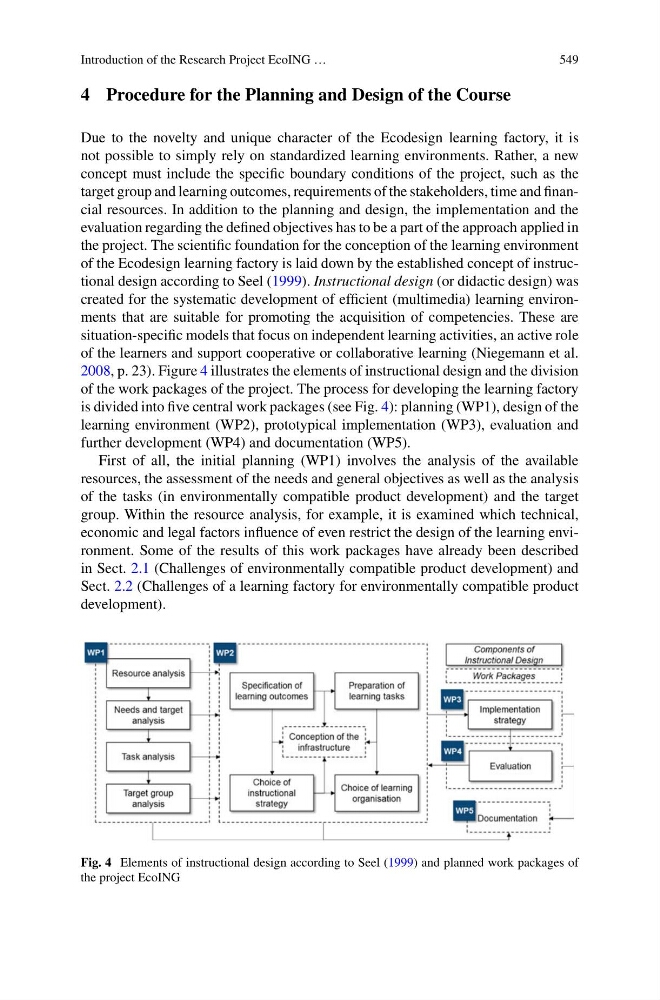
2008, p. 23). Figure 4 illustrates the elements of instructional design and the division
of the work packages of the project. The process for developing the learning factory
is divided into five central work packages (see Fig. 4): planning (WP1), design of the
learning environment (WP2), prototypical implementation (WP3), evaluation and
further development (WP4) and documentation (WP5).
First of all, the initial planning (WP1) involves the analysis of the available
resources, the assessment of the needs and general objectives as well as the analysis
of the tasks (in environmentally compatible product development) and the target
group. Within the resource analysis, for example, it is examined which technical,
economic and legal factors influence of even restrict the design of the learning environment. Some of the results of this work packages have already been described
in Sect. 2.1 (Challenges of environmentally compatible product development) and
Sect. 2.2 (Challenges of a learning factory for environmentally compatible product
development).
Fig. 4 Elements of instructional design according to Seel (1999) and planned work packages of
the project EcoING
549
4 Procedure for the Planning and Design of the Course
Due to the novelty and unique character of the Ecodesign learning factory, it is
not possible to simply rely on standardized learning environments. Rather, a new
concept must include the specific boundary conditions of the project, such as the
target group and learning outcomes, requirements of the stakeholders, time and financial resources. In addition to the planning and design, the implementation and the
evaluation regarding the defined objectives has to be a part of the approach applied in
the project. The scientific foundation for the conception of the learning environment
of the Ecodesign learning factory is laid down by the established concept of instructional design according to Seel (1999). Instructional design (or didactic design) was
created for the systematic development of efficient (multimedia) learning environments that are suitable for promoting the acquisition of competencies. These are
situation-specific models that focus on independent learning activities, an active role
of the learners and support cooperative or collaborative learning (Niegemann et al.
2008, p. 23). Figure 4 illustrates the elements of instructional design and the division
of the work packages of the project. The process for developing the learning factory
is divided into five central work packages (see Fig. 4): planning (WP1), design of the
learning environment (WP2), prototypical implementation (WP3), evaluation and
further development (WP4) and documentation (WP5).
First of all, the initial planning (WP1) involves the analysis of the available
resources, the assessment of the needs and general objectives as well as the analysis
of the tasks (in environmentally compatible product development) and the target
group. Within the resource analysis, for example, it is examined which technical,
economic and legal factors influence of even restrict the design of the learning environment. Some of the results of this work packages have already been described
in Sect. 2.1 (Challenges of environmentally compatible product development) and
Sect. 2.2 (Challenges of a learning factory for environmentally compatible product
development).
Fig. 4 Elements of instructional design according to Seel (1999) and planned work packages of
the project EcoING