

528
S. da Silva Neiva et al.
SDGs, awareness on the study of sustainable development grew internationally and
this is reflected clearly in Fig. 2. In the following years, the IJSHE had the biggest
number of publications in a single year in 2016, publishing 47 articles including two
special issues, with seven articles each: the first regarding sustainable development in
African HEIs and the second addressing Campus Sustainability and Social Sciences.
In 2017, the IJSHE saw again the largest number of articles in a single year: 72
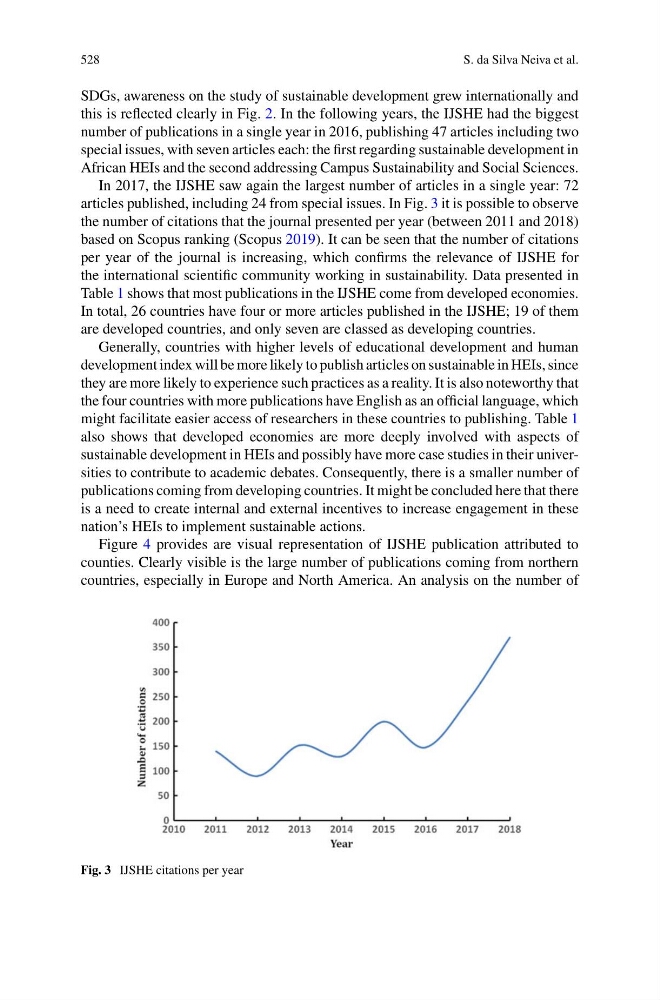
articles published, including 24 from special issues. In Fig. 3 it is possible to observe
the number of citations that the journal presented per year (between 2011 and 2018)
based on Scopus ranking (Scopus 2019). It can be seen that the number of citations
per year of the journal is increasing, which confirms the relevance of IJSHE for
the international scientific community working in sustainability. Data presented in
Table 1 shows that most publications in the IJSHE come from developed economies.
In total, 26 countries have four or more articles published in the IJSHE; 19 of them
are developed countries, and only seven are classed as developing countries.
Generally, countries with higher levels of educational development and human
development index will be more likely to publish articles on sustainable in HEIs, since
they are more likely to experience such practices as a reality. It is also noteworthy that
the four countries with more publications have English as an official language, which
might facilitate easier access of researchers in these countries to publishing. Table 1
also shows that developed economies are more deeply involved with aspects of
sustainable development in HEIs and possibly have more case studies in their universities to contribute to academic debates. Consequently, there is a smaller number of
publications coming from developing countries. It might be concluded here that there
is a need to create internal and external incentives to increase engagement in these
nation’s HEIs to implement sustainable actions.
Figure 4 provides are visual representation of IJSHE publication attributed to
counties. Clearly visible is the large number of publications coming from northern
countries, especially in Europe and North America. An analysis on the number of
Fig. 3 IJSHE citations per year
S. da Silva Neiva et al.
SDGs, awareness on the study of sustainable development grew internationally and
this is reflected clearly in Fig. 2. In the following years, the IJSHE had the biggest
number of publications in a single year in 2016, publishing 47 articles including two
special issues, with seven articles each: the first regarding sustainable development in
African HEIs and the second addressing Campus Sustainability and Social Sciences.
In 2017, the IJSHE saw again the largest number of articles in a single year: 72
articles published, including 24 from special issues. In Fig. 3 it is possible to observe
the number of citations that the journal presented per year (between 2011 and 2018)
based on Scopus ranking (Scopus 2019). It can be seen that the number of citations
per year of the journal is increasing, which confirms the relevance of IJSHE for
the international scientific community working in sustainability. Data presented in
Table 1 shows that most publications in the IJSHE come from developed economies.
In total, 26 countries have four or more articles published in the IJSHE; 19 of them
are developed countries, and only seven are classed as developing countries.
Generally, countries with higher levels of educational development and human
development index will be more likely to publish articles on sustainable in HEIs, since
they are more likely to experience such practices as a reality. It is also noteworthy that
the four countries with more publications have English as an official language, which
might facilitate easier access of researchers in these countries to publishing. Table 1
also shows that developed economies are more deeply involved with aspects of
sustainable development in HEIs and possibly have more case studies in their universities to contribute to academic debates. Consequently, there is a smaller number of
publications coming from developing countries. It might be concluded here that there
is a need to create internal and external incentives to increase engagement in these
nation’s HEIs to implement sustainable actions.
Figure 4 provides are visual representation of IJSHE publication attributed to
counties. Clearly visible is the large number of publications coming from northern
countries, especially in Europe and North America. An analysis on the number of
Fig. 3 IJSHE citations per year