

Sustainable Development in Higher Education …
527
validation of these terms where the authors reviewed the terms manually to select
those most relevant to answer the research questions.
5 Results and Discussion
Ultimately, the process outlined in the methodology analyzed 618 articles and,
considering the depth to which the areas of interest could be explored, care was
taken to focus only on the main connections between terms related to the implementation of sustainability in universities. In this way, 100 key terms were validated
by the authors manually and summarized as being used in the IJSHE publication in
relation to the implementation of sustainable development in activities of HEIs (e.g.,
terms such as “full text” and “case study’ were disregarded as irrelevant). A full list
of these 100 validated terms appears in the Appendix together with their frequency
of use ranking.
Each phase of the methodology yields a level of analysis that can be employed
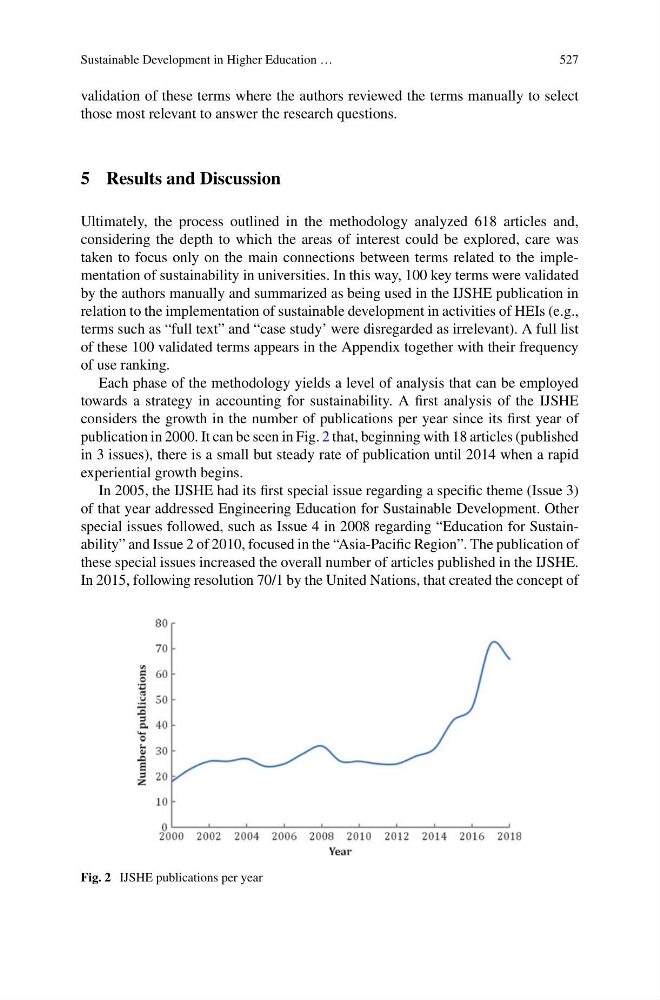
towards a strategy in accounting for sustainability. A first analysis of the IJSHE
considers the growth in the number of publications per year since its first year of
publication in 2000. It can be seen in Fig. 2 that, beginning with 18 articles (published
in 3 issues), there is a small but steady rate of publication until 2014 when a rapid
experiential growth begins.
In 2005, the IJSHE had its first special issue regarding a specific theme (Issue 3)
of that year addressed Engineering Education for Sustainable Development. Other
special issues followed, such as Issue 4 in 2008 regarding “Education for Sustainability” and Issue 2 of 2010, focused in the “Asia-Pacific Region”. The publication of
these special issues increased the overall number of articles published in the IJSHE.
In 2015, following resolution 70/1 by the United Nations, that created the concept of
Fig. 2 IJSHE publications per year
527
validation of these terms where the authors reviewed the terms manually to select
those most relevant to answer the research questions.
5 Results and Discussion
Ultimately, the process outlined in the methodology analyzed 618 articles and,
considering the depth to which the areas of interest could be explored, care was
taken to focus only on the main connections between terms related to the implementation of sustainability in universities. In this way, 100 key terms were validated
by the authors manually and summarized as being used in the IJSHE publication in
relation to the implementation of sustainable development in activities of HEIs (e.g.,
terms such as “full text” and “case study’ were disregarded as irrelevant). A full list
of these 100 validated terms appears in the Appendix together with their frequency
of use ranking.
Each phase of the methodology yields a level of analysis that can be employed
towards a strategy in accounting for sustainability. A first analysis of the IJSHE
considers the growth in the number of publications per year since its first year of
publication in 2000. It can be seen in Fig. 2 that, beginning with 18 articles (published
in 3 issues), there is a small but steady rate of publication until 2014 when a rapid
experiential growth begins.
In 2005, the IJSHE had its first special issue regarding a specific theme (Issue 3)
of that year addressed Engineering Education for Sustainable Development. Other
special issues followed, such as Issue 4 in 2008 regarding “Education for Sustainability” and Issue 2 of 2010, focused in the “Asia-Pacific Region”. The publication of
these special issues increased the overall number of articles published in the IJSHE.
In 2015, following resolution 70/1 by the United Nations, that created the concept of
Fig. 2 IJSHE publications per year