

514
S. Zenchanka et al.
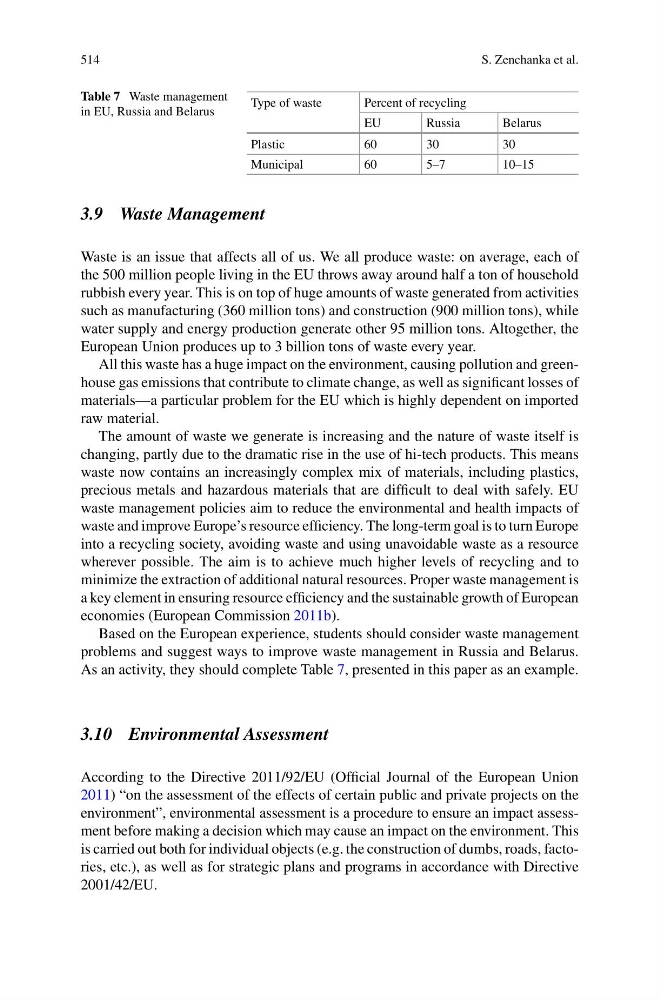
Table 7 Waste management
in EU, Russia and Belarus
Type of waste
Percent of recycling
EU
Russia
Belarus
Plastic
60
30
30
Municipal
60
5–7
10–15
3.9 Waste Management
Waste is an issue that affects all of us. We all produce waste: on average, each of
the 500 million people living in the EU throws away around half a ton of household
rubbish every year. This is on top of huge amounts of waste generated from activities
such as manufacturing (360 million tons) and construction (900 million tons), while
water supply and energy production generate other 95 million tons. Altogether, the
European Union produces up to 3 billion tons of waste every year.
All this waste has a huge impact on the environment, causing pollution and greenhouse gas emissions that contribute to climate change, as well as significant losses of
materials—a particular problem for the EU which is highly dependent on imported
raw material.
The amount of waste we generate is increasing and the nature of waste itself is
changing, partly due to the dramatic rise in the use of hi-tech products. This means
waste now contains an increasingly complex mix of materials, including plastics,
precious metals and hazardous materials that are difficult to deal with safely. EU
waste management policies aim to reduce the environmental and health impacts of
waste and improve Europe’s resource efficiency. The long-term goal is to turn Europe
into a recycling society, avoiding waste and using unavoidable waste as a resource
wherever possible. The aim is to achieve much higher levels of recycling and to
minimize the extraction of additional natural resources. Proper waste management is
a key element in ensuring resource efficiency and the sustainable growth of European
economies (European Commission 2011b).
Based on the European experience, students should consider waste management
problems and suggest ways to improve waste management in Russia and Belarus.
As an activity, they should complete Table 7, presented in this paper as an example.
3.10 Environmental Assessment
According to the Directive 2011/92/EU (Official Journal of the European Union
2011) “on the assessment of the effects of certain public and private projects on the
environment”, environmental assessment is a procedure to ensure an impact assessment before making a decision which may cause an impact on the environment. This
is carried out both for individual objects (e.g. the construction of dumbs, roads, factories, etc.), as well as for strategic plans and programs in accordance with Directive
2001/42/EU.
S. Zenchanka et al.
Table 7 Waste management
in EU, Russia and Belarus
Type of waste
Percent of recycling
EU
Russia
Belarus
Plastic
60
30
30
Municipal
60
5–7
10–15
3.9 Waste Management
Waste is an issue that affects all of us. We all produce waste: on average, each of
the 500 million people living in the EU throws away around half a ton of household
rubbish every year. This is on top of huge amounts of waste generated from activities
such as manufacturing (360 million tons) and construction (900 million tons), while
water supply and energy production generate other 95 million tons. Altogether, the
European Union produces up to 3 billion tons of waste every year.
All this waste has a huge impact on the environment, causing pollution and greenhouse gas emissions that contribute to climate change, as well as significant losses of
materials—a particular problem for the EU which is highly dependent on imported
raw material.
The amount of waste we generate is increasing and the nature of waste itself is
changing, partly due to the dramatic rise in the use of hi-tech products. This means
waste now contains an increasingly complex mix of materials, including plastics,
precious metals and hazardous materials that are difficult to deal with safely. EU
waste management policies aim to reduce the environmental and health impacts of
waste and improve Europe’s resource efficiency. The long-term goal is to turn Europe
into a recycling society, avoiding waste and using unavoidable waste as a resource
wherever possible. The aim is to achieve much higher levels of recycling and to
minimize the extraction of additional natural resources. Proper waste management is
a key element in ensuring resource efficiency and the sustainable growth of European
economies (European Commission 2011b).
Based on the European experience, students should consider waste management
problems and suggest ways to improve waste management in Russia and Belarus.
As an activity, they should complete Table 7, presented in this paper as an example.
3.10 Environmental Assessment
According to the Directive 2011/92/EU (Official Journal of the European Union
2011) “on the assessment of the effects of certain public and private projects on the
environment”, environmental assessment is a procedure to ensure an impact assessment before making a decision which may cause an impact on the environment. This
is carried out both for individual objects (e.g. the construction of dumbs, roads, factories, etc.), as well as for strategic plans and programs in accordance with Directive
2001/42/EU.