

510
S. Zenchanka et al.
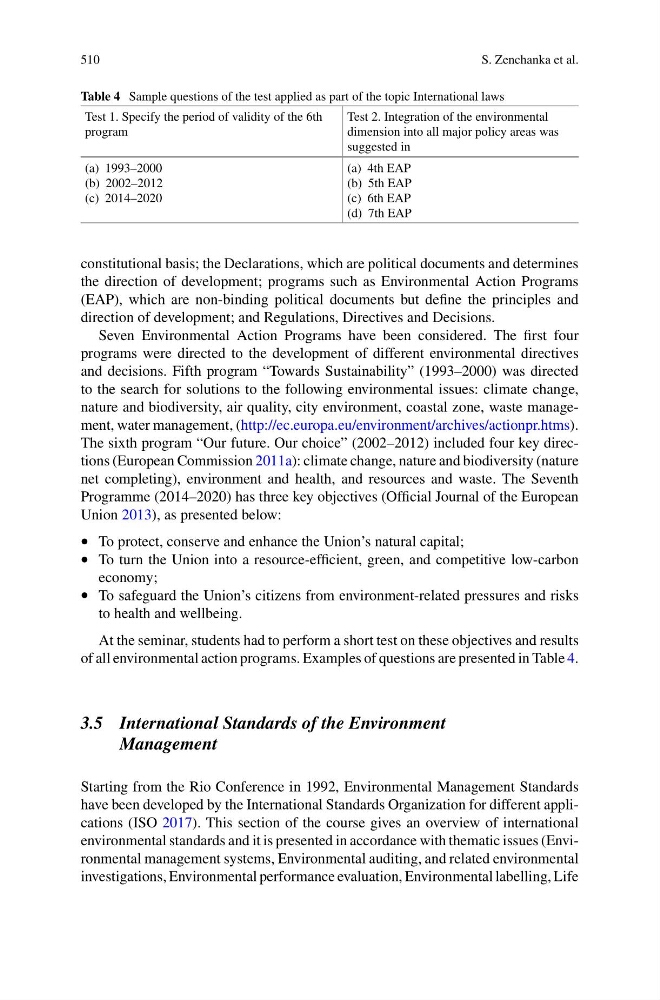
Table 4 Sample questions of the test applied as part of the topic International laws
Test 1. Specify the period of validity of the 6th
program
Test 2. Integration of the environmental
dimension into all major policy areas was
suggested in
(a) 1993–2000
(b) 2002–2012
(c) 2014–2020
(a) 4th EAP
(b) 5th EAP
(c) 6th EAP
(d) 7th EAP
constitutional basis; the Declarations, which are political documents and determines
the direction of development; programs such as Environmental Action Programs
(EAP), which are non-binding political documents but define the principles and
direction of development; and Regulations, Directives and Decisions.
Seven Environmental Action Programs have been considered. The first four
programs were directed to the development of different environmental directives
and decisions. Fifth program “Towards Sustainability” (1993–2000) was directed
to the search for solutions to the following environmental issues: climate change,
nature and biodiversity, air quality, city environment, coastal zone, waste management, water management, (http://ec.europa.eu/environment/archives/actionpr.htms).
The sixth program “Our future. Our choice” (2002–2012) included four key directions (European Commission 2011a): climate change, nature and biodiversity (nature
net completing), environment and health, and resources and waste. The Seventh
Programme (2014–2020) has three key objectives (Official Journal of the European
Union 2013), as presented below:
• To protect, conserve and enhance the Union’s natural capital;
• To turn the Union into a resource-efficient, green, and competitive low-carbon
economy;
• To safeguard the Union’s citizens from environment-related pressures and risks
to health and wellbeing.
At the seminar, students had to perform a short test on these objectives and results
of all environmental action programs. Examples of questions are presented in Table 4.
3.5 International Standards of the Environment
Management
Starting from the Rio Conference in 1992, Environmental Management Standards
have been developed by the International Standards Organization for different applications (ISO 2017). This section of the course gives an overview of international
environmental standards and it is presented in accordance with thematic issues (Environmental management systems, Environmental auditing, and related environmental
investigations, Environmental performance evaluation, Environmental labelling, Life
S. Zenchanka et al.
Table 4 Sample questions of the test applied as part of the topic International laws
Test 1. Specify the period of validity of the 6th
program
Test 2. Integration of the environmental
dimension into all major policy areas was
suggested in
(a) 1993–2000
(b) 2002–2012
(c) 2014–2020
(a) 4th EAP
(b) 5th EAP
(c) 6th EAP
(d) 7th EAP
constitutional basis; the Declarations, which are political documents and determines
the direction of development; programs such as Environmental Action Programs
(EAP), which are non-binding political documents but define the principles and
direction of development; and Regulations, Directives and Decisions.
Seven Environmental Action Programs have been considered. The first four
programs were directed to the development of different environmental directives
and decisions. Fifth program “Towards Sustainability” (1993–2000) was directed
to the search for solutions to the following environmental issues: climate change,
nature and biodiversity, air quality, city environment, coastal zone, waste management, water management, (http://ec.europa.eu/environment/archives/actionpr.htms).
The sixth program “Our future. Our choice” (2002–2012) included four key directions (European Commission 2011a): climate change, nature and biodiversity (nature
net completing), environment and health, and resources and waste. The Seventh
Programme (2014–2020) has three key objectives (Official Journal of the European
Union 2013), as presented below:
• To protect, conserve and enhance the Union’s natural capital;
• To turn the Union into a resource-efficient, green, and competitive low-carbon
economy;
• To safeguard the Union’s citizens from environment-related pressures and risks
to health and wellbeing.
At the seminar, students had to perform a short test on these objectives and results
of all environmental action programs. Examples of questions are presented in Table 4.
3.5 International Standards of the Environment
Management
Starting from the Rio Conference in 1992, Environmental Management Standards
have been developed by the International Standards Organization for different applications (ISO 2017). This section of the course gives an overview of international
environmental standards and it is presented in accordance with thematic issues (Environmental management systems, Environmental auditing, and related environmental
investigations, Environmental performance evaluation, Environmental labelling, Life