

508
S. Zenchanka et al.
Overpopulation
Change in the
nature use
structure
Consumption
growth
Production
growth
Poverty
Biodiversity change
Deforestation
Resource depletion
Environmental pollution
Air
Soil
Water
Ozone layer depletion
Climate change
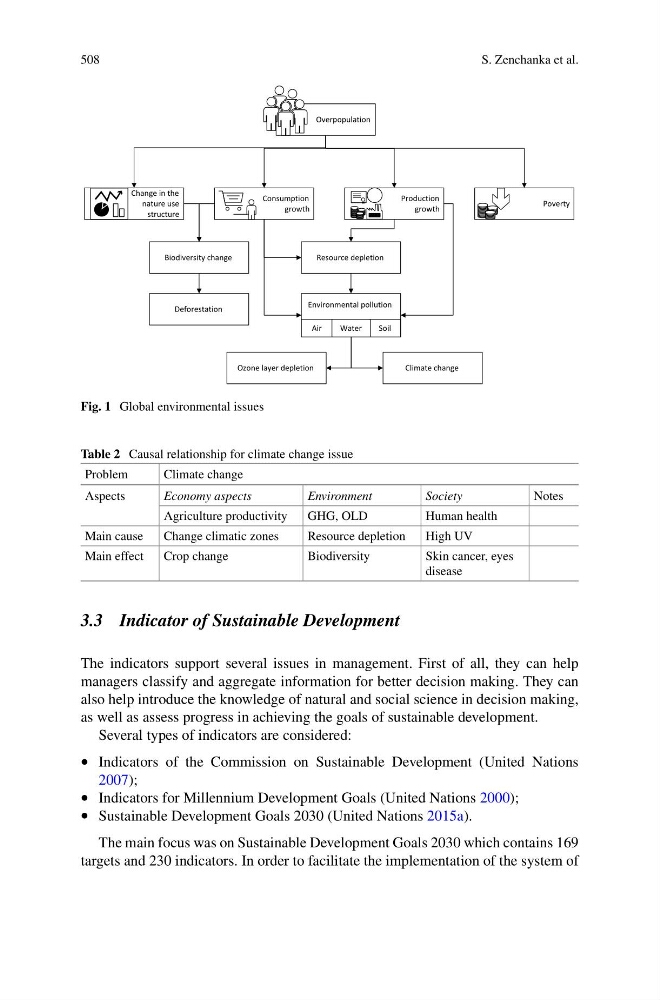
Fig. 1 Global environmental issues
Table 2 Causal relationship for climate change issue
Problem
Climate change
Aspects
Economy aspects
Environment
Society
Notes
Agriculture productivity
GHG, OLD
Human health
Main cause
Change climatic zones
Resource depletion
High UV
Main effect
Crop change
Biodiversity
Skin cancer, eyes
disease
3.3 Indicator of Sustainable Development
The indicators support several issues in management. First of all, they can help
managers classify and aggregate information for better decision making. They can
also help introduce the knowledge of natural and social science in decision making,
as well as assess progress in achieving the goals of sustainable development.
Several types of indicators are considered:
• Indicators of the Commission on Sustainable Development (United Nations
2007);
• Indicators for Millennium Development Goals (United Nations 2000);
• Sustainable Development Goals 2030 (United Nations 2015a).
The main focus was on Sustainable Development Goals 2030 which contains 169
targets and 230 indicators. In order to facilitate the implementation of the system of
S. Zenchanka et al.
Overpopulation
Change in the
nature use
structure
Consumption
growth
Production
growth
Poverty
Biodiversity change
Deforestation
Resource depletion
Environmental pollution
Air
Soil
Water
Ozone layer depletion
Climate change
Fig. 1 Global environmental issues
Table 2 Causal relationship for climate change issue
Problem
Climate change
Aspects
Economy aspects
Environment
Society
Notes
Agriculture productivity
GHG, OLD
Human health
Main cause
Change climatic zones
Resource depletion
High UV
Main effect
Crop change
Biodiversity
Skin cancer, eyes
disease
3.3 Indicator of Sustainable Development
The indicators support several issues in management. First of all, they can help
managers classify and aggregate information for better decision making. They can
also help introduce the knowledge of natural and social science in decision making,
as well as assess progress in achieving the goals of sustainable development.
Several types of indicators are considered:
• Indicators of the Commission on Sustainable Development (United Nations
2007);
• Indicators for Millennium Development Goals (United Nations 2000);
• Sustainable Development Goals 2030 (United Nations 2015a).
The main focus was on Sustainable Development Goals 2030 which contains 169
targets and 230 indicators. In order to facilitate the implementation of the system of