

The “Sustainable Development Goals (SDG) Teaching Map” …
489
3 Theoretical Framework: The “Future Art Model”
At the centre of the “Future Art Model,” or transformational literacy (“Zukunftskunst”), lies the question relating to the radical incremental change of the economic
order (Schneidewind 2014, 2018; Schneidewind and Rehm 2019; Schneidewind
and Singer-Brodowski 2013). According to Macy (2009), three main dimensions
could initiate a great transformation: actions to slow the damage to Earth and its
beings, analysis of structural causes and the creation of structural alternatives and
a shift in consciousness. Society has to find its space on this continuum between
raising its voice in protest (fighter) and reshaping and building a new future (artist)
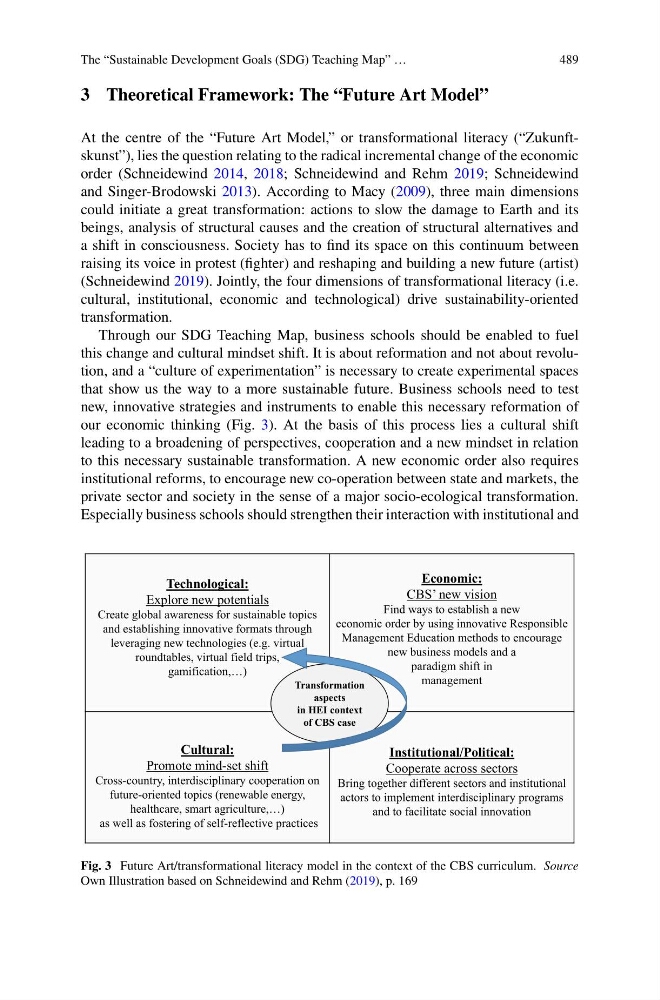
(Schneidewind 2019). Jointly, the four dimensions of transformational literacy (i.e.
cultural, institutional, economic and technological) drive sustainability-oriented
transformation.
Through our SDG Teaching Map, business schools should be enabled to fuel
this change and cultural mindset shift. It is about reformation and not about revolution, and a “culture of experimentation” is necessary to create experimental spaces
that show us the way to a more sustainable future. Business schools need to test
new, innovative strategies and instruments to enable this necessary reformation of
our economic thinking (Fig. 3). At the basis of this process lies a cultural shift
leading to a broadening of perspectives, cooperation and a new mindset in relation
to this necessary sustainable transformation. A new economic order also requires
institutional reforms, to encourage new co-operation between state and markets, the
private sector and society in the sense of a major socio-ecological transformation.
Especially business schools should strengthen their interaction with institutional and
Technological:
Explore new potentials
Create global awareness for sustainable topics
and establishing innovative formats through
leveraging new technologies (e.g. virtual
roundtables, virtual field trips,
gamification,…)
Economic:
CBS’ new vision
Find ways to establish a new
economic order by using innovative Responsible
Management Education methods to encourage
new business models and a
paradigm shift in
management
Cultural:
Promote mind-set shift
Cross-country, interdisciplinary cooperation on
future-oriented topics (renewable energy,
healthcare, smart agriculture,…)
as well as fostering of self-reflective practices
Institutional/Political:
Cooperate across sectors
Bring together different sectors and institutional
actors to implement interdisciplinary programs
and to facilitate social innovation
Transformation
aspects
in HEI context
of CBS case
Fig. 3 Future Art/transformational literacy model in the context of the CBS curriculum. Source
Own Illustration based on Schneidewind and Rehm (2019), p. 169
489
3 Theoretical Framework: The “Future Art Model”
At the centre of the “Future Art Model,” or transformational literacy (“Zukunftskunst”), lies the question relating to the radical incremental change of the economic
order (Schneidewind 2014, 2018; Schneidewind and Rehm 2019; Schneidewind
and Singer-Brodowski 2013). According to Macy (2009), three main dimensions
could initiate a great transformation: actions to slow the damage to Earth and its
beings, analysis of structural causes and the creation of structural alternatives and
a shift in consciousness. Society has to find its space on this continuum between
raising its voice in protest (fighter) and reshaping and building a new future (artist)
(Schneidewind 2019). Jointly, the four dimensions of transformational literacy (i.e.
cultural, institutional, economic and technological) drive sustainability-oriented
transformation.
Through our SDG Teaching Map, business schools should be enabled to fuel
this change and cultural mindset shift. It is about reformation and not about revolution, and a “culture of experimentation” is necessary to create experimental spaces
that show us the way to a more sustainable future. Business schools need to test
new, innovative strategies and instruments to enable this necessary reformation of
our economic thinking (Fig. 3). At the basis of this process lies a cultural shift
leading to a broadening of perspectives, cooperation and a new mindset in relation
to this necessary sustainable transformation. A new economic order also requires
institutional reforms, to encourage new co-operation between state and markets, the
private sector and society in the sense of a major socio-ecological transformation.
Especially business schools should strengthen their interaction with institutional and
Technological:
Explore new potentials
Create global awareness for sustainable topics
and establishing innovative formats through
leveraging new technologies (e.g. virtual
roundtables, virtual field trips,
gamification,…)
Economic:
CBS’ new vision
Find ways to establish a new
economic order by using innovative Responsible
Management Education methods to encourage
new business models and a
paradigm shift in
management
Cultural:
Promote mind-set shift
Cross-country, interdisciplinary cooperation on
future-oriented topics (renewable energy,
healthcare, smart agriculture,…)
as well as fostering of self-reflective practices
Institutional/Political:
Cooperate across sectors
Bring together different sectors and institutional
actors to implement interdisciplinary programs
and to facilitate social innovation
Transformation
aspects
in HEI context
of CBS case
Fig. 3 Future Art/transformational literacy model in the context of the CBS curriculum. Source
Own Illustration based on Schneidewind and Rehm (2019), p. 169