

Climate Change Education in Ukrainian Universities…
389
We started with a crosscut survey in three sample universities, disseminating the
questionnaire related to climate change teaching through all university departments.
Afterwards we selected a certain amount of interviewees among willing respondents for in-depth interviews, and a final face-to-face group discussion with research
participants is planned in order to elaborate deeper on the problematic questions
raised.
4.1 Crosscut Survey
Our case is defined as a phenomenon occurring in a bounded context of three universities in Ukraine. A purposive sampling method (Palinkas et al. 2015) was used to
determine the unit of analysis because we wanted to access a particular subset of
interviewees from three universities out of over 800 universities in the Ukraine that
offer higher education. The criterion included universities in which we had collegial
access, with an existing Uppsala University partnership, and with teachers who had
previously taken part in Baltic University Programme (BUP) ESD courses. We then
settled on a sample of three universities, Taras Chevchenko National University of
Kyiv where there is a current Erasmus mobility partnership with Uppsala, and the
other two, National University of Kyiv-Mohyla Academy and Sumy State University that are active members of the BUP. A detailed information about the surveyed
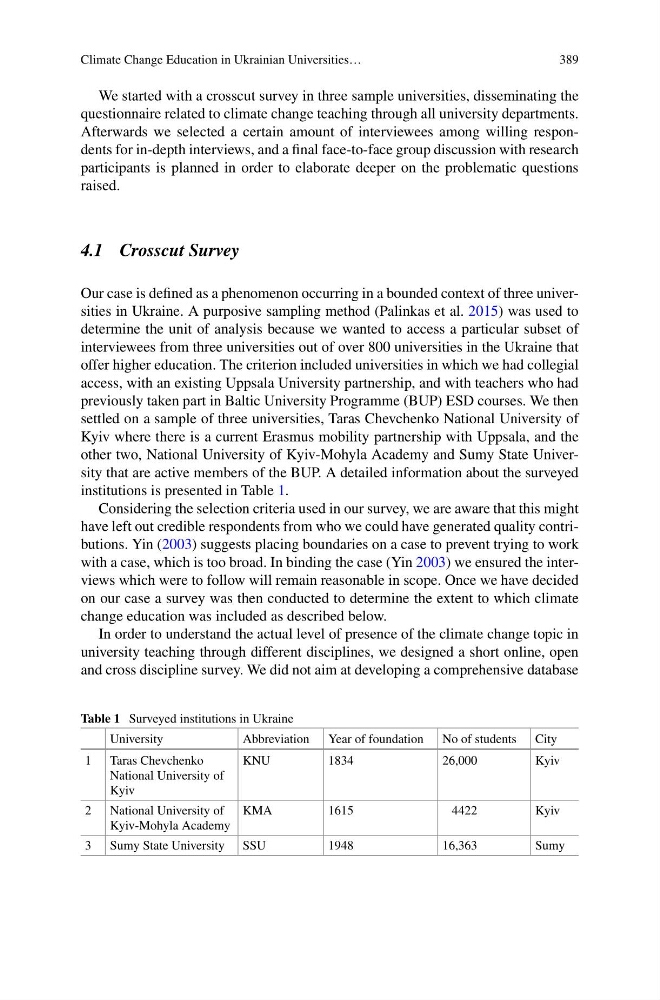
institutions is presented in Table 1.
Considering the selection criteria used in our survey, we are aware that this might
have left out credible respondents from who we could have generated quality contributions. Yin (2003) suggests placing boundaries on a case to prevent trying to work
with a case, which is too broad. In binding the case (Yin 2003) we ensured the interviews which were to follow will remain reasonable in scope. Once we have decided
on our case a survey was then conducted to determine the extent to which climate
change education was included as described below.
In order to understand the actual level of presence of the climate change topic in
university teaching through different disciplines, we designed a short online, open
and cross discipline survey. We did not aim at developing a comprehensive database
Table 1 Surveyed institutions in Ukraine
University
Abbreviation Year of foundation No of students City
1 Taras Chevchenko
National University of
Kyiv
KNU
1834
26,000
Kyiv
2 National University of
Kyiv-Mohyla Academy
KMA
1615
4422
Kyiv
3 Sumy State University SSU
1948
16,363
Sumy
389
We started with a crosscut survey in three sample universities, disseminating the
questionnaire related to climate change teaching through all university departments.
Afterwards we selected a certain amount of interviewees among willing respondents for in-depth interviews, and a final face-to-face group discussion with research
participants is planned in order to elaborate deeper on the problematic questions
raised.
4.1 Crosscut Survey
Our case is defined as a phenomenon occurring in a bounded context of three universities in Ukraine. A purposive sampling method (Palinkas et al. 2015) was used to
determine the unit of analysis because we wanted to access a particular subset of
interviewees from three universities out of over 800 universities in the Ukraine that
offer higher education. The criterion included universities in which we had collegial
access, with an existing Uppsala University partnership, and with teachers who had
previously taken part in Baltic University Programme (BUP) ESD courses. We then
settled on a sample of three universities, Taras Chevchenko National University of
Kyiv where there is a current Erasmus mobility partnership with Uppsala, and the
other two, National University of Kyiv-Mohyla Academy and Sumy State University that are active members of the BUP. A detailed information about the surveyed
institutions is presented in Table 1.
Considering the selection criteria used in our survey, we are aware that this might
have left out credible respondents from who we could have generated quality contributions. Yin (2003) suggests placing boundaries on a case to prevent trying to work
with a case, which is too broad. In binding the case (Yin 2003) we ensured the interviews which were to follow will remain reasonable in scope. Once we have decided
on our case a survey was then conducted to determine the extent to which climate
change education was included as described below.
In order to understand the actual level of presence of the climate change topic in
university teaching through different disciplines, we designed a short online, open
and cross discipline survey. We did not aim at developing a comprehensive database
Table 1 Surveyed institutions in Ukraine
University
Abbreviation Year of foundation No of students City
1 Taras Chevchenko
National University of
Kyiv
KNU
1834
26,000
Kyiv
2 National University of
Kyiv-Mohyla Academy
KMA
1615
4422
Kyiv
3 Sumy State University SSU
1948
16,363
Sumy