

388
O. Khalaim and S. Urenje
laws “On Education” and “On Higher Education” at all. There are no formal standards and detailed provisions of ESD, ecological education, and specifically climate
change ESD as its part. Universities add climate change related topics to specific
courses, hardly trying to link ESD to university and campus operations by adopting
a ‘whole-of-university’ approach to sustainability. Thus, there is no evidence that
formal education in Ukraine is responding to current climatic challenges, being not
relevant to the actual situation with the climate change “out of classroom”.
Our research could also make an input in covering the gap on climate change
learning, not presented in SDG 13, formulated in “Sustainable Development Goals:
Ukraine” national report (2017) as “Mitigate climate change impact”—with no word
on adaptation. There is only one national target set there, which is “Limit greenhouse
gas emissions in the economy”, compared with 1990 level. One out of two key
recommendations presented in this section emphasizes the necessity to “Inform the
public about the consequences of climate change and mechanisms and practices to
combat and adapt to them, and implement appropriate educational programs at all
levels of formal and informal education.”
Thus, there is a room left for initiatives related to CCESD in Ukraine. Few
research questions could be posed at this stage: (1) what hindrances and opportunities concerning transformative ESD are expressed in interviews with Ukrainian
teachers; (2) In what way does the respondents’ information correspond with what
is defined as key components in a transformative learning process?
4 Materials and Methods
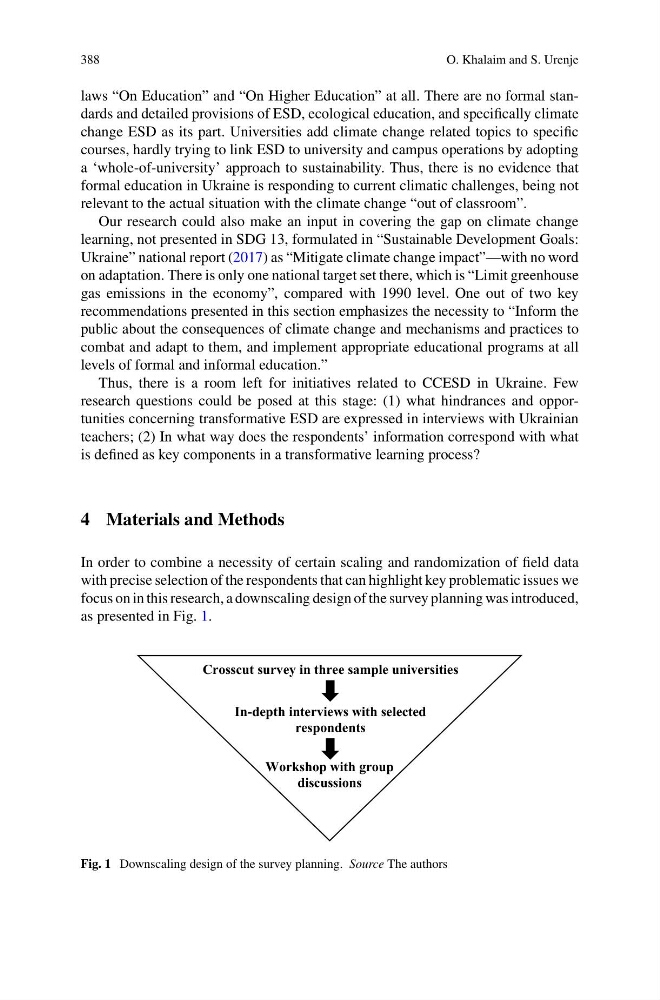
In order to combine a necessity of certain scaling and randomization of field data
with precise selection of the respondents that can highlight key problematic issues we
focus on in this research, a downscaling design of the survey planning was introduced,
as presented in Fig. 1.
Crosscut survey in three sample universities
In-depth interviews with selected
respondents
Workshop with group
discussions
Fig. 1 Downscaling design of the survey planning. Source The authors
O. Khalaim and S. Urenje
laws “On Education” and “On Higher Education” at all. There are no formal standards and detailed provisions of ESD, ecological education, and specifically climate
change ESD as its part. Universities add climate change related topics to specific
courses, hardly trying to link ESD to university and campus operations by adopting
a ‘whole-of-university’ approach to sustainability. Thus, there is no evidence that
formal education in Ukraine is responding to current climatic challenges, being not
relevant to the actual situation with the climate change “out of classroom”.
Our research could also make an input in covering the gap on climate change
learning, not presented in SDG 13, formulated in “Sustainable Development Goals:
Ukraine” national report (2017) as “Mitigate climate change impact”—with no word
on adaptation. There is only one national target set there, which is “Limit greenhouse
gas emissions in the economy”, compared with 1990 level. One out of two key
recommendations presented in this section emphasizes the necessity to “Inform the
public about the consequences of climate change and mechanisms and practices to
combat and adapt to them, and implement appropriate educational programs at all
levels of formal and informal education.”
Thus, there is a room left for initiatives related to CCESD in Ukraine. Few
research questions could be posed at this stage: (1) what hindrances and opportunities concerning transformative ESD are expressed in interviews with Ukrainian
teachers; (2) In what way does the respondents’ information correspond with what
is defined as key components in a transformative learning process?
4 Materials and Methods
In order to combine a necessity of certain scaling and randomization of field data
with precise selection of the respondents that can highlight key problematic issues we
focus on in this research, a downscaling design of the survey planning was introduced,
as presented in Fig. 1.
Crosscut survey in three sample universities
In-depth interviews with selected
respondents
Workshop with group
discussions
Fig. 1 Downscaling design of the survey planning. Source The authors