

354
N. Husenbeth and M. K. Tegeler
sustainability. Building on an economic understanding of sustainability, a resourceoriented framework is developed which contrasts the traditional efficiency-oriented
model. As contradictions arise due to contrasting efficiency and sustainability, strategies on how to deal with contradictions are developed. Due to the high political, social,
economic and ecological actuality, which means the adaption of the 2030 Agenda,
providing for a shared global vision towards sustainable development for all. The
SDGs were engaged in the main topic in summer semester 2018.
3 Learning Outcome of the Seminar “Sustainable
Management”
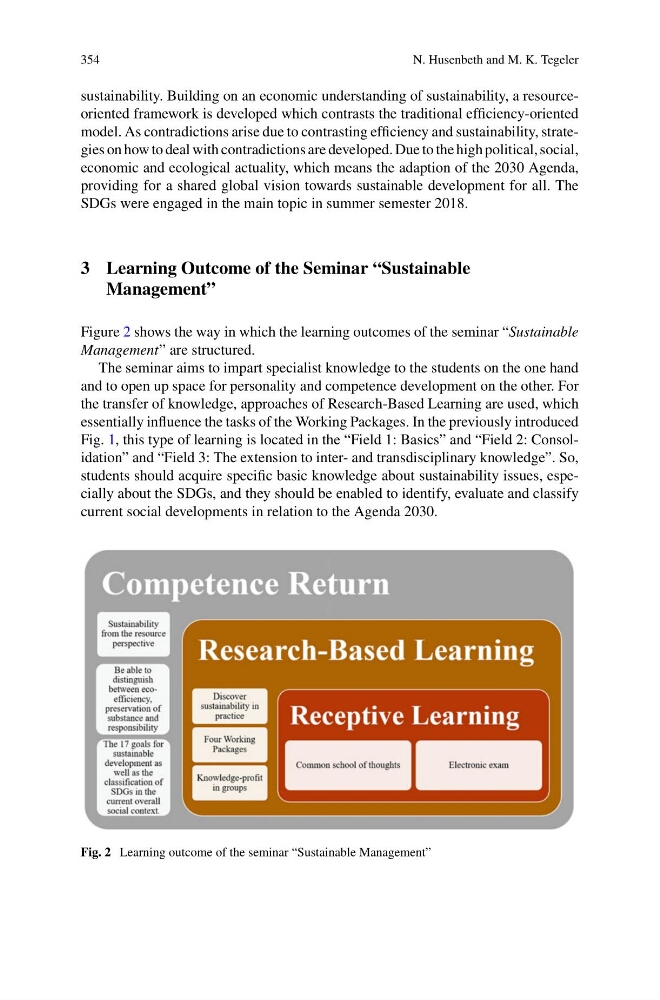
Figure 2 shows the way in which the learning outcomes of the seminar “Sustainable
Management” are structured.
The seminar aims to impart specialist knowledge to the students on the one hand
and to open up space for personality and competence development on the other. For
the transfer of knowledge, approaches of Research-Based Learning are used, which
essentially influence the tasks of the Working Packages. In the previously introduced
Fig. 1, this type of learning is located in the “Field 1: Basics” and “Field 2: Consolidation” and “Field 3: The extension to inter- and transdisciplinary knowledge”. So,
students should acquire specific basic knowledge about sustainability issues, especially about the SDGs, and they should be enabled to identify, evaluate and classify
current social developments in relation to the Agenda 2030.
Fig. 2 Learning outcome of the seminar “Sustainable Management”
N. Husenbeth and M. K. Tegeler
sustainability. Building on an economic understanding of sustainability, a resourceoriented framework is developed which contrasts the traditional efficiency-oriented
model. As contradictions arise due to contrasting efficiency and sustainability, strategies on how to deal with contradictions are developed. Due to the high political, social,
economic and ecological actuality, which means the adaption of the 2030 Agenda,
providing for a shared global vision towards sustainable development for all. The
SDGs were engaged in the main topic in summer semester 2018.
3 Learning Outcome of the Seminar “Sustainable
Management”
Figure 2 shows the way in which the learning outcomes of the seminar “Sustainable
Management” are structured.
The seminar aims to impart specialist knowledge to the students on the one hand
and to open up space for personality and competence development on the other. For
the transfer of knowledge, approaches of Research-Based Learning are used, which
essentially influence the tasks of the Working Packages. In the previously introduced
Fig. 1, this type of learning is located in the “Field 1: Basics” and “Field 2: Consolidation” and “Field 3: The extension to inter- and transdisciplinary knowledge”. So,
students should acquire specific basic knowledge about sustainability issues, especially about the SDGs, and they should be enabled to identify, evaluate and classify
current social developments in relation to the Agenda 2030.
Fig. 2 Learning outcome of the seminar “Sustainable Management”