

“The Value of Mixed Teaching Methods in the Context …
353
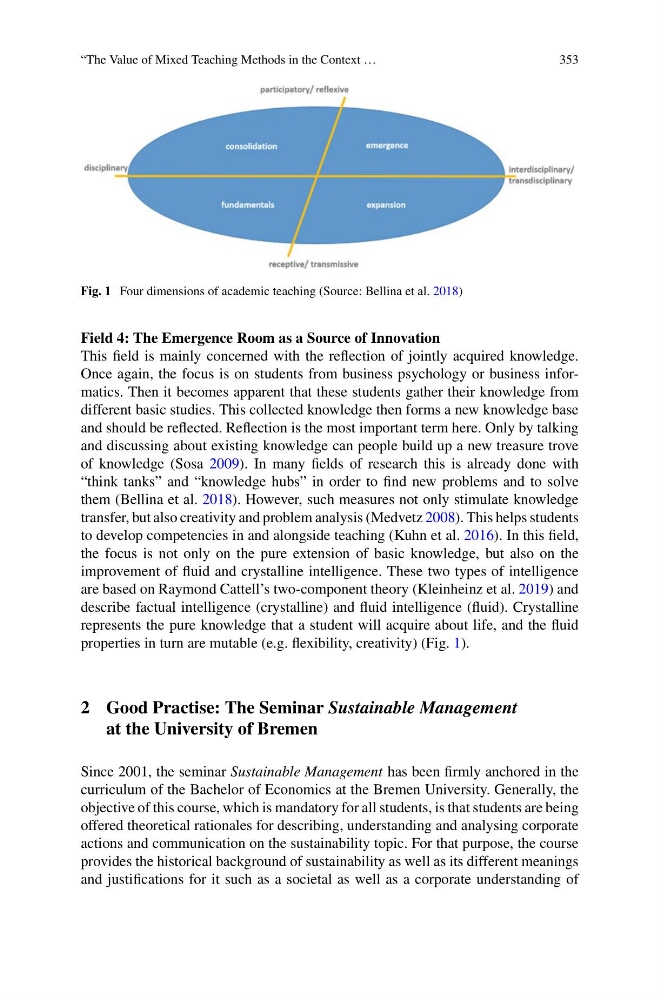
Fig. 1 Four dimensions of academic teaching (Source: Bellina et al. 2018)
Field 4: The Emergence Room as a Source of Innovation
This field is mainly concerned with the reflection of jointly acquired knowledge.
Once again, the focus is on students from business psychology or business informatics. Then it becomes apparent that these students gather their knowledge from
different basic studies. This collected knowledge then forms a new knowledge base
and should be reflected. Reflection is the most important term here. Only by talking
and discussing about existing knowledge can people build up a new treasure trove
of knowledge (Sosa 2009). In many fields of research this is already done with
“think tanks” and “knowledge hubs” in order to find new problems and to solve
them (Bellina et al. 2018). However, such measures not only stimulate knowledge
transfer, but also creativity and problem analysis (Medvetz 2008). This helps students
to develop competencies in and alongside teaching (Kuhn et al. 2016). In this field,
the focus is not only on the pure extension of basic knowledge, but also on the
improvement of fluid and crystalline intelligence. These two types of intelligence
are based on Raymond Cattell’s two-component theory (Kleinheinz et al. 2019) and
describe factual intelligence (crystalline) and fluid intelligence (fluid). Crystalline
represents the pure knowledge that a student will acquire about life, and the fluid
properties in turn are mutable (e.g. flexibility, creativity) (Fig. 1).
2 Good Practise: The Seminar Sustainable Management
at the University of Bremen
Since 2001, the seminar Sustainable Management has been firmly anchored in the
curriculum of the Bachelor of Economics at the Bremen University. Generally, the
objective of this course, which is mandatory for all students, is that students are being
offered theoretical rationales for describing, understanding and analysing corporate
actions and communication on the sustainability topic. For that purpose, the course
provides the historical background of sustainability as well as its different meanings
and justifications for it such as a societal as well as a corporate understanding of
353
Fig. 1 Four dimensions of academic teaching (Source: Bellina et al. 2018)
Field 4: The Emergence Room as a Source of Innovation
This field is mainly concerned with the reflection of jointly acquired knowledge.
Once again, the focus is on students from business psychology or business informatics. Then it becomes apparent that these students gather their knowledge from
different basic studies. This collected knowledge then forms a new knowledge base
and should be reflected. Reflection is the most important term here. Only by talking
and discussing about existing knowledge can people build up a new treasure trove
of knowledge (Sosa 2009). In many fields of research this is already done with
“think tanks” and “knowledge hubs” in order to find new problems and to solve
them (Bellina et al. 2018). However, such measures not only stimulate knowledge
transfer, but also creativity and problem analysis (Medvetz 2008). This helps students
to develop competencies in and alongside teaching (Kuhn et al. 2016). In this field,
the focus is not only on the pure extension of basic knowledge, but also on the
improvement of fluid and crystalline intelligence. These two types of intelligence
are based on Raymond Cattell’s two-component theory (Kleinheinz et al. 2019) and
describe factual intelligence (crystalline) and fluid intelligence (fluid). Crystalline
represents the pure knowledge that a student will acquire about life, and the fluid
properties in turn are mutable (e.g. flexibility, creativity) (Fig. 1).
2 Good Practise: The Seminar Sustainable Management
at the University of Bremen
Since 2001, the seminar Sustainable Management has been firmly anchored in the
curriculum of the Bachelor of Economics at the Bremen University. Generally, the
objective of this course, which is mandatory for all students, is that students are being
offered theoretical rationales for describing, understanding and analysing corporate
actions and communication on the sustainability topic. For that purpose, the course
provides the historical background of sustainability as well as its different meanings
and justifications for it such as a societal as well as a corporate understanding of