

340
J. Kleinen and L. Kurz
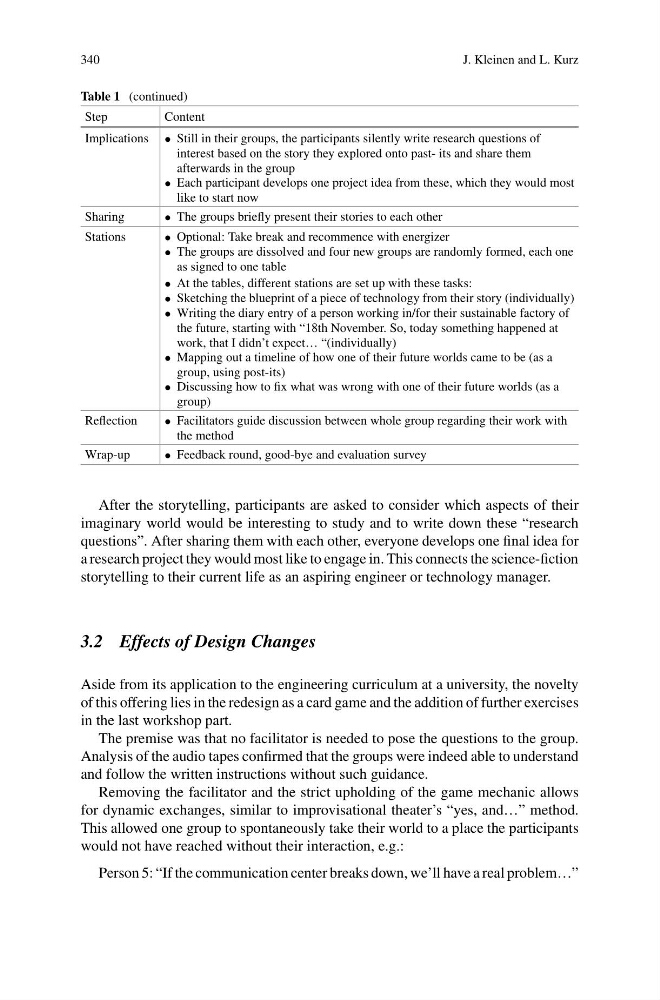
Table 1 (continued)
Step
Content
Implications • Still in their groups, the participants silently write research questions of
interest based on the story they explored onto past- its and share them
afterwards in the group
• Each participant develops one project idea from these, which they would most
like to start now
Sharing
• The groups briefly present their stories to each other
Stations
• Optional: Take break and recommence with energizer
• The groups are dissolved and four new groups are randomly formed, each one
as signed to one table
• At the tables, different stations are set up with these tasks:
• Sketching the blueprint of a piece of technology from their story (individually)
• Writing the diary entry of a person working in/for their sustainable factory of
the future, starting with “18th November. So, today something happened at
work, that I didn’t expect… “(individually)
• Mapping out a timeline of how one of their future worlds came to be (as a
group, using post-its)
• Discussing how to fix what was wrong with one of their future worlds (as a
group)
Reflection
• Facilitators guide discussion between whole group regarding their work with
the method
Wrap-up
• Feedback round, good-bye and evaluation survey
After the storytelling, participants are asked to consider which aspects of their
imaginary world would be interesting to study and to write down these “research
questions”. After sharing them with each other, everyone develops one final idea for
a research project they would most like to engage in. This connects the science-fiction
storytelling to their current life as an aspiring engineer or technology manager.
3.2 Effects of Design Changes
Aside from its application to the engineering curriculum at a university, the novelty
of this offering lies in the redesign as a card game and the addition of further exercises
in the last workshop part.
The premise was that no facilitator is needed to pose the questions to the group.
Analysis of the audio tapes confirmed that the groups were indeed able to understand
and follow the written instructions without such guidance.
Removing the facilitator and the strict upholding of the game mechanic allows
for dynamic exchanges, similar to improvisational theater’s “yes, and…” method.
This allowed one group to spontaneously take their world to a place the participants
would not have reached without their interaction, e.g.:
Person 5: “If the communication center breaks down, we’ll have a real problem…”
J. Kleinen and L. Kurz
Table 1 (continued)
Step
Content
Implications • Still in their groups, the participants silently write research questions of
interest based on the story they explored onto past- its and share them
afterwards in the group
• Each participant develops one project idea from these, which they would most
like to start now
Sharing
• The groups briefly present their stories to each other
Stations
• Optional: Take break and recommence with energizer
• The groups are dissolved and four new groups are randomly formed, each one
as signed to one table
• At the tables, different stations are set up with these tasks:
• Sketching the blueprint of a piece of technology from their story (individually)
• Writing the diary entry of a person working in/for their sustainable factory of
the future, starting with “18th November. So, today something happened at
work, that I didn’t expect… “(individually)
• Mapping out a timeline of how one of their future worlds came to be (as a
group, using post-its)
• Discussing how to fix what was wrong with one of their future worlds (as a
group)
Reflection
• Facilitators guide discussion between whole group regarding their work with
the method
Wrap-up
• Feedback round, good-bye and evaluation survey
After the storytelling, participants are asked to consider which aspects of their
imaginary world would be interesting to study and to write down these “research
questions”. After sharing them with each other, everyone develops one final idea for
a research project they would most like to engage in. This connects the science-fiction
storytelling to their current life as an aspiring engineer or technology manager.
3.2 Effects of Design Changes
Aside from its application to the engineering curriculum at a university, the novelty
of this offering lies in the redesign as a card game and the addition of further exercises
in the last workshop part.
The premise was that no facilitator is needed to pose the questions to the group.
Analysis of the audio tapes confirmed that the groups were indeed able to understand
and follow the written instructions without such guidance.
Removing the facilitator and the strict upholding of the game mechanic allows
for dynamic exchanges, similar to improvisational theater’s “yes, and…” method.
This allowed one group to spontaneously take their world to a place the participants
would not have reached without their interaction, e.g.:
Person 5: “If the communication center breaks down, we’ll have a real problem…”