

Exploring New Technology’s Meaning for a Sustainable Future …
339
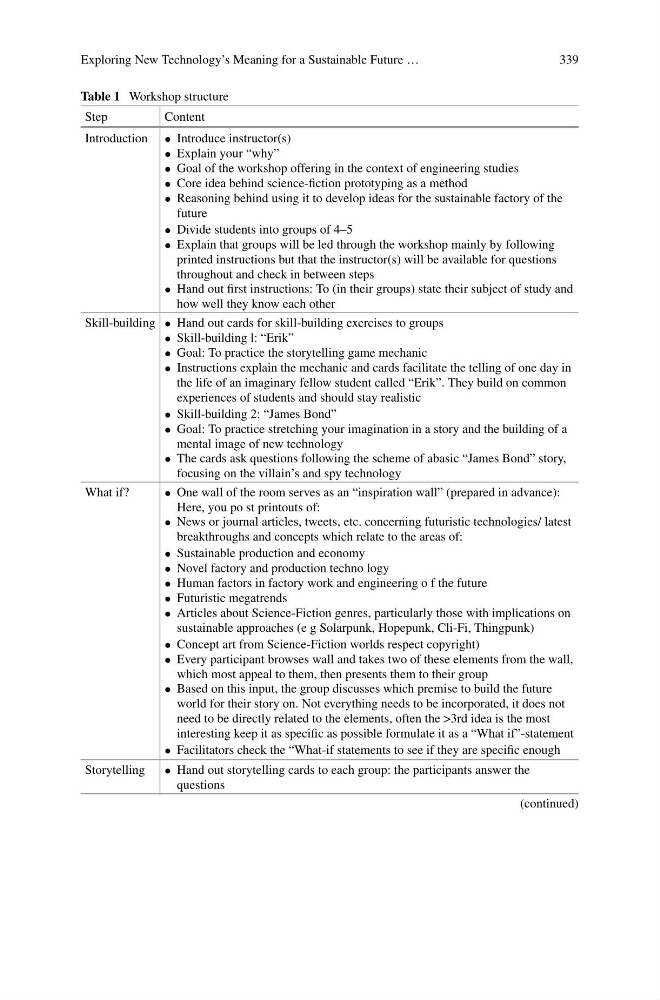
Table 1 Workshop structure
Step
Content
Introduction • Introduce instructor(s)
• Explain your “why”
• Goal of the workshop offering in the context of engineering studies
• Core idea behind science-fiction prototyping as a method
• Reasoning behind using it to develop ideas for the sustainable factory of the
future
• Divide students into groups of 4–5
• Explain that groups will be led through the workshop mainly by following
printed instructions but that the instructor(s) will be available for questions
throughout and check in between steps
• Hand out first instructions: To (in their groups) state their subject of study and
how well they know each other
Skill-building • Hand out cards for skill-building exercises to groups
• Skill-building l: “Erik”
• Goal: To practice the storytelling game mechanic
• Instructions explain the mechanic and cards facilitate the telling of one day in
the life of an imaginary fellow student called “Erik”. They build on common
experiences of students and should stay realistic
• Skill-building 2: “James Bond”
• Goal: To practice stretching your imagination in a story and the building of a
mental image of new technology
• The cards ask questions following the scheme of abasic “James Bond” story,
focusing on the villain’s and spy technology
What if?
• One wall of the room serves as an “inspiration wall” (prepared in advance):
Here, you po st printouts of:
• News or journal articles, tweets, etc. concerning futuristic technologies/ latest
breakthroughs and concepts which relate to the areas of:
• Sustainable production and economy
• Novel factory and production techno logy
• Human factors in factory work and engineering o f the future
• Futuristic megatrends
• Articles about Science-Fiction genres, particularly those with implications on
sustainable approaches (e g Solarpunk, Hopepunk, Cli-Fi, Thingpunk)
• Concept art from Science-Fiction worlds respect copyright)
• Every participant browses wall and takes two of these elements from the wall,
which most appeal to them, then presents them to their group
• Based on this input, the group discusses which premise to build the future
world for their story on. Not everything needs to be incorporated, it does not
need to be directly related to the elements, often the >3rd idea is the most
interesting keep it as specific as possible formulate it as a “What if”-statement
• Facilitators check the “What-if statements to see if they are specific enough
Storytelling
• Hand out storytelling cards to each group: the participants answer the
questions
(continued)
339
Table 1 Workshop structure
Step
Content
Introduction • Introduce instructor(s)
• Explain your “why”
• Goal of the workshop offering in the context of engineering studies
• Core idea behind science-fiction prototyping as a method
• Reasoning behind using it to develop ideas for the sustainable factory of the
future
• Divide students into groups of 4–5
• Explain that groups will be led through the workshop mainly by following
printed instructions but that the instructor(s) will be available for questions
throughout and check in between steps
• Hand out first instructions: To (in their groups) state their subject of study and
how well they know each other
Skill-building • Hand out cards for skill-building exercises to groups
• Skill-building l: “Erik”
• Goal: To practice the storytelling game mechanic
• Instructions explain the mechanic and cards facilitate the telling of one day in
the life of an imaginary fellow student called “Erik”. They build on common
experiences of students and should stay realistic
• Skill-building 2: “James Bond”
• Goal: To practice stretching your imagination in a story and the building of a
mental image of new technology
• The cards ask questions following the scheme of abasic “James Bond” story,
focusing on the villain’s and spy technology
What if?
• One wall of the room serves as an “inspiration wall” (prepared in advance):
Here, you po st printouts of:
• News or journal articles, tweets, etc. concerning futuristic technologies/ latest
breakthroughs and concepts which relate to the areas of:
• Sustainable production and economy
• Novel factory and production techno logy
• Human factors in factory work and engineering o f the future
• Futuristic megatrends
• Articles about Science-Fiction genres, particularly those with implications on
sustainable approaches (e g Solarpunk, Hopepunk, Cli-Fi, Thingpunk)
• Concept art from Science-Fiction worlds respect copyright)
• Every participant browses wall and takes two of these elements from the wall,
which most appeal to them, then presents them to their group
• Based on this input, the group discusses which premise to build the future
world for their story on. Not everything needs to be incorporated, it does not
need to be directly related to the elements, often the >3rd idea is the most
interesting keep it as specific as possible formulate it as a “What if”-statement
• Facilitators check the “What-if statements to see if they are specific enough
Storytelling
• Hand out storytelling cards to each group: the participants answer the
questions
(continued)