

292
C. R. P. Vasconcelos et al.
perceptions of their sustainability effectiveness may complement a more holistic
perspective, by bringing new insights to the assessment process. As a complementary approach, it would concur to a better understanding of HEIs’ effort to become
more sustainable.
The use of subjective tools to measure sustainability in HEIs may induce an
improvement of social control in managing the HEIs’ system, which is a gain in
terms of governance, and, in addition, would improve the students’ engagement, as
key stakeholders, in achieving the institution’s sustainability goals.
5 Description of the Study Areas and Methodology
5.1 Case Study
The Federal University of Paraíba is a national public university located in the north
east of Brazil. It is the biggest of the Paraíba State. It has 127 undergraduate and
111 postgraduate courses that enrol 38,880 students. For this study, the sample was
composed of students from two of the 16 HEI study centres, namely the Technology
Centre and the Renewable Energy Centre. These two centres comprise most of the
engineering courses offered by the HEI.
5.2 Research Methods—Scale Design
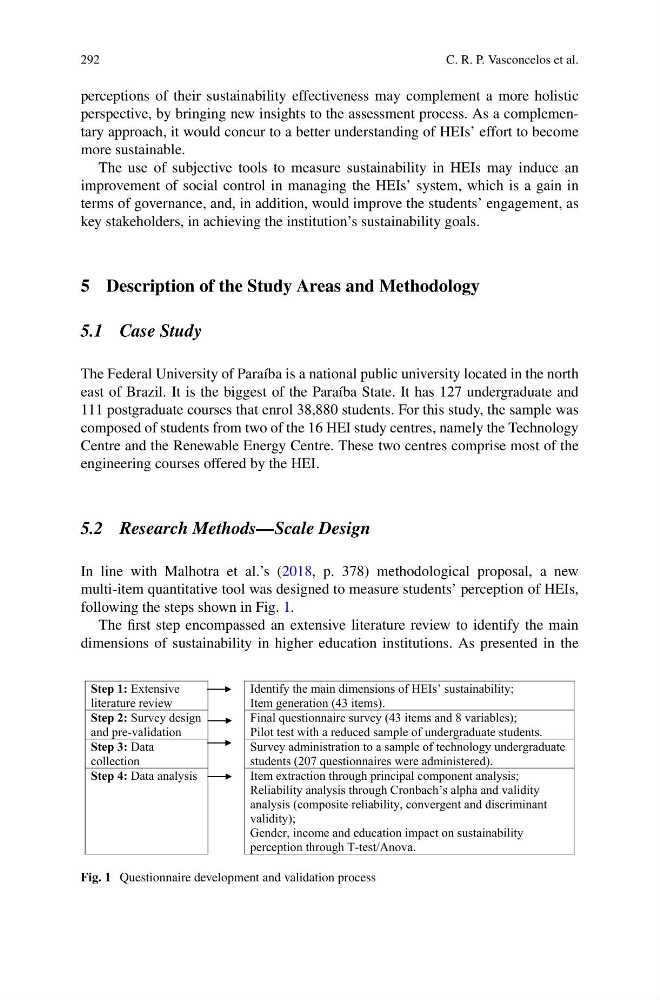
In line with Malhotra et al.’s (2018, p. 378) methodological proposal, a new
multi-item quantitative tool was designed to measure students’ perception of HEIs,
following the steps shown in Fig. 1.
The first step encompassed an extensive literature review to identify the main
dimensions of sustainability in higher education institutions. As presented in the
Step 1: Extensive
literature review
Identify the main dimensions of HEIs’ sustainability;
Item generation (43 items).
Step 2: Survey design
and pre-validation
Final questionnaire survey (43 items and 8 variables);
Pilot test with a reduced sample of undergraduate students.
Step 3: Data
collection
Survey administration to a sample of technology undergraduate
students (207 questionnaires were administered).
Step 4: Data analysis
Item extraction through principal component analysis;
Reliability analysis through Cronbach’s alpha and validity
analysis (composite reliability, convergent and discriminant
validity);
Gender, income and education impact on sustainability
perception through T-test/Anova.
Fig. 1 Questionnaire development and validation process
C. R. P. Vasconcelos et al.
perceptions of their sustainability effectiveness may complement a more holistic
perspective, by bringing new insights to the assessment process. As a complementary approach, it would concur to a better understanding of HEIs’ effort to become
more sustainable.
The use of subjective tools to measure sustainability in HEIs may induce an
improvement of social control in managing the HEIs’ system, which is a gain in
terms of governance, and, in addition, would improve the students’ engagement, as
key stakeholders, in achieving the institution’s sustainability goals.
5 Description of the Study Areas and Methodology
5.1 Case Study
The Federal University of Paraíba is a national public university located in the north
east of Brazil. It is the biggest of the Paraíba State. It has 127 undergraduate and
111 postgraduate courses that enrol 38,880 students. For this study, the sample was
composed of students from two of the 16 HEI study centres, namely the Technology
Centre and the Renewable Energy Centre. These two centres comprise most of the
engineering courses offered by the HEI.
5.2 Research Methods—Scale Design
In line with Malhotra et al.’s (2018, p. 378) methodological proposal, a new
multi-item quantitative tool was designed to measure students’ perception of HEIs,
following the steps shown in Fig. 1.
The first step encompassed an extensive literature review to identify the main
dimensions of sustainability in higher education institutions. As presented in the
Step 1: Extensive
literature review
Identify the main dimensions of HEIs’ sustainability;
Item generation (43 items).
Step 2: Survey design
and pre-validation
Final questionnaire survey (43 items and 8 variables);
Pilot test with a reduced sample of undergraduate students.
Step 3: Data
collection
Survey administration to a sample of technology undergraduate
students (207 questionnaires were administered).
Step 4: Data analysis
Item extraction through principal component analysis;
Reliability analysis through Cronbach’s alpha and validity
analysis (composite reliability, convergent and discriminant
validity);
Gender, income and education impact on sustainability
perception through T-test/Anova.
Fig. 1 Questionnaire development and validation process