

258
O. Khalaim et al.
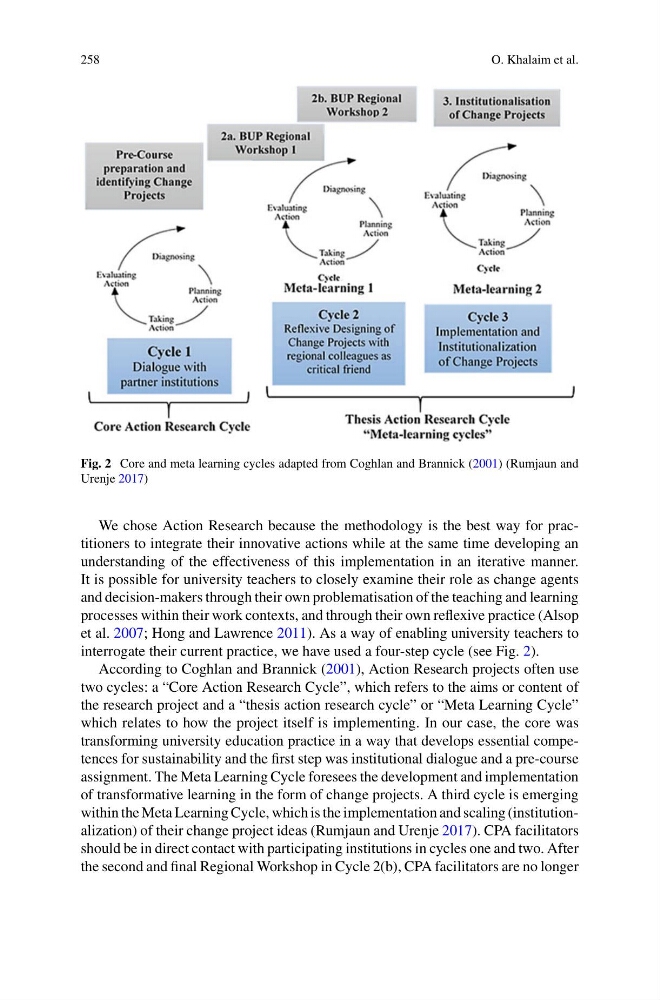
Fig. 2 Core and meta learning cycles adapted from Coghlan and Brannick (2001) (Rumjaun and
Urenje 2017)
We chose Action Research because the methodology is the best way for practitioners to integrate their innovative actions while at the same time developing an
understanding of the effectiveness of this implementation in an iterative manner.
It is possible for university teachers to closely examine their role as change agents
and decision-makers through their own problematisation of the teaching and learning
processes within their work contexts, and through their own reflexive practice (Alsop
et al. 2007; Hong and Lawrence 2011). As a way of enabling university teachers to
interrogate their current practice, we have used a four-step cycle (see Fig. 2).
According to Coghlan and Brannick (2001), Action Research projects often use
two cycles: a “Core Action Research Cycle”, which refers to the aims or content of
the research project and a “thesis action research cycle” or “Meta Learning Cycle”
which relates to how the project itself is implementing. In our case, the core was
transforming university education practice in a way that develops essential competences for sustainability and the first step was institutional dialogue and a pre-course
assignment. The Meta Learning Cycle foresees the development and implementation
of transformative learning in the form of change projects. A third cycle is emerging
within the Meta Learning Cycle, which is the implementation and scaling (institutionalization) of their change project ideas (Rumjaun and Urenje 2017). CPA facilitators
should be in direct contact with participating institutions in cycles one and two. After
the second and final Regional Workshop in Cycle 2(b), CPA facilitators are no longer
O. Khalaim et al.
Fig. 2 Core and meta learning cycles adapted from Coghlan and Brannick (2001) (Rumjaun and
Urenje 2017)
We chose Action Research because the methodology is the best way for practitioners to integrate their innovative actions while at the same time developing an
understanding of the effectiveness of this implementation in an iterative manner.
It is possible for university teachers to closely examine their role as change agents
and decision-makers through their own problematisation of the teaching and learning
processes within their work contexts, and through their own reflexive practice (Alsop
et al. 2007; Hong and Lawrence 2011). As a way of enabling university teachers to
interrogate their current practice, we have used a four-step cycle (see Fig. 2).
According to Coghlan and Brannick (2001), Action Research projects often use
two cycles: a “Core Action Research Cycle”, which refers to the aims or content of
the research project and a “thesis action research cycle” or “Meta Learning Cycle”
which relates to how the project itself is implementing. In our case, the core was
transforming university education practice in a way that develops essential competences for sustainability and the first step was institutional dialogue and a pre-course
assignment. The Meta Learning Cycle foresees the development and implementation
of transformative learning in the form of change projects. A third cycle is emerging
within the Meta Learning Cycle, which is the implementation and scaling (institutionalization) of their change project ideas (Rumjaun and Urenje 2017). CPA facilitators
should be in direct contact with participating institutions in cycles one and two. After
the second and final Regional Workshop in Cycle 2(b), CPA facilitators are no longer