

Change Project Approach for Reorienting University …
257
2.1 Change Project Action Research Cycle and Stages
The Change Project Approach (CPA) is an action learning intervention designed
to stimulate transformative innovations towards sustainability in Higher Education.
The intervention is contextually defined and implemented through a specific Change
Project. We present the Change Project as a collectively developed initiative within
the institution. The CPA stimulates and supports change processes beyond individuals, such that learning processes and the momentum of change remain in the
institution even after the individuals move to other places. Each partner institution
will be challenged to respond to their institutional demands in line with national and
global sustainability trends. These methods and processes are applied in the iterative
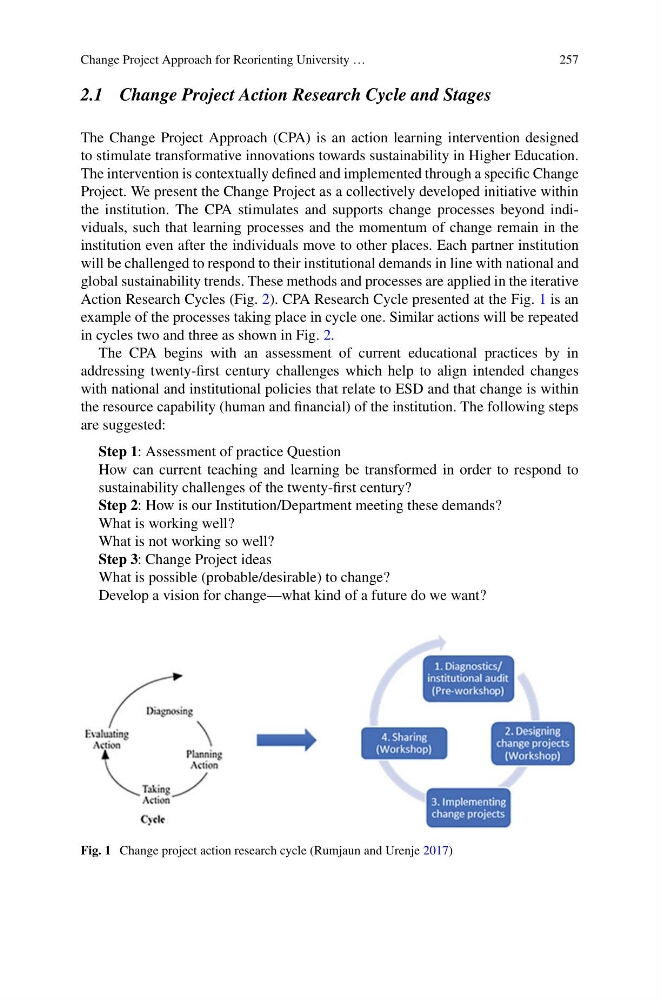
Action Research Cycles (Fig. 2). CPA Research Cycle presented at the Fig. 1 is an
example of the processes taking place in cycle one. Similar actions will be repeated
in cycles two and three as shown in Fig. 2.
The CPA begins with an assessment of current educational practices by in
addressing twenty-first century challenges which help to align intended changes
with national and institutional policies that relate to ESD and that change is within
the resource capability (human and financial) of the institution. The following steps
are suggested:
Step 1: Assessment of practice Question
How can current teaching and learning be transformed in order to respond to
sustainability challenges of the twenty-first century?
Step 2: How is our Institution/Department meeting these demands?
What is working well?
What is not working so well?
Step 3: Change Project ideas
What is possible (probable/desirable) to change?
Develop a vision for change—what kind of a future do we want?
Fig. 1 Change project action research cycle (Rumjaun and Urenje 2017)
257
2.1 Change Project Action Research Cycle and Stages
The Change Project Approach (CPA) is an action learning intervention designed
to stimulate transformative innovations towards sustainability in Higher Education.
The intervention is contextually defined and implemented through a specific Change
Project. We present the Change Project as a collectively developed initiative within
the institution. The CPA stimulates and supports change processes beyond individuals, such that learning processes and the momentum of change remain in the
institution even after the individuals move to other places. Each partner institution
will be challenged to respond to their institutional demands in line with national and
global sustainability trends. These methods and processes are applied in the iterative
Action Research Cycles (Fig. 2). CPA Research Cycle presented at the Fig. 1 is an
example of the processes taking place in cycle one. Similar actions will be repeated
in cycles two and three as shown in Fig. 2.
The CPA begins with an assessment of current educational practices by in
addressing twenty-first century challenges which help to align intended changes
with national and institutional policies that relate to ESD and that change is within
the resource capability (human and financial) of the institution. The following steps
are suggested:
Step 1: Assessment of practice Question
How can current teaching and learning be transformed in order to respond to
sustainability challenges of the twenty-first century?
Step 2: How is our Institution/Department meeting these demands?
What is working well?
What is not working so well?
Step 3: Change Project ideas
What is possible (probable/desirable) to change?
Develop a vision for change—what kind of a future do we want?
Fig. 1 Change project action research cycle (Rumjaun and Urenje 2017)