

212
M. de Andrade Lima et al.
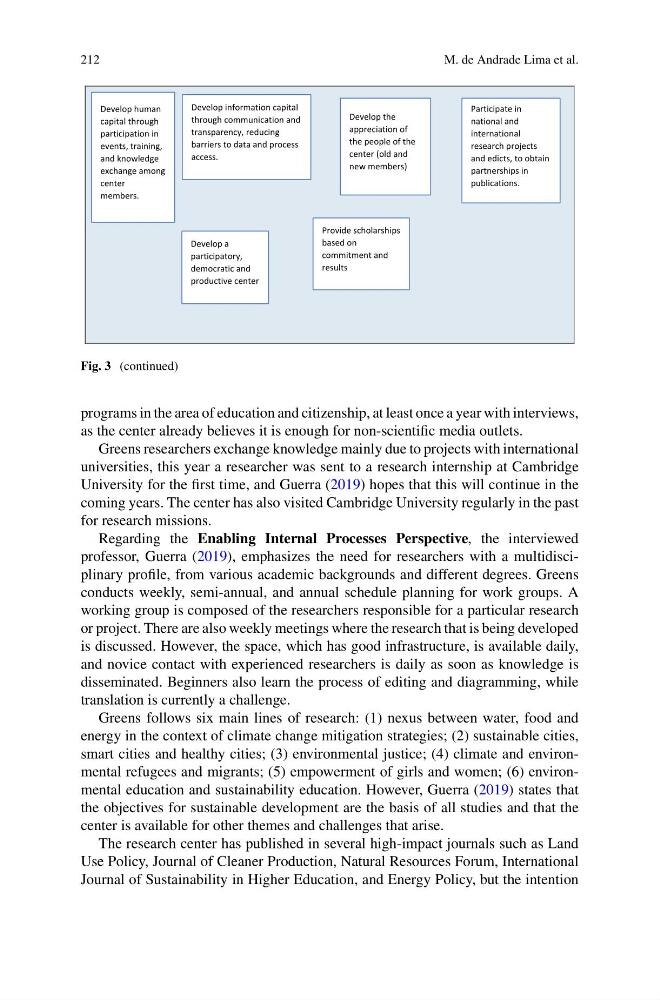
Develop human
capital through
participation in
events, training,
and knowledge
exchange among
center
members.
Develop information capital
through communication and
transparency, reducing
barriers to data and process
access.
Develop the
appreciation of
the people of the
center (old and
new members)
Participate in
national and
international
research projects
and edicts, to obtain
partnerships in
publications.
Develop a
participatory,
democratic and
productive center
Provide scholarships
based on
commitment and
results
Fig. 3 (continued)
programs in the area of education and citizenship, at least once a year with interviews,
as the center already believes it is enough for non-scientific media outlets.
Greens researchers exchange knowledge mainly due to projects with international
universities, this year a researcher was sent to a research internship at Cambridge
University for the first time, and Guerra (2019) hopes that this will continue in the
coming years. The center has also visited Cambridge University regularly in the past
for research missions.
Regarding the Enabling Internal Processes Perspective, the interviewed
professor, Guerra (2019), emphasizes the need for researchers with a multidisciplinary profile, from various academic backgrounds and different degrees. Greens
conducts weekly, semi-annual, and annual schedule planning for work groups. A
working group is composed of the researchers responsible for a particular research
or project. There are also weekly meetings where the research that is being developed
is discussed. However, the space, which has good infrastructure, is available daily,
and novice contact with experienced researchers is daily as soon as knowledge is
disseminated. Beginners also learn the process of editing and diagramming, while
translation is currently a challenge.
Greens follows six main lines of research: (1) nexus between water, food and
energy in the context of climate change mitigation strategies; (2) sustainable cities,
smart cities and healthy cities; (3) environmental justice; (4) climate and environmental refugees and migrants; (5) empowerment of girls and women; (6) environmental education and sustainability education. However, Guerra (2019) states that
the objectives for sustainable development are the basis of all studies and that the
center is available for other themes and challenges that arise.
The research center has published in several high-impact journals such as Land
Use Policy, Journal of Cleaner Production, Natural Resources Forum, International
Journal of Sustainability in Higher Education, and Energy Policy, but the intention
M. de Andrade Lima et al.
Develop human
capital through
participation in
events, training,
and knowledge
exchange among
center
members.
Develop information capital
through communication and
transparency, reducing
barriers to data and process
access.
Develop the
appreciation of
the people of the
center (old and
new members)
Participate in
national and
international
research projects
and edicts, to obtain
partnerships in
publications.
Develop a
participatory,
democratic and
productive center
Provide scholarships
based on
commitment and
results
Fig. 3 (continued)
programs in the area of education and citizenship, at least once a year with interviews,
as the center already believes it is enough for non-scientific media outlets.
Greens researchers exchange knowledge mainly due to projects with international
universities, this year a researcher was sent to a research internship at Cambridge
University for the first time, and Guerra (2019) hopes that this will continue in the
coming years. The center has also visited Cambridge University regularly in the past
for research missions.
Regarding the Enabling Internal Processes Perspective, the interviewed
professor, Guerra (2019), emphasizes the need for researchers with a multidisciplinary profile, from various academic backgrounds and different degrees. Greens
conducts weekly, semi-annual, and annual schedule planning for work groups. A
working group is composed of the researchers responsible for a particular research
or project. There are also weekly meetings where the research that is being developed
is discussed. However, the space, which has good infrastructure, is available daily,
and novice contact with experienced researchers is daily as soon as knowledge is
disseminated. Beginners also learn the process of editing and diagramming, while
translation is currently a challenge.
Greens follows six main lines of research: (1) nexus between water, food and
energy in the context of climate change mitigation strategies; (2) sustainable cities,
smart cities and healthy cities; (3) environmental justice; (4) climate and environmental refugees and migrants; (5) empowerment of girls and women; (6) environmental education and sustainability education. However, Guerra (2019) states that
the objectives for sustainable development are the basis of all studies and that the
center is available for other themes and challenges that arise.
The research center has published in several high-impact journals such as Land
Use Policy, Journal of Cleaner Production, Natural Resources Forum, International
Journal of Sustainability in Higher Education, and Energy Policy, but the intention