

Strategic Planning for a Sustainable Development Centre …
205
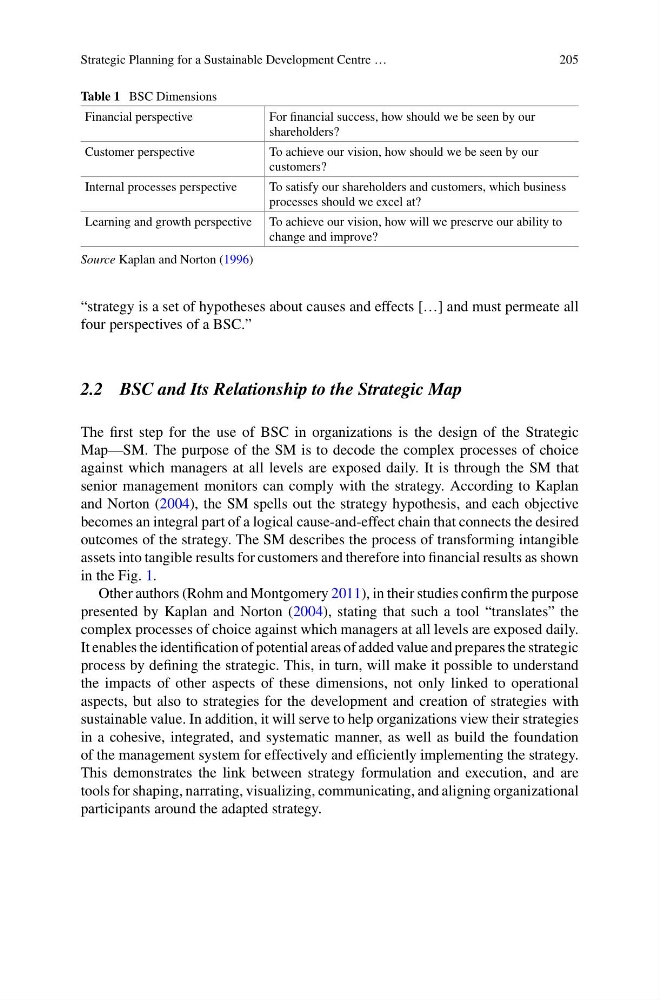
Table 1 BSC Dimensions
Financial perspective
For financial success, how should we be seen by our
shareholders?
Customer perspective
To achieve our vision, how should we be seen by our
customers?
Internal processes perspective
To satisfy our shareholders and customers, which business
processes should we excel at?
Learning and growth perspective To achieve our vision, how will we preserve our ability to
change and improve?
Source Kaplan and Norton (1996)
“strategy is a set of hypotheses about causes and effects […] and must permeate all
four perspectives of a BSC.”
2.2 BSC and Its Relationship to the Strategic Map
The first step for the use of BSC in organizations is the design of the Strategic
Map—SM. The purpose of the SM is to decode the complex processes of choice
against which managers at all levels are exposed daily. It is through the SM that
senior management monitors can comply with the strategy. According to Kaplan
and Norton (2004), the SM spells out the strategy hypothesis, and each objective
becomes an integral part of a logical cause-and-effect chain that connects the desired
outcomes of the strategy. The SM describes the process of transforming intangible
assets into tangible results for customers and therefore into financial results as shown
in the Fig. 1.
Other authors (Rohm and Montgomery 2011), in their studies confirm the purpose
presented by Kaplan and Norton (2004), stating that such a tool “translates” the
complex processes of choice against which managers at all levels are exposed daily.
It enables the identification of potential areas of added value and prepares the strategic
process by defining the strategic. This, in turn, will make it possible to understand
the impacts of other aspects of these dimensions, not only linked to operational
aspects, but also to strategies for the development and creation of strategies with
sustainable value. In addition, it will serve to help organizations view their strategies
in a cohesive, integrated, and systematic manner, as well as build the foundation
of the management system for effectively and efficiently implementing the strategy.
This demonstrates the link between strategy formulation and execution, and are
tools for shaping, narrating, visualizing, communicating, and aligning organizational
participants around the adapted strategy.
205
Table 1 BSC Dimensions
Financial perspective
For financial success, how should we be seen by our
shareholders?
Customer perspective
To achieve our vision, how should we be seen by our
customers?
Internal processes perspective
To satisfy our shareholders and customers, which business
processes should we excel at?
Learning and growth perspective To achieve our vision, how will we preserve our ability to
change and improve?
Source Kaplan and Norton (1996)
“strategy is a set of hypotheses about causes and effects […] and must permeate all
four perspectives of a BSC.”
2.2 BSC and Its Relationship to the Strategic Map
The first step for the use of BSC in organizations is the design of the Strategic
Map—SM. The purpose of the SM is to decode the complex processes of choice
against which managers at all levels are exposed daily. It is through the SM that
senior management monitors can comply with the strategy. According to Kaplan
and Norton (2004), the SM spells out the strategy hypothesis, and each objective
becomes an integral part of a logical cause-and-effect chain that connects the desired
outcomes of the strategy. The SM describes the process of transforming intangible
assets into tangible results for customers and therefore into financial results as shown
in the Fig. 1.
Other authors (Rohm and Montgomery 2011), in their studies confirm the purpose
presented by Kaplan and Norton (2004), stating that such a tool “translates” the
complex processes of choice against which managers at all levels are exposed daily.
It enables the identification of potential areas of added value and prepares the strategic
process by defining the strategic. This, in turn, will make it possible to understand
the impacts of other aspects of these dimensions, not only linked to operational
aspects, but also to strategies for the development and creation of strategies with
sustainable value. In addition, it will serve to help organizations view their strategies
in a cohesive, integrated, and systematic manner, as well as build the foundation
of the management system for effectively and efficiently implementing the strategy.
This demonstrates the link between strategy formulation and execution, and are
tools for shaping, narrating, visualizing, communicating, and aligning organizational
participants around the adapted strategy.