

132
V. R. Vargas et al.
(c) T could the wrong activity to be doing. We manage T by asking: Is T the
right thing to be doing? The answer measures the Effectiveness of the System,
measured by the monitoring and controlling activities at the ‘planning system’
level.
3.4 Assessing the Performance of Stakeholder’s Network:
A Soft Systems Methodology (SSM) Model
SSM and the Transformation Process
The concept and the different views around issues pertaining to stakeholders’ network
involvement in HEIs were described using Checkland’s Transformation Process. The
following is a partial list of how the role of a stakeholders’ network is viewed by
different members of the network:
(1) A way of exercising HEI staff concerns about SD implementation in HEIs
(2) A way of preparing students to become more aware of the value of SDGs.
(3) A way of exercising pressure on HEI Senior management to be more active in
pursuing SD in HEIs
(4) A way of creating and consolidating a SDGs culture in HEIs.
If we use Checkland’s model on the third of the above views, we can apply the
following control and monitoring concepts to this situation:
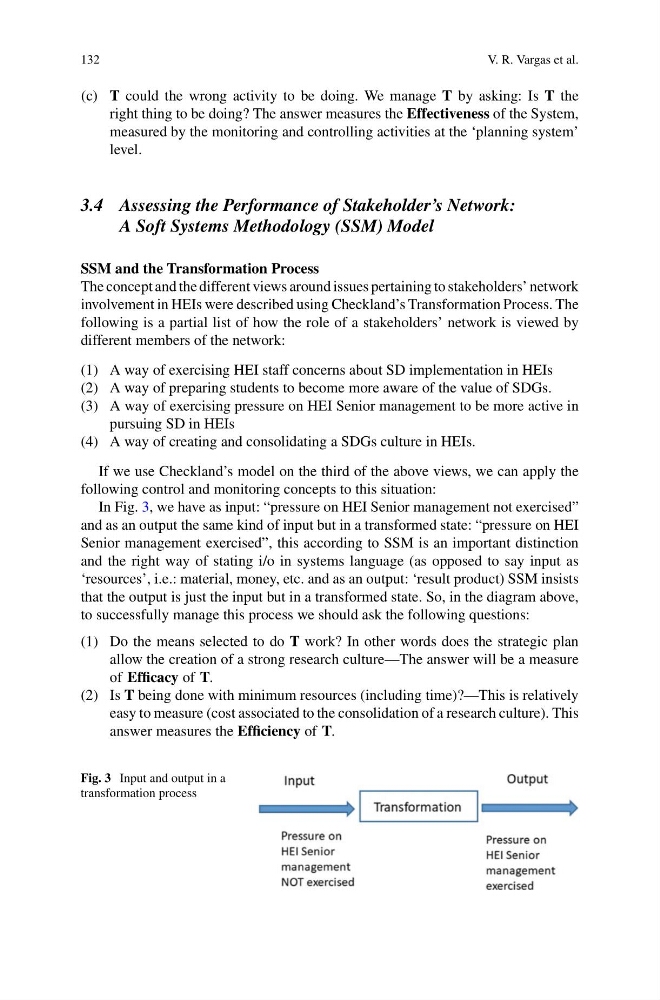
In Fig. 3, we have as input: “pressure on HEI Senior management not exercised”
and as an output the same kind of input but in a transformed state: “pressure on HEI
Senior management exercised”, this according to SSM is an important distinction
and the right way of stating i/o in systems language (as opposed to say input as
‘resources’, i.e.: material, money, etc. and as an output: ‘result product) SSM insists
that the output is just the input but in a transformed state. So, in the diagram above,
to successfully manage this process we should ask the following questions:
(1) Do the means selected to do T work? In other words does the strategic plan
allow the creation of a strong research culture—The answer will be a measure
of Efficacy of T.
(2) Is T being done with minimum resources (including time)?—This is relatively
easy to measure (cost associated to the consolidation of a research culture). This
answer measures the Efficiency of T.
Fig. 3 Input and output in a
transformation process
V. R. Vargas et al.
(c) T could the wrong activity to be doing. We manage T by asking: Is T the
right thing to be doing? The answer measures the Effectiveness of the System,
measured by the monitoring and controlling activities at the ‘planning system’
level.
3.4 Assessing the Performance of Stakeholder’s Network:
A Soft Systems Methodology (SSM) Model
SSM and the Transformation Process
The concept and the different views around issues pertaining to stakeholders’ network
involvement in HEIs were described using Checkland’s Transformation Process. The
following is a partial list of how the role of a stakeholders’ network is viewed by
different members of the network:
(1) A way of exercising HEI staff concerns about SD implementation in HEIs
(2) A way of preparing students to become more aware of the value of SDGs.
(3) A way of exercising pressure on HEI Senior management to be more active in
pursuing SD in HEIs
(4) A way of creating and consolidating a SDGs culture in HEIs.
If we use Checkland’s model on the third of the above views, we can apply the
following control and monitoring concepts to this situation:
In Fig. 3, we have as input: “pressure on HEI Senior management not exercised”
and as an output the same kind of input but in a transformed state: “pressure on HEI
Senior management exercised”, this according to SSM is an important distinction
and the right way of stating i/o in systems language (as opposed to say input as
‘resources’, i.e.: material, money, etc. and as an output: ‘result product) SSM insists
that the output is just the input but in a transformed state. So, in the diagram above,
to successfully manage this process we should ask the following questions:
(1) Do the means selected to do T work? In other words does the strategic plan
allow the creation of a strong research culture—The answer will be a measure
of Efficacy of T.
(2) Is T being done with minimum resources (including time)?—This is relatively
easy to measure (cost associated to the consolidation of a research culture). This
answer measures the Efficiency of T.
Fig. 3 Input and output in a
transformation process