

The Role of Higher Education Stakeholder Networks …
131
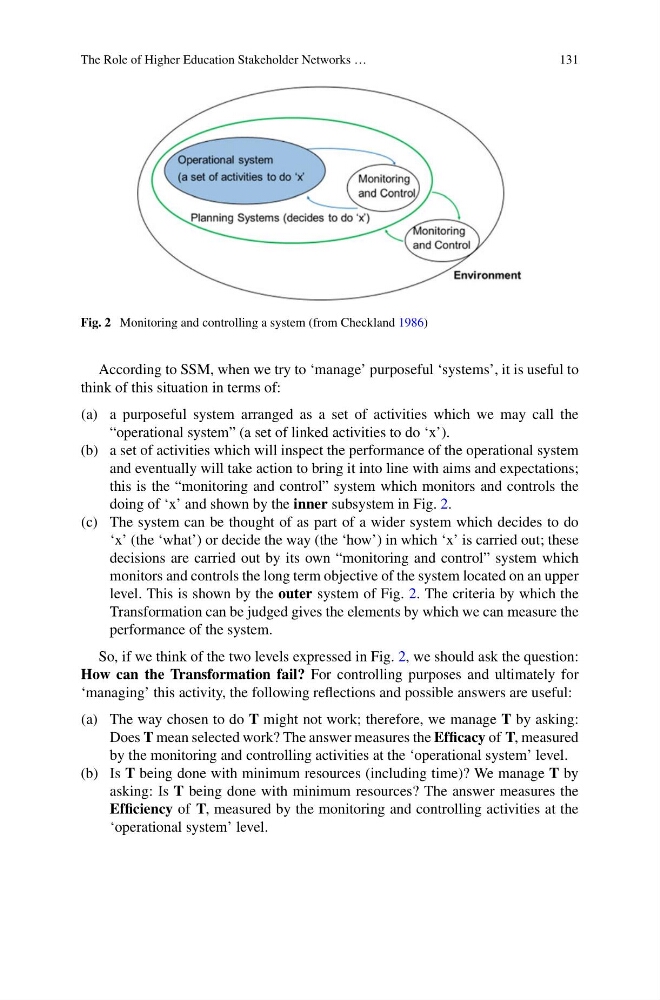
Fig. 2 Monitoring and controlling a system (from Checkland 1986)
According to SSM, when we try to ‘manage’ purposeful ‘systems’, it is useful to
think of this situation in terms of:
(a) a purposeful system arranged as a set of activities which we may call the
“operational system” (a set of linked activities to do ‘x’).
(b) a set of activities which will inspect the performance of the operational system
and eventually will take action to bring it into line with aims and expectations;
this is the “monitoring and control” system which monitors and controls the
doing of ‘x’ and shown by the inner subsystem in Fig. 2.
(c) The system can be thought of as part of a wider system which decides to do
‘x’ (the ‘what’) or decide the way (the ‘how’) in which ‘x’ is carried out; these
decisions are carried out by its own “monitoring and control” system which
monitors and controls the long term objective of the system located on an upper
level. This is shown by the outer system of Fig. 2. The criteria by which the
Transformation can be judged gives the elements by which we can measure the
performance of the system.
So, if we think of the two levels expressed in Fig. 2, we should ask the question:
How can the Transformation fail? For controlling purposes and ultimately for
‘managing’ this activity, the following reflections and possible answers are useful:
(a) The way chosen to do T might not work; therefore, we manage T by asking:
Does T mean selected work? The answer measures the Efficacy of T, measured
by the monitoring and controlling activities at the ‘operational system’ level.
(b) Is T being done with minimum resources (including time)? We manage T by
asking: Is T being done with minimum resources? The answer measures the
Efficiency of T, measured by the monitoring and controlling activities at the
‘operational system’ level.
131
Fig. 2 Monitoring and controlling a system (from Checkland 1986)
According to SSM, when we try to ‘manage’ purposeful ‘systems’, it is useful to
think of this situation in terms of:
(a) a purposeful system arranged as a set of activities which we may call the
“operational system” (a set of linked activities to do ‘x’).
(b) a set of activities which will inspect the performance of the operational system
and eventually will take action to bring it into line with aims and expectations;
this is the “monitoring and control” system which monitors and controls the
doing of ‘x’ and shown by the inner subsystem in Fig. 2.
(c) The system can be thought of as part of a wider system which decides to do
‘x’ (the ‘what’) or decide the way (the ‘how’) in which ‘x’ is carried out; these
decisions are carried out by its own “monitoring and control” system which
monitors and controls the long term objective of the system located on an upper
level. This is shown by the outer system of Fig. 2. The criteria by which the
Transformation can be judged gives the elements by which we can measure the
performance of the system.
So, if we think of the two levels expressed in Fig. 2, we should ask the question:
How can the Transformation fail? For controlling purposes and ultimately for
‘managing’ this activity, the following reflections and possible answers are useful:
(a) The way chosen to do T might not work; therefore, we manage T by asking:
Does T mean selected work? The answer measures the Efficacy of T, measured
by the monitoring and controlling activities at the ‘operational system’ level.
(b) Is T being done with minimum resources (including time)? We manage T by
asking: Is T being done with minimum resources? The answer measures the
Efficiency of T, measured by the monitoring and controlling activities at the
‘operational system’ level.