

392
seven times higher than values of the samples from the rest of the area (average
value of 20.1 mg kg
−1
). Differences between the content of As in stems and leaves
from samples around the Allchar mine (19.7 mg kg
−1
and 22.7 mg kg
−1
, respectively) compared with samples from the rest of the area (5.61 mg kg
−1
in stems and
9.15 mg kg
−1
in leaves) were also evident.
The content of Tl was significantly higher compared with As and Sb in all parts
of the plant. Accumulation of Tl was much higher in the roots collected from the
(A-R) area, with the average content being 317 mg kg
−1
, compared with roots from
the (R-R) area, where the average value was 53.6 mg kg
−1
. Remarkable differences
between the contents of Tl in aboveground parts of the plant (flowers, leaves, and
stems) were evident from samples collected around the Allchar mine (262, 172, and
89.7 mg kg
−1
, respectively) compared with samples from the rest of the area (58.8,
66.5, and 44.5 mg kg
−1
, respectively). Antimony had considerably less accumulation compared with As and Tl, and it had no significant variation between the different parts of T. alsarensis collected from the Allchar locality (Fig. 13.7). Less
accumulation and lower content of Sb in samples of T. alsarensis were due to fact
that the Sb mineralization (mainly mineral stibnite) was distributed in deeper layers
in the mine deposit (Jelenković and Boev 2011).
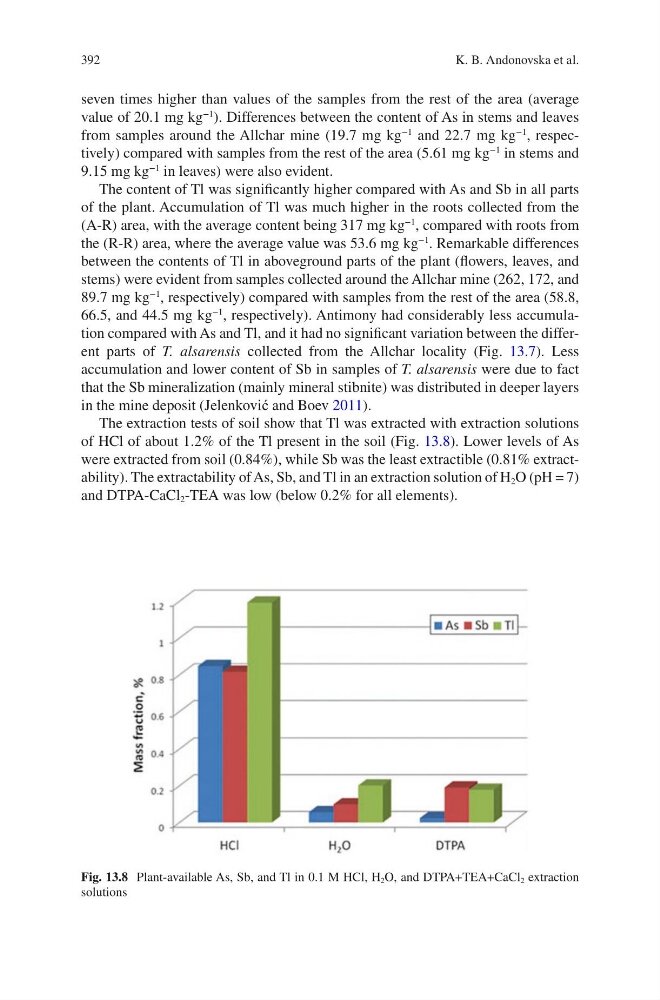
The extraction tests of soil show that Tl was extracted with extraction solutions
of HCl of about 1.2% of the Tl present in the soil (Fig. 13.8). Lower levels of As
were extracted from soil (0.84%), while Sb was the least extractible (0.81% extractability). The extractability of As, Sb, and Tl in an extraction solution of H 2 O (pH = 7)
and DTPA-CaCl 2 -TEA was low (below 0.2% for all elements).
Fig. 13.8 Plant-available As, Sb, and Tl in 0.1 M HCl, H 2 O, and DTPA+TEA+CaCl 2 extraction
solutions
K. B. Andonovska et al.
seven times higher than values of the samples from the rest of the area (average
value of 20.1 mg kg
−1
). Differences between the content of As in stems and leaves
from samples around the Allchar mine (19.7 mg kg
−1
and 22.7 mg kg
−1
, respectively) compared with samples from the rest of the area (5.61 mg kg
−1
in stems and
9.15 mg kg
−1
in leaves) were also evident.
The content of Tl was significantly higher compared with As and Sb in all parts
of the plant. Accumulation of Tl was much higher in the roots collected from the
(A-R) area, with the average content being 317 mg kg
−1
, compared with roots from
the (R-R) area, where the average value was 53.6 mg kg
−1
. Remarkable differences
between the contents of Tl in aboveground parts of the plant (flowers, leaves, and
stems) were evident from samples collected around the Allchar mine (262, 172, and
89.7 mg kg
−1
, respectively) compared with samples from the rest of the area (58.8,
66.5, and 44.5 mg kg
−1
, respectively). Antimony had considerably less accumulation compared with As and Tl, and it had no significant variation between the different parts of T. alsarensis collected from the Allchar locality (Fig. 13.7). Less
accumulation and lower content of Sb in samples of T. alsarensis were due to fact
that the Sb mineralization (mainly mineral stibnite) was distributed in deeper layers
in the mine deposit (Jelenković and Boev 2011).
The extraction tests of soil show that Tl was extracted with extraction solutions
of HCl of about 1.2% of the Tl present in the soil (Fig. 13.8). Lower levels of As
were extracted from soil (0.84%), while Sb was the least extractible (0.81% extractability). The extractability of As, Sb, and Tl in an extraction solution of H 2 O (pH = 7)
and DTPA-CaCl 2 -TEA was low (below 0.2% for all elements).
Fig. 13.8 Plant-available As, Sb, and Tl in 0.1 M HCl, H 2 O, and DTPA+TEA+CaCl 2 extraction
solutions
K. B. Andonovska et al.