

20
M
M
EE R
OE
N
⋅+
+
⋅
⋅+
⋅+
→
+
→
+
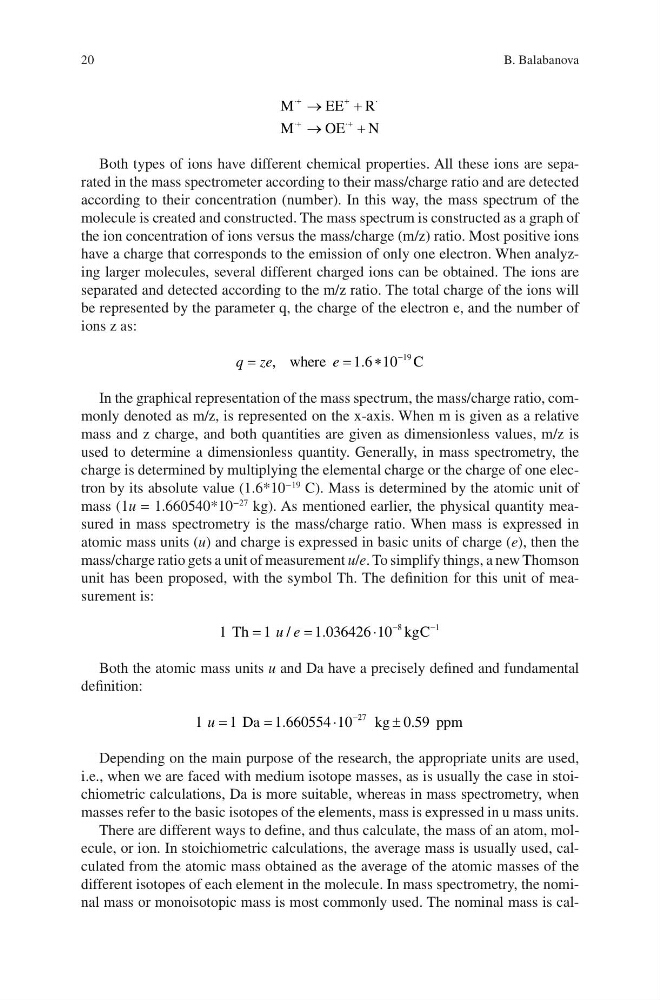
Both types of ions have different chemical properties. All these ions are separated in the mass spectrometer according to their mass/charge ratio and are detected
according to their concentration (number). In this way, the mass spectrum of the
molecule is created and constructed. The mass spectrum is constructed as a graph of
the ion concentration of ions versus the mass/charge (m/z) ratio. Most positive ions
have a charge that corresponds to the emission of only one electron. When analyzing larger molecules, several different charged ions can be obtained. The ions are
separated and detected according to the m/z ratio. The total charge of the ions will
be represented by the parameter q, the charge of the electron e, and the number of
ions z as:
q ze
e
=
=
∗
−
,
.
where
C
1 6 10
19
In the graphical representation of the mass spectrum, the mass/charge ratio, commonly denoted as m/z, is represented on the x-axis. When m is given as a relative
mass and z charge, and both quantities are given as dimensionless values, m/z is
used to determine a dimensionless quantity. Generally, in mass spectrometry, the
charge is determined by multiplying the elemental charge or the charge of one electron by its absolute value (1.6*10
−19
C). Mass is determined by the atomic unit of
mass (1u = 1.660540*10
−27
kg). As mentioned earlier, the physical quantity measured in mass spectrometry is the mass/charge ratio. When mass is expressed in
atomic mass units (u) and charge is expressed in basic units of charge (e), then the
mass/charge ratio gets a unit of measurement u/e. To simplify things, a new Thomson
unit has been proposed, with the symbol Th. The definition for this unit of measurement is:
1
1
1 036426 10
8
1
Th
kgC
=
=
⋅
−
−
u e
/
.
Both the atomic mass units u and Da have a precisely defined and fundamental
definition:
1
1
1 660554 10
0 59
27
u =
=
⋅
±
−
Da
kg
ppm
.
.
Depending on the main purpose of the research, the appropriate units are used,
i.e., when we are faced with medium isotope masses, as is usually the case in stoichiometric calculations, Da is more suitable, whereas in mass spectrometry, when
masses refer to the basic isotopes of the elements, mass is expressed in u mass units.
There are different ways to define, and thus calculate, the mass of an atom, molecule, or ion. In stoichiometric calculations, the average mass is usually used, calculated from the atomic mass obtained as the average of the atomic masses of the
different isotopes of each element in the molecule. In mass spectrometry, the nominal mass or monoisotopic mass is most commonly used. The nominal mass is calB. Balabanova
M
M
EE R
OE
N
⋅+
+
⋅
⋅+
⋅+
→
+
→
+
Both types of ions have different chemical properties. All these ions are separated in the mass spectrometer according to their mass/charge ratio and are detected
according to their concentration (number). In this way, the mass spectrum of the
molecule is created and constructed. The mass spectrum is constructed as a graph of
the ion concentration of ions versus the mass/charge (m/z) ratio. Most positive ions
have a charge that corresponds to the emission of only one electron. When analyzing larger molecules, several different charged ions can be obtained. The ions are
separated and detected according to the m/z ratio. The total charge of the ions will
be represented by the parameter q, the charge of the electron e, and the number of
ions z as:
q ze
e
=
=
∗
−
,
.
where
C
1 6 10
19
In the graphical representation of the mass spectrum, the mass/charge ratio, commonly denoted as m/z, is represented on the x-axis. When m is given as a relative
mass and z charge, and both quantities are given as dimensionless values, m/z is
used to determine a dimensionless quantity. Generally, in mass spectrometry, the
charge is determined by multiplying the elemental charge or the charge of one electron by its absolute value (1.6*10
−19
C). Mass is determined by the atomic unit of
mass (1u = 1.660540*10
−27
kg). As mentioned earlier, the physical quantity measured in mass spectrometry is the mass/charge ratio. When mass is expressed in
atomic mass units (u) and charge is expressed in basic units of charge (e), then the
mass/charge ratio gets a unit of measurement u/e. To simplify things, a new Thomson
unit has been proposed, with the symbol Th. The definition for this unit of measurement is:
1
1
1 036426 10
8
1
Th
kgC
=
=
⋅
−
−
u e
/
.
Both the atomic mass units u and Da have a precisely defined and fundamental
definition:
1
1
1 660554 10
0 59
27
u =
=
⋅
±
−
Da
kg
ppm
.
.
Depending on the main purpose of the research, the appropriate units are used,
i.e., when we are faced with medium isotope masses, as is usually the case in stoichiometric calculations, Da is more suitable, whereas in mass spectrometry, when
masses refer to the basic isotopes of the elements, mass is expressed in u mass units.
There are different ways to define, and thus calculate, the mass of an atom, molecule, or ion. In stoichiometric calculations, the average mass is usually used, calculated from the atomic mass obtained as the average of the atomic masses of the
different isotopes of each element in the molecule. In mass spectrometry, the nominal mass or monoisotopic mass is most commonly used. The nominal mass is calB. Balabanova