

323
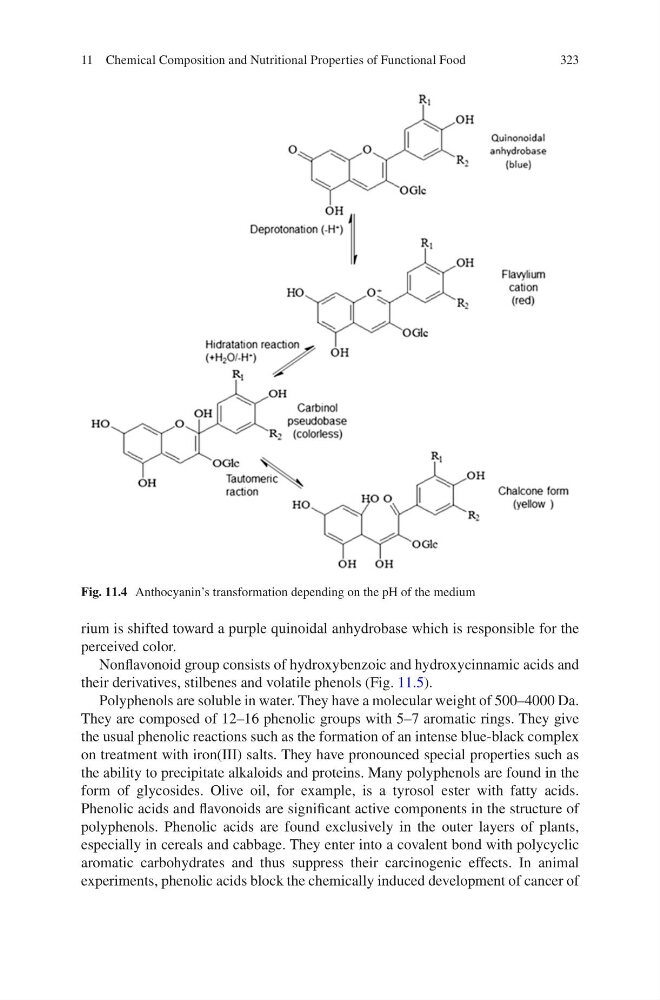
rium is shifted toward a purple quinoidal anhydrobase which is responsible for the
perceived color.
Nonflavonoid group consists of hydroxybenzoic and hydroxycinnamic acids and
their derivatives, stilbenes and volatile phenols (Fig. 11.5).
Polyphenols are soluble in water. They have a molecular weight of 500–4000 Da.
They are composed of 12–16 phenolic groups with 5–7 aromatic rings. They give
the usual phenolic reactions such as the formation of an intense blue-black complex
on treatment with iron(III) salts. They have pronounced special properties such as
the ability to precipitate alkaloids and proteins. Many polyphenols are found in the
form of glycosides. Olive oil, for example, is a tyrosol ester with fatty acids.
Phenolic acids and flavonoids are significant active components in the structure of
polyphenols. Phenolic acids are found exclusively in the outer layers of plants,
especially in cereals and cabbage. They enter into a covalent bond with polycyclic
aromatic carbohydrates and thus suppress their carcinogenic effects. In animal
experiments, phenolic acids block the chemically induced development of cancer of
Fig. 11.4 Anthocyanin’s transformation depending on the pH of the medium
11 Chemical Composition and Nutritional Properties of Functional Food
rium is shifted toward a purple quinoidal anhydrobase which is responsible for the
perceived color.
Nonflavonoid group consists of hydroxybenzoic and hydroxycinnamic acids and
their derivatives, stilbenes and volatile phenols (Fig. 11.5).
Polyphenols are soluble in water. They have a molecular weight of 500–4000 Da.
They are composed of 12–16 phenolic groups with 5–7 aromatic rings. They give
the usual phenolic reactions such as the formation of an intense blue-black complex
on treatment with iron(III) salts. They have pronounced special properties such as
the ability to precipitate alkaloids and proteins. Many polyphenols are found in the
form of glycosides. Olive oil, for example, is a tyrosol ester with fatty acids.
Phenolic acids and flavonoids are significant active components in the structure of
polyphenols. Phenolic acids are found exclusively in the outer layers of plants,
especially in cereals and cabbage. They enter into a covalent bond with polycyclic
aromatic carbohydrates and thus suppress their carcinogenic effects. In animal
experiments, phenolic acids block the chemically induced development of cancer of
Fig. 11.4 Anthocyanin’s transformation depending on the pH of the medium
11 Chemical Composition and Nutritional Properties of Functional Food