

285
domesticated in the Nile River Valley of Egypt at least 17,000 year ago (Wendorf et al.
1979). Barley has an extremely wide geographic range, wider than almost every other
crop species. It is cultivated at the highest arable mountaintops down to the seacoast
and from the highest north/south latitudes to the tropics (Paulitz and Steffenson 2011).
Barley is commonly cultivated for centuries due to its versatility, ability to adapt to
unfavorable environmental conditions. Hordeum vulgare L. is one of the oldest and
the most important cereal grown worldwide that contains a lot of nutrients. This crop
is still considered one of the four most important cereals in the world after wheat,
maize, and rice (Akar et al. 2004; Zaefizadeh et al. 2011; Biel and Jacyno 2013).
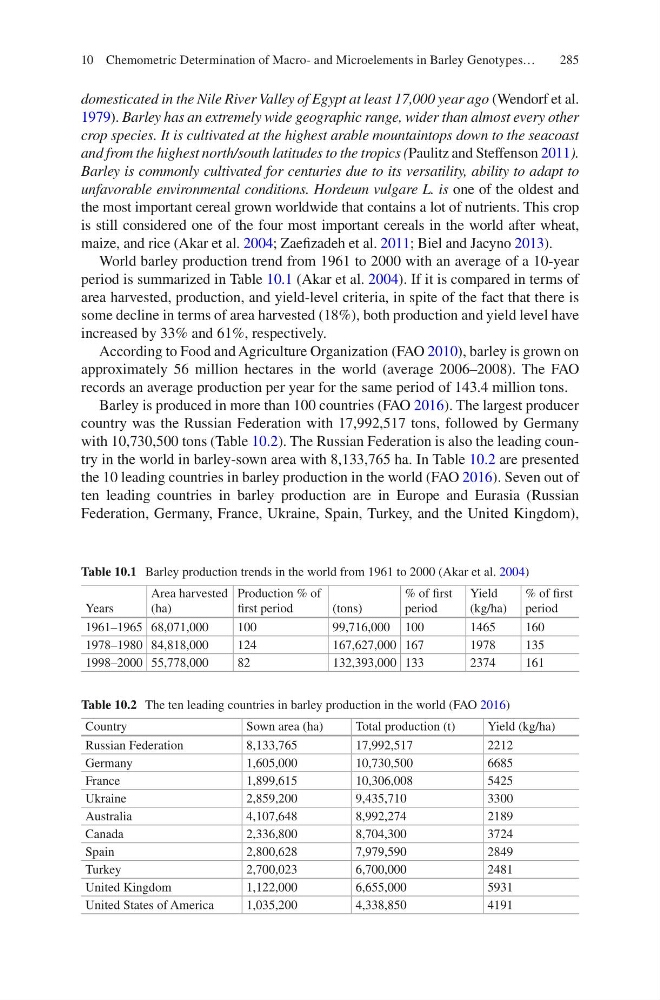
World barley production trend from 1961 to 2000 with an average of a 10-year
period is summarized in Table 10.1 (Akar et al. 2004). If it is compared in terms of
area harvested, production, and yield-level criteria, in spite of the fact that there is
some decline in terms of area harvested (18%), both production and yield level have
increased by 33% and 61%, respectively.
According to Food and Agriculture Organization (FAO 2010), barley is grown on
approximately 56 million hectares in the world (average 2006–2008). The FAO
records an average production per year for the same period of 143.4 million tons.
Barley is produced in more than 100 countries (FAO 2016). The largest producer
country was the Russian Federation with 17,992,517 tons, followed by Germany
with 10,730,500 tons (Table 10.2). The Russian Federation is also the leading country in the world in barley-sown area with 8,133,765 ha. In Table 10.2 are presented
the 10 leading countries in barley production in the world (FAO 2016). Seven out of
ten leading countries in barley production are in Europe and Eurasia (Russian
Federation, Germany, France, Ukraine, Spain, Turkey, and the United Kingdom),
Table 10.1 Barley production trends in the world from 1961 to 2000 (Akar et al. 2004)
Years
Area harvested
(ha)
Production % of
first period
(tons)
% of first
period
Yield
(kg/ha)
% of first
period
1961–1965 68,071,000
100
99,716,000 100
1465
160
1978–1980 84,818,000
124
167,627,000 167
1978
135
1998–2000 55,778,000
82
132,393,000 133
2374
161
Table 10.2 The ten leading countries in barley production in the world (FAO 2016)
Country
Sown area (ha)
Total production (t)
Yield (kg/ha)
Russian Federation
8,133,765
17,992,517
2212
Germany
1,605,000
10,730,500
6685
France
1,899,615
10,306,008
5425
Ukraine
2,859,200
9,435,710
3300
Australia
4,107,648
8,992,274
2189
Canada
2,336,800
8,704,300
3724
Spain
2,800,628
7,979,590
2849
Turkey
2,700,023
6,700,000
2481
United Kingdom
1,122,000
6,655,000
5931
United States of America
1,035,200
4,338,850
4191
10 Chemometric Determination of Macro- and Microelements in Barley Genotypes…
domesticated in the Nile River Valley of Egypt at least 17,000 year ago (Wendorf et al.
1979). Barley has an extremely wide geographic range, wider than almost every other
crop species. It is cultivated at the highest arable mountaintops down to the seacoast
and from the highest north/south latitudes to the tropics (Paulitz and Steffenson 2011).
Barley is commonly cultivated for centuries due to its versatility, ability to adapt to
unfavorable environmental conditions. Hordeum vulgare L. is one of the oldest and
the most important cereal grown worldwide that contains a lot of nutrients. This crop
is still considered one of the four most important cereals in the world after wheat,
maize, and rice (Akar et al. 2004; Zaefizadeh et al. 2011; Biel and Jacyno 2013).
World barley production trend from 1961 to 2000 with an average of a 10-year
period is summarized in Table 10.1 (Akar et al. 2004). If it is compared in terms of
area harvested, production, and yield-level criteria, in spite of the fact that there is
some decline in terms of area harvested (18%), both production and yield level have
increased by 33% and 61%, respectively.
According to Food and Agriculture Organization (FAO 2010), barley is grown on
approximately 56 million hectares in the world (average 2006–2008). The FAO
records an average production per year for the same period of 143.4 million tons.
Barley is produced in more than 100 countries (FAO 2016). The largest producer
country was the Russian Federation with 17,992,517 tons, followed by Germany
with 10,730,500 tons (Table 10.2). The Russian Federation is also the leading country in the world in barley-sown area with 8,133,765 ha. In Table 10.2 are presented
the 10 leading countries in barley production in the world (FAO 2016). Seven out of
ten leading countries in barley production are in Europe and Eurasia (Russian
Federation, Germany, France, Ukraine, Spain, Turkey, and the United Kingdom),
Table 10.1 Barley production trends in the world from 1961 to 2000 (Akar et al. 2004)
Years
Area harvested
(ha)
Production % of
first period
(tons)
% of first
period
Yield
(kg/ha)
% of first
period
1961–1965 68,071,000
100
99,716,000 100
1465
160
1978–1980 84,818,000
124
167,627,000 167
1978
135
1998–2000 55,778,000
82
132,393,000 133
2374
161
Table 10.2 The ten leading countries in barley production in the world (FAO 2016)
Country
Sown area (ha)
Total production (t)
Yield (kg/ha)
Russian Federation
8,133,765
17,992,517
2212
Germany
1,605,000
10,730,500
6685
France
1,899,615
10,306,008
5425
Ukraine
2,859,200
9,435,710
3300
Australia
4,107,648
8,992,274
2189
Canada
2,336,800
8,704,300
3724
Spain
2,800,628
7,979,590
2849
Turkey
2,700,023
6,700,000
2481
United Kingdom
1,122,000
6,655,000
5931
United States of America
1,035,200
4,338,850
4191
10 Chemometric Determination of Macro- and Microelements in Barley Genotypes…