

187
Miocene to the end of the Pleistocene, there were alternating periods of fast and
slow landslide accompanied with variable sedimentation (deposition). The Cenozoic
volcanism represents a more recent extension in the Serbian-Macedonian massive
and the Vardar zone. The oldest volcanic rocks occur in the areas of Bučim, Damjan,
the Borov Dol district and in the zone of Toranica, Sasa, Delčevo and Pehčevo
(Dumurdzanov et al. 2004). These older volcanic rocks were formed in the middle
Miocene from sedimentary rocks that represent the upper age limit of the rocks. The
origin of these oldest volcanic rocks is related to the Oligocene – the early Miocene
period. Volcanic rocks are categorized as follows: andesite, latite, quartz latite and
dacite. Volcanism appears sequentially and, in several phases, forming sub-volcanic
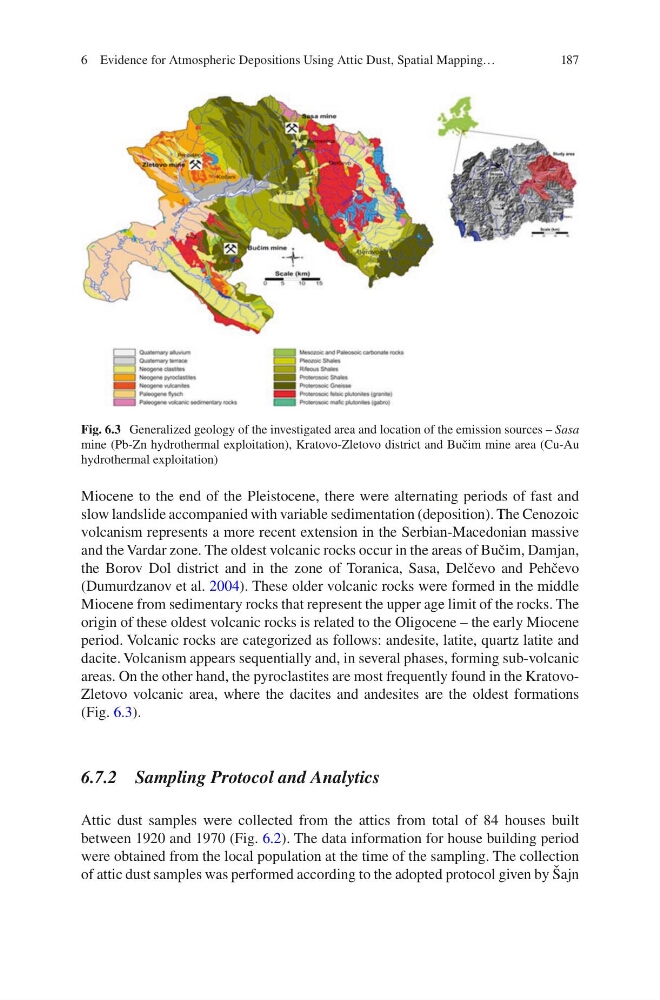
areas. On the other hand, the pyroclastites are most frequently found in the KratovoZletovo volcanic area, where the dacites and andesites are the oldest formations
(Fig. 6.3).
6.7.2 Sampling Protocol and Analytics
Attic dust samples were collected from the attics from total of 84 houses built
between 1920 and 1970 (Fig. 6.2). The data information for house building period
were obtained from the local population at the time of the sampling. The collection
of attic dust samples was performed according to the adopted protocol given by Šajn
Fig. 6.3 Generalized geology of the investigated area and location of the emission sources – Sasa
mine (Pb-Zn hydrothermal exploitation), Kratovo-Zletovo district and Bučim mine area (Cu-Au
hydrothermal exploitation)
6 Evidence for Atmospheric Depositions Using Attic Dust, Spatial Mapping…
Miocene to the end of the Pleistocene, there were alternating periods of fast and
slow landslide accompanied with variable sedimentation (deposition). The Cenozoic
volcanism represents a more recent extension in the Serbian-Macedonian massive
and the Vardar zone. The oldest volcanic rocks occur in the areas of Bučim, Damjan,
the Borov Dol district and in the zone of Toranica, Sasa, Delčevo and Pehčevo
(Dumurdzanov et al. 2004). These older volcanic rocks were formed in the middle
Miocene from sedimentary rocks that represent the upper age limit of the rocks. The
origin of these oldest volcanic rocks is related to the Oligocene – the early Miocene
period. Volcanic rocks are categorized as follows: andesite, latite, quartz latite and
dacite. Volcanism appears sequentially and, in several phases, forming sub-volcanic
areas. On the other hand, the pyroclastites are most frequently found in the KratovoZletovo volcanic area, where the dacites and andesites are the oldest formations
(Fig. 6.3).
6.7.2 Sampling Protocol and Analytics
Attic dust samples were collected from the attics from total of 84 houses built
between 1920 and 1970 (Fig. 6.2). The data information for house building period
were obtained from the local population at the time of the sampling. The collection
of attic dust samples was performed according to the adopted protocol given by Šajn
Fig. 6.3 Generalized geology of the investigated area and location of the emission sources – Sasa
mine (Pb-Zn hydrothermal exploitation), Kratovo-Zletovo district and Bučim mine area (Cu-Au
hydrothermal exploitation)
6 Evidence for Atmospheric Depositions Using Attic Dust, Spatial Mapping…