

Greenhouse Gas Emissions from Municipal Solid Waste Management …
133
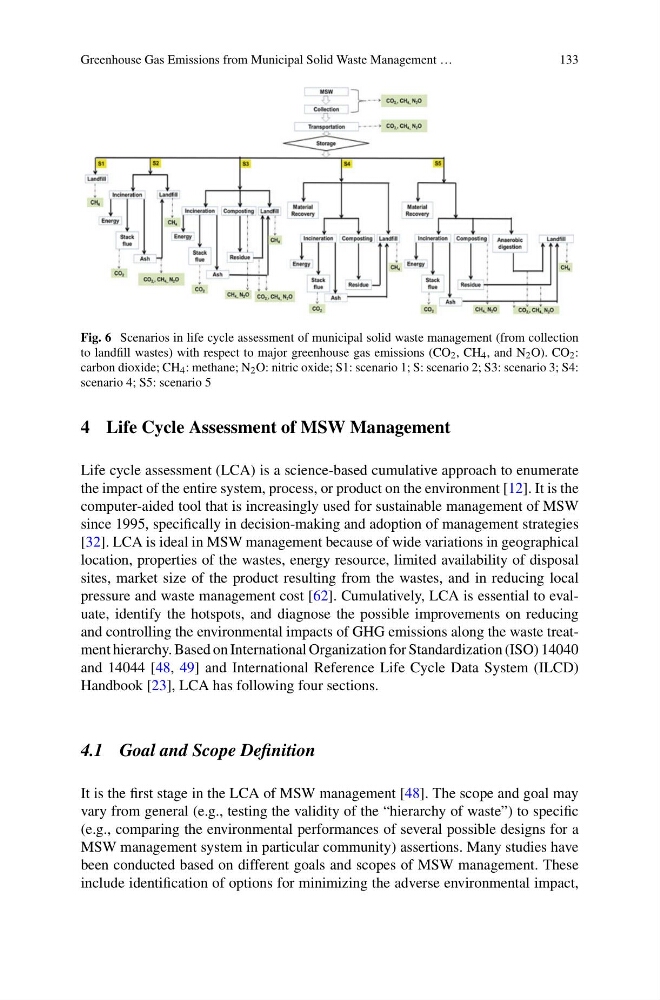
Fig. 6 Scenarios in life cycle assessment of municipal solid waste management (from collection
to landfill wastes) with respect to major greenhouse gas emissions (CO 2 , CH 4 , and N 2 O). CO 2 :
carbon dioxide; CH 4 : methane; N 2 O: nitric oxide; S1: scenario 1; S: scenario 2; S3: scenario 3; S4:
scenario 4; S5: scenario 5
4 Life Cycle Assessment of MSW Management
Life cycle assessment (LCA) is a science-based cumulative approach to enumerate
the impact of the entire system, process, or product on the environment [12]. It is the
computer-aided tool that is increasingly used for sustainable management of MSW
since 1995, specifically in decision-making and adoption of management strategies
[32]. LCA is ideal in MSW management because of wide variations in geographical
location, properties of the wastes, energy resource, limited availability of disposal
sites, market size of the product resulting from the wastes, and in reducing local
pressure and waste management cost [62]. Cumulatively, LCA is essential to evaluate, identify the hotspots, and diagnose the possible improvements on reducing
and controlling the environmental impacts of GHG emissions along the waste treatment hierarchy. Based on International Organization for Standardization (ISO) 14040
and 14044 [48, 49] and International Reference Life Cycle Data System (ILCD)
Handbook [23], LCA has following four sections.
4.1 Goal and Scope Definition
It is the first stage in the LCA of MSW management [48]. The scope and goal may
vary from general (e.g., testing the validity of the “hierarchy of waste”) to specific
(e.g., comparing the environmental performances of several possible designs for a
MSW management system in particular community) assertions. Many studies have
been conducted based on different goals and scopes of MSW management. These
include identification of options for minimizing the adverse environmental impact,
133
Fig. 6 Scenarios in life cycle assessment of municipal solid waste management (from collection
to landfill wastes) with respect to major greenhouse gas emissions (CO 2 , CH 4 , and N 2 O). CO 2 :
carbon dioxide; CH 4 : methane; N 2 O: nitric oxide; S1: scenario 1; S: scenario 2; S3: scenario 3; S4:
scenario 4; S5: scenario 5
4 Life Cycle Assessment of MSW Management
Life cycle assessment (LCA) is a science-based cumulative approach to enumerate
the impact of the entire system, process, or product on the environment [12]. It is the
computer-aided tool that is increasingly used for sustainable management of MSW
since 1995, specifically in decision-making and adoption of management strategies
[32]. LCA is ideal in MSW management because of wide variations in geographical
location, properties of the wastes, energy resource, limited availability of disposal
sites, market size of the product resulting from the wastes, and in reducing local
pressure and waste management cost [62]. Cumulatively, LCA is essential to evaluate, identify the hotspots, and diagnose the possible improvements on reducing
and controlling the environmental impacts of GHG emissions along the waste treatment hierarchy. Based on International Organization for Standardization (ISO) 14040
and 14044 [48, 49] and International Reference Life Cycle Data System (ILCD)
Handbook [23], LCA has following four sections.
4.1 Goal and Scope Definition
It is the first stage in the LCA of MSW management [48]. The scope and goal may
vary from general (e.g., testing the validity of the “hierarchy of waste”) to specific
(e.g., comparing the environmental performances of several possible designs for a
MSW management system in particular community) assertions. Many studies have
been conducted based on different goals and scopes of MSW management. These
include identification of options for minimizing the adverse environmental impact,