

Greenhouse Gas Emissions from Municipal Solid Waste Management …
131
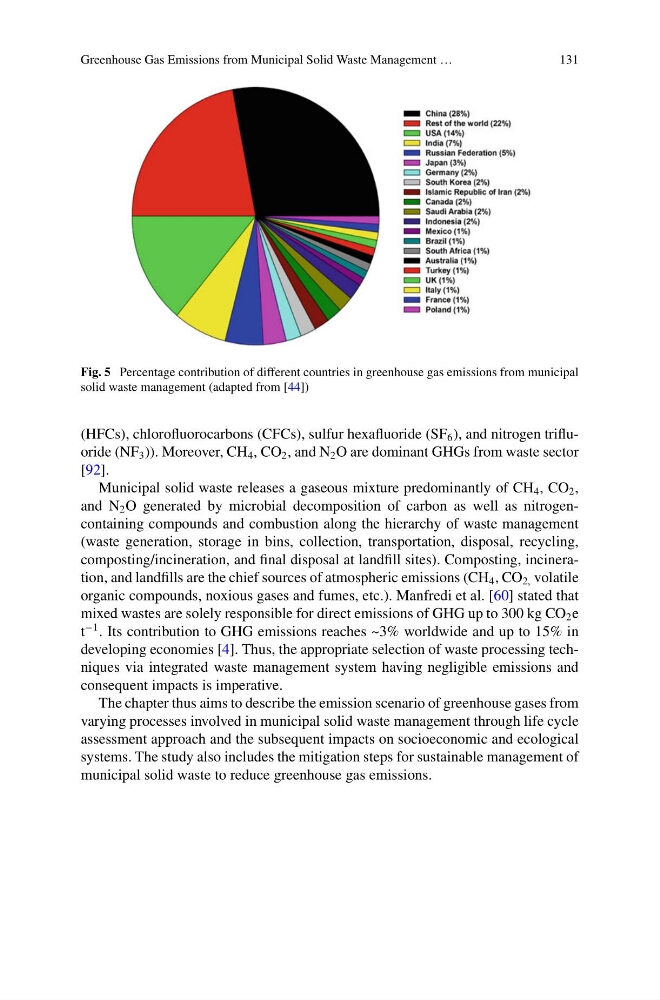
Fig. 5 Percentage contribution of different countries in greenhouse gas emissions from municipal
solid waste management (adapted from [44])
(HFCs), chlorofluorocarbons (CFCs), sulfur hexafluoride (SF 6 ), and nitrogen trifluoride (NF 3 )). Moreover, CH 4 , CO 2 , and N 2 O are dominant GHGs from waste sector
[92].
Municipal solid waste releases a gaseous mixture predominantly of CH 4 , CO 2 ,
and N 2 O generated by microbial decomposition of carbon as well as nitrogencontaining compounds and combustion along the hierarchy of waste management
(waste generation, storage in bins, collection, transportation, disposal, recycling,
composting/incineration, and final disposal at landfill sites). Composting, incineration, and landfills are the chief sources of atmospheric emissions (CH 4 , CO 2, volatile
organic compounds, noxious gases and fumes, etc.). Manfredi et al. [60] stated that
mixed wastes are solely responsible for direct emissions of GHG up to 300 kg CO 2 e
t
−1 . Its contribution to GHG emissions reaches ~3% worldwide and up to 15% in
developing economies [4]. Thus, the appropriate selection of waste processing techniques via integrated waste management system having negligible emissions and
consequent impacts is imperative.
The chapter thus aims to describe the emission scenario of greenhouse gases from
varying processes involved in municipal solid waste management through life cycle
assessment approach and the subsequent impacts on socioeconomic and ecological
systems. The study also includes the mitigation steps for sustainable management of
municipal solid waste to reduce greenhouse gas emissions.
131
Fig. 5 Percentage contribution of different countries in greenhouse gas emissions from municipal
solid waste management (adapted from [44])
(HFCs), chlorofluorocarbons (CFCs), sulfur hexafluoride (SF 6 ), and nitrogen trifluoride (NF 3 )). Moreover, CH 4 , CO 2 , and N 2 O are dominant GHGs from waste sector
[92].
Municipal solid waste releases a gaseous mixture predominantly of CH 4 , CO 2 ,
and N 2 O generated by microbial decomposition of carbon as well as nitrogencontaining compounds and combustion along the hierarchy of waste management
(waste generation, storage in bins, collection, transportation, disposal, recycling,
composting/incineration, and final disposal at landfill sites). Composting, incineration, and landfills are the chief sources of atmospheric emissions (CH 4 , CO 2, volatile
organic compounds, noxious gases and fumes, etc.). Manfredi et al. [60] stated that
mixed wastes are solely responsible for direct emissions of GHG up to 300 kg CO 2 e
t
−1 . Its contribution to GHG emissions reaches ~3% worldwide and up to 15% in
developing economies [4]. Thus, the appropriate selection of waste processing techniques via integrated waste management system having negligible emissions and
consequent impacts is imperative.
The chapter thus aims to describe the emission scenario of greenhouse gases from
varying processes involved in municipal solid waste management through life cycle
assessment approach and the subsequent impacts on socioeconomic and ecological
systems. The study also includes the mitigation steps for sustainable management of
municipal solid waste to reduce greenhouse gas emissions.