

124
M. Gautam and M. Agrawal
Keywords GHGs · Global · Life cycle assessment · Methane · Municipal solid
waste management · Mitigation
1 Introduction
Solid waste refers to any unwanted solid materials of everyday use that are generated by community activities. Of the total solid waste generated worldwide, ~70%
constitute municipal solid waste (MSW) [78]. Increase in population and prosperity
are the two critical drivers for waste generation, thereby making MSW management
one of the key challenges of the twenty-first century [22]. Globally around 2.01
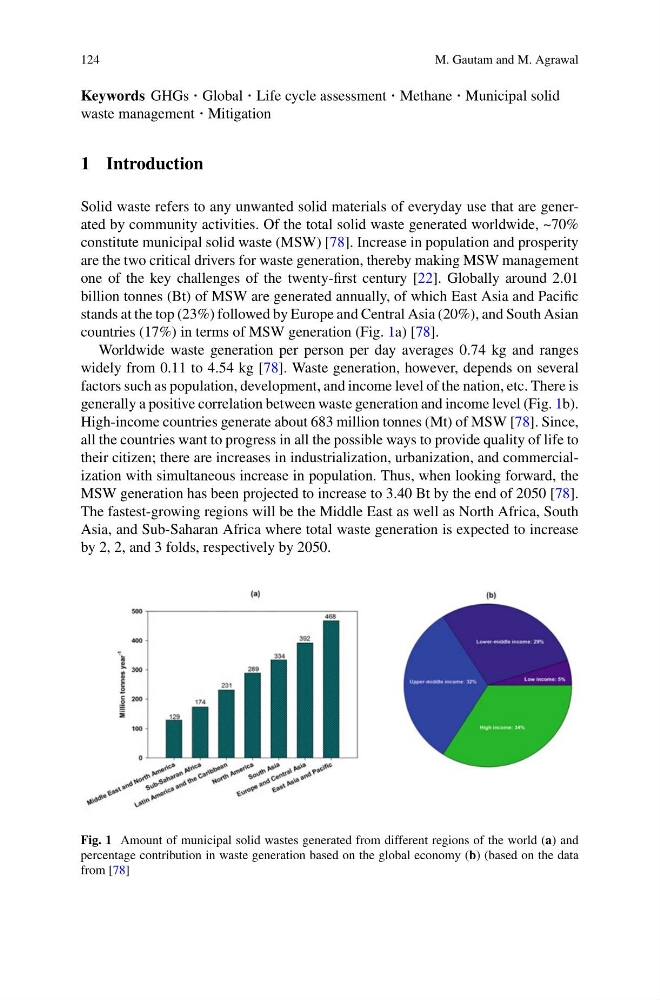
billion tonnes (Bt) of MSW are generated annually, of which East Asia and Pacific
stands at the top (23%) followed by Europe and Central Asia (20%), and South Asian
countries (17%) in terms of MSW generation (Fig. 1a) [78].
Worldwide waste generation per person per day averages 0.74 kg and ranges
widely from 0.11 to 4.54 kg [78]. Waste generation, however, depends on several
factors such as population, development, and income level of the nation, etc. There is
generally a positive correlation between waste generation and income level (Fig. 1b).
High-income countries generate about 683 million tonnes (Mt) of MSW [78]. Since,
all the countries want to progress in all the possible ways to provide quality of life to
their citizen; there are increases in industrialization, urbanization, and commercialization with simultaneous increase in population. Thus, when looking forward, the
MSW generation has been projected to increase to 3.40 Bt by the end of 2050 [78].
The fastest-growing regions will be the Middle East as well as North Africa, South
Asia, and Sub-Saharan Africa where total waste generation is expected to increase
by 2, 2, and 3 folds, respectively by 2050.
Fig. 1 Amount of municipal solid wastes generated from different regions of the world (a) and
percentage contribution in waste generation based on the global economy (b) (based on the data
from [78]
M. Gautam and M. Agrawal
Keywords GHGs · Global · Life cycle assessment · Methane · Municipal solid
waste management · Mitigation
1 Introduction
Solid waste refers to any unwanted solid materials of everyday use that are generated by community activities. Of the total solid waste generated worldwide, ~70%
constitute municipal solid waste (MSW) [78]. Increase in population and prosperity
are the two critical drivers for waste generation, thereby making MSW management
one of the key challenges of the twenty-first century [22]. Globally around 2.01
billion tonnes (Bt) of MSW are generated annually, of which East Asia and Pacific
stands at the top (23%) followed by Europe and Central Asia (20%), and South Asian
countries (17%) in terms of MSW generation (Fig. 1a) [78].
Worldwide waste generation per person per day averages 0.74 kg and ranges
widely from 0.11 to 4.54 kg [78]. Waste generation, however, depends on several
factors such as population, development, and income level of the nation, etc. There is
generally a positive correlation between waste generation and income level (Fig. 1b).
High-income countries generate about 683 million tonnes (Mt) of MSW [78]. Since,
all the countries want to progress in all the possible ways to provide quality of life to
their citizen; there are increases in industrialization, urbanization, and commercialization with simultaneous increase in population. Thus, when looking forward, the
MSW generation has been projected to increase to 3.40 Bt by the end of 2050 [78].
The fastest-growing regions will be the Middle East as well as North Africa, South
Asia, and Sub-Saharan Africa where total waste generation is expected to increase
by 2, 2, and 3 folds, respectively by 2050.
Fig. 1 Amount of municipal solid wastes generated from different regions of the world (a) and
percentage contribution in waste generation based on the global economy (b) (based on the data
from [78]