

74
V. Nawandar et al.
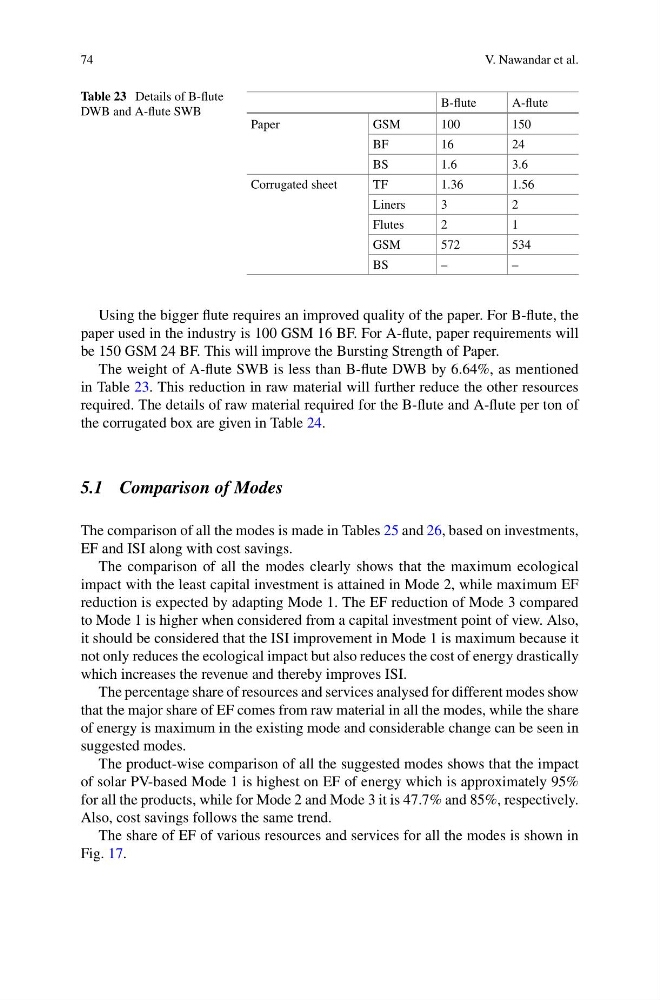
Table 23 Details of B-flute
DWB and A-flute SWB
B-flute
A-flute
Paper
GSM
100
150
BF
16
24
BS
1.6
3.6
Corrugated sheet
TF
1.36
1.56
Liners
3
2
Flutes
2
1
GSM
572
534
BS
–
–
Using the bigger flute requires an improved quality of the paper. For B-flute, the
paper used in the industry is 100 GSM 16 BF. For A-flute, paper requirements will
be 150 GSM 24 BF. This will improve the Bursting Strength of Paper.
The weight of A-flute SWB is less than B-flute DWB by 6.64%, as mentioned
in Table 23. This reduction in raw material will further reduce the other resources
required. The details of raw material required for the B-flute and A-flute per ton of
the corrugated box are given in Table 24.
5.1 Comparison of Modes
The comparison of all the modes is made in Tables 25 and 26, based on investments,
EF and ISI along with cost savings.
The comparison of all the modes clearly shows that the maximum ecological
impact with the least capital investment is attained in Mode 2, while maximum EF
reduction is expected by adapting Mode 1. The EF reduction of Mode 3 compared
to Mode 1 is higher when considered from a capital investment point of view. Also,
it should be considered that the ISI improvement in Mode 1 is maximum because it
not only reduces the ecological impact but also reduces the cost of energy drastically
which increases the revenue and thereby improves ISI.
The percentage share of resources and services analysed for different modes show
that the major share of EF comes from raw material in all the modes, while the share
of energy is maximum in the existing mode and considerable change can be seen in
suggested modes.
The product-wise comparison of all the suggested modes shows that the impact
of solar PV-based Mode 1 is highest on EF of energy which is approximately 95%
for all the products, while for Mode 2 and Mode 3 it is 47.7% and 85%, respectively.
Also, cost savings follows the same trend.
The share of EF of various resources and services for all the modes is shown in
Fig. 17.
V. Nawandar et al.
Table 23 Details of B-flute
DWB and A-flute SWB
B-flute
A-flute
Paper
GSM
100
150
BF
16
24
BS
1.6
3.6
Corrugated sheet
TF
1.36
1.56
Liners
3
2
Flutes
2
1
GSM
572
534
BS
–
–
Using the bigger flute requires an improved quality of the paper. For B-flute, the
paper used in the industry is 100 GSM 16 BF. For A-flute, paper requirements will
be 150 GSM 24 BF. This will improve the Bursting Strength of Paper.
The weight of A-flute SWB is less than B-flute DWB by 6.64%, as mentioned
in Table 23. This reduction in raw material will further reduce the other resources
required. The details of raw material required for the B-flute and A-flute per ton of
the corrugated box are given in Table 24.
5.1 Comparison of Modes
The comparison of all the modes is made in Tables 25 and 26, based on investments,
EF and ISI along with cost savings.
The comparison of all the modes clearly shows that the maximum ecological
impact with the least capital investment is attained in Mode 2, while maximum EF
reduction is expected by adapting Mode 1. The EF reduction of Mode 3 compared
to Mode 1 is higher when considered from a capital investment point of view. Also,
it should be considered that the ISI improvement in Mode 1 is maximum because it
not only reduces the ecological impact but also reduces the cost of energy drastically
which increases the revenue and thereby improves ISI.
The percentage share of resources and services analysed for different modes show
that the major share of EF comes from raw material in all the modes, while the share
of energy is maximum in the existing mode and considerable change can be seen in
suggested modes.
The product-wise comparison of all the suggested modes shows that the impact
of solar PV-based Mode 1 is highest on EF of energy which is approximately 95%
for all the products, while for Mode 2 and Mode 3 it is 47.7% and 85%, respectively.
Also, cost savings follows the same trend.
The share of EF of various resources and services for all the modes is shown in
Fig. 17.