

4
C. Rivero-Camacho et al.
to extract the impact points and the conclusions of the research work carried out
according to the objectives set for calculating total impact of BLC with EF indicator.
2 LCA and EF Applied to the Building
To measure the interaction of the building with the environment and to identify the
load balance between all stages of a building’s service period, life cycle analyses
(LCA) are recommended. LCAs are regulated by the international standards ISO
14040 [20] and ISO 14044 [21]. By taking into account all the flows exchanged
between the product/system under analysis and the environment, LCAs provide an
overview of the environmental performance of the object under study and help to
support circularity between the different product systems. It has been widely applied
in the construction sector and is increasingly used as an advocate for decisionmaking at all levels of the built environment, material [22, 23], systems [24, 25],
entire buildings [26, 27] and neighbourhoods [28, 29]. It is true that the application of LCA methodologies to the construction sector is complicated and varies
according to several studies, this is due to the fact that existing standards have not
been able to establish an exact methodology, and therefore researchers, use their own
interpretations of these standards [30].
A large number of studies strive to estimate the environmental impact of buildings
[31] have been presented in several reviews focusing on LCA [32], life cycle energy
analysis [33] or CF of the BLC [34], or a combination of these [35, 36]. There are
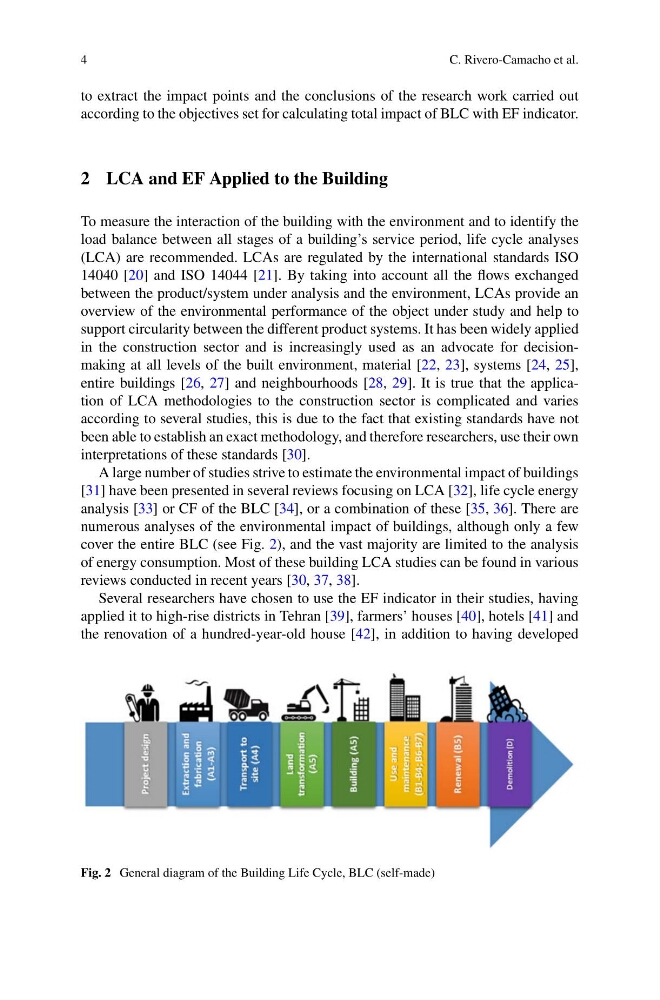
numerous analyses of the environmental impact of buildings, although only a few
cover the entire BLC (see Fig. 2), and the vast majority are limited to the analysis
of energy consumption. Most of these building LCA studies can be found in various
reviews conducted in recent years [30, 37, 38].
Several researchers have chosen to use the EF indicator in their studies, having
applied it to high-rise districts in Tehran [39], farmers’ houses [40], hotels [41] and
the renovation of a hundred-year-old house [42], in addition to having developed
Fig. 2 General diagram of the Building Life Cycle, BLC (self-made)
C. Rivero-Camacho et al.
to extract the impact points and the conclusions of the research work carried out
according to the objectives set for calculating total impact of BLC with EF indicator.
2 LCA and EF Applied to the Building
To measure the interaction of the building with the environment and to identify the
load balance between all stages of a building’s service period, life cycle analyses
(LCA) are recommended. LCAs are regulated by the international standards ISO
14040 [20] and ISO 14044 [21]. By taking into account all the flows exchanged
between the product/system under analysis and the environment, LCAs provide an
overview of the environmental performance of the object under study and help to
support circularity between the different product systems. It has been widely applied
in the construction sector and is increasingly used as an advocate for decisionmaking at all levels of the built environment, material [22, 23], systems [24, 25],
entire buildings [26, 27] and neighbourhoods [28, 29]. It is true that the application of LCA methodologies to the construction sector is complicated and varies
according to several studies, this is due to the fact that existing standards have not
been able to establish an exact methodology, and therefore researchers, use their own
interpretations of these standards [30].
A large number of studies strive to estimate the environmental impact of buildings
[31] have been presented in several reviews focusing on LCA [32], life cycle energy
analysis [33] or CF of the BLC [34], or a combination of these [35, 36]. There are
numerous analyses of the environmental impact of buildings, although only a few
cover the entire BLC (see Fig. 2), and the vast majority are limited to the analysis
of energy consumption. Most of these building LCA studies can be found in various
reviews conducted in recent years [30, 37, 38].
Several researchers have chosen to use the EF indicator in their studies, having
applied it to high-rise districts in Tehran [39], farmers’ houses [40], hotels [41] and
the renovation of a hundred-year-old house [42], in addition to having developed
Fig. 2 General diagram of the Building Life Cycle, BLC (self-made)