

76
E. A. Zaghloul
2.2 Deir al-Hagar Ancient Water Supply System
Archaeological investigation had identified evidence of irrigation in Mesopotamia
and Egypt as far back as the 6th millennium BC when barley was grown in areas where
the natural rainfall was insufficient to support such a crop. Zaghloul et al. (2013) used
the term Ancient Irrigation Canals to describe these canals. In the present work, the
author prefers to use the term Ancient Water Supply System which represents how
people bring the water from the natural flowing spring in the south for the irrigation
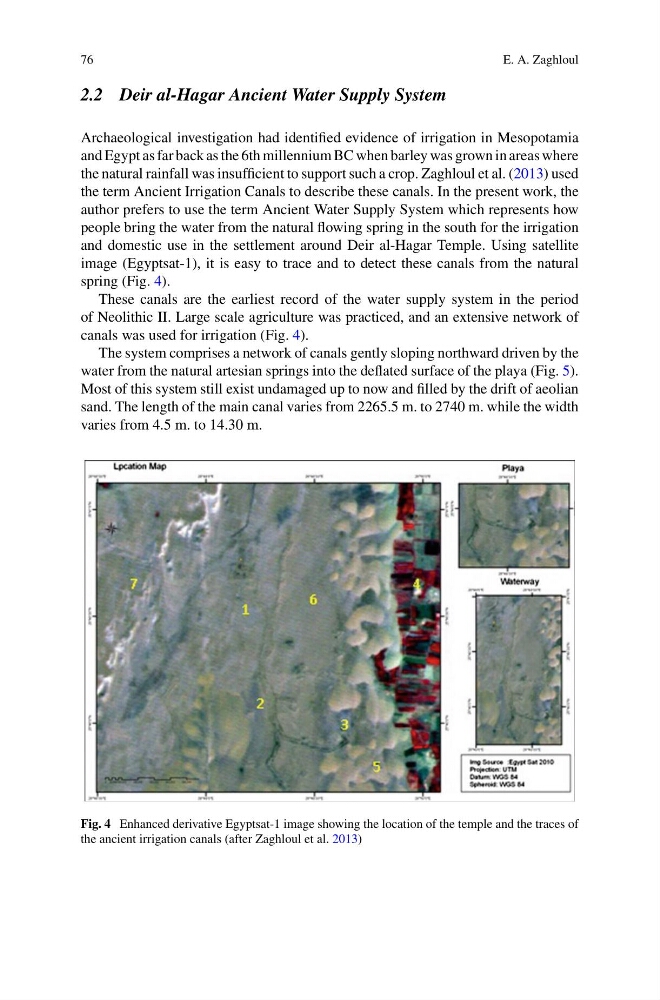
and domestic use in the settlement around Deir al-Hagar Temple. Using satellite
image (Egyptsat-1), it is easy to trace and to detect these canals from the natural
spring (Fig. 4).
These canals are the earliest record of the water supply system in the period
of Neolithic II. Large scale agriculture was practiced, and an extensive network of
canals was used for irrigation (Fig. 4).
The system comprises a network of canals gently sloping northward driven by the
water from the natural artesian springs into the deflated surface of the playa (Fig. 5).
Most of this system still exist undamaged up to now and filled by the drift of aeolian
sand. The length of the main canal varies from 2265.5 m. to 2740 m. while the width
varies from 4.5 m. to 14.30 m.
Fig. 4 Enhanced derivative Egyptsat-1 image showing the location of the temple and the traces of
the ancient irrigation canals (after Zaghloul et al. 2013)
E. A. Zaghloul
2.2 Deir al-Hagar Ancient Water Supply System
Archaeological investigation had identified evidence of irrigation in Mesopotamia
and Egypt as far back as the 6th millennium BC when barley was grown in areas where
the natural rainfall was insufficient to support such a crop. Zaghloul et al. (2013) used
the term Ancient Irrigation Canals to describe these canals. In the present work, the
author prefers to use the term Ancient Water Supply System which represents how
people bring the water from the natural flowing spring in the south for the irrigation
and domestic use in the settlement around Deir al-Hagar Temple. Using satellite
image (Egyptsat-1), it is easy to trace and to detect these canals from the natural
spring (Fig. 4).
These canals are the earliest record of the water supply system in the period
of Neolithic II. Large scale agriculture was practiced, and an extensive network of
canals was used for irrigation (Fig. 4).
The system comprises a network of canals gently sloping northward driven by the
water from the natural artesian springs into the deflated surface of the playa (Fig. 5).
Most of this system still exist undamaged up to now and filled by the drift of aeolian
sand. The length of the main canal varies from 2265.5 m. to 2740 m. while the width
varies from 4.5 m. to 14.30 m.
Fig. 4 Enhanced derivative Egyptsat-1 image showing the location of the temple and the traces of
the ancient irrigation canals (after Zaghloul et al. 2013)