

186
S. F. Elbeih and E. A. Zaghloul
Sustainable development and agricultural progress in Dakhla Oasis have been
lagging behind expectations. The flood irrigation practices and poor water-use efficiency has negative impacts on the agricultural sustainable developmental projects.
Most of the irrigation canals and ditches in the oasis are open and unlined. This means
that seepage and evaporation in these canals increase the water loss. Drainage systems
are not working efficiently in many places, causing water logging, soil degradation
and salinity problems. Thus the sustainable water management in Dakhla Oasis and
in the New Valley is an issue of prime concern. New Valley Project was a part of the
socialist land reforms that aimed to integrate rural development with land reclamation
schemes (Kato and Iwasaki 2016).
The specific objectives of this chapter is to review the previous investigations of
the hydrogeologic conditions of the deep Nubian Sandstone aquifers in the Dakhla
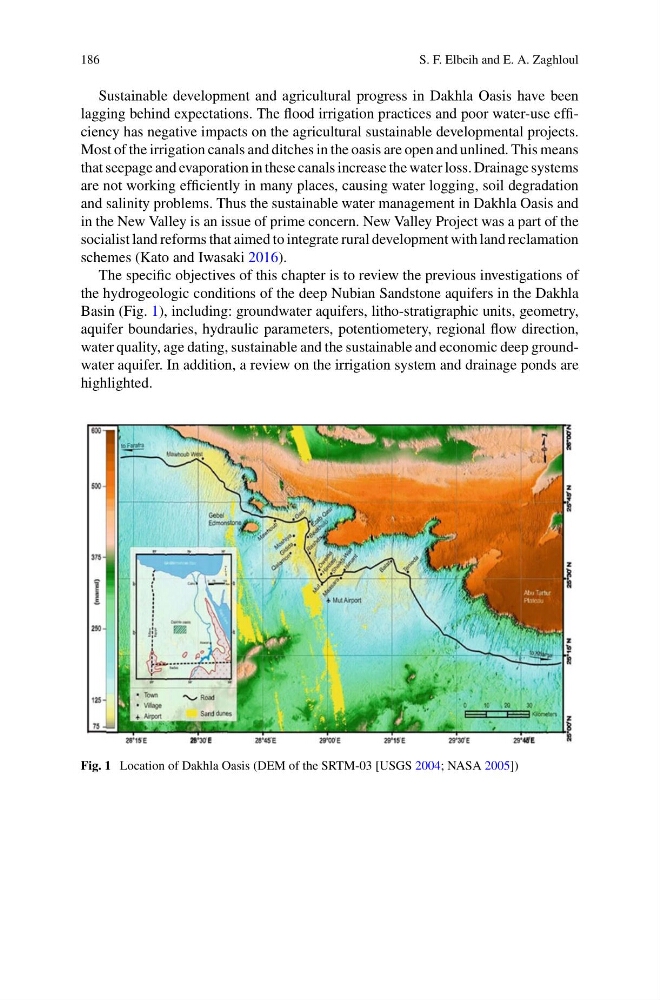
Basin (Fig. 1), including: groundwater aquifers, litho-stratigraphic units, geometry,
aquifer boundaries, hydraulic parameters, potentiometery, regional flow direction,
water quality, age dating, sustainable and the sustainable and economic deep groundwater aquifer. In addition, a review on the irrigation system and drainage ponds are
highlighted.
Fig. 1 Location of Dakhla Oasis (DEM of the SRTM-03 [USGS 2004; NASA 2005])
S. F. Elbeih and E. A. Zaghloul
Sustainable development and agricultural progress in Dakhla Oasis have been
lagging behind expectations. The flood irrigation practices and poor water-use efficiency has negative impacts on the agricultural sustainable developmental projects.
Most of the irrigation canals and ditches in the oasis are open and unlined. This means
that seepage and evaporation in these canals increase the water loss. Drainage systems
are not working efficiently in many places, causing water logging, soil degradation
and salinity problems. Thus the sustainable water management in Dakhla Oasis and
in the New Valley is an issue of prime concern. New Valley Project was a part of the
socialist land reforms that aimed to integrate rural development with land reclamation
schemes (Kato and Iwasaki 2016).
The specific objectives of this chapter is to review the previous investigations of
the hydrogeologic conditions of the deep Nubian Sandstone aquifers in the Dakhla
Basin (Fig. 1), including: groundwater aquifers, litho-stratigraphic units, geometry,
aquifer boundaries, hydraulic parameters, potentiometery, regional flow direction,
water quality, age dating, sustainable and the sustainable and economic deep groundwater aquifer. In addition, a review on the irrigation system and drainage ponds are
highlighted.
Fig. 1 Location of Dakhla Oasis (DEM of the SRTM-03 [USGS 2004; NASA 2005])