

Crop Diversification and Its Efficiency …
165
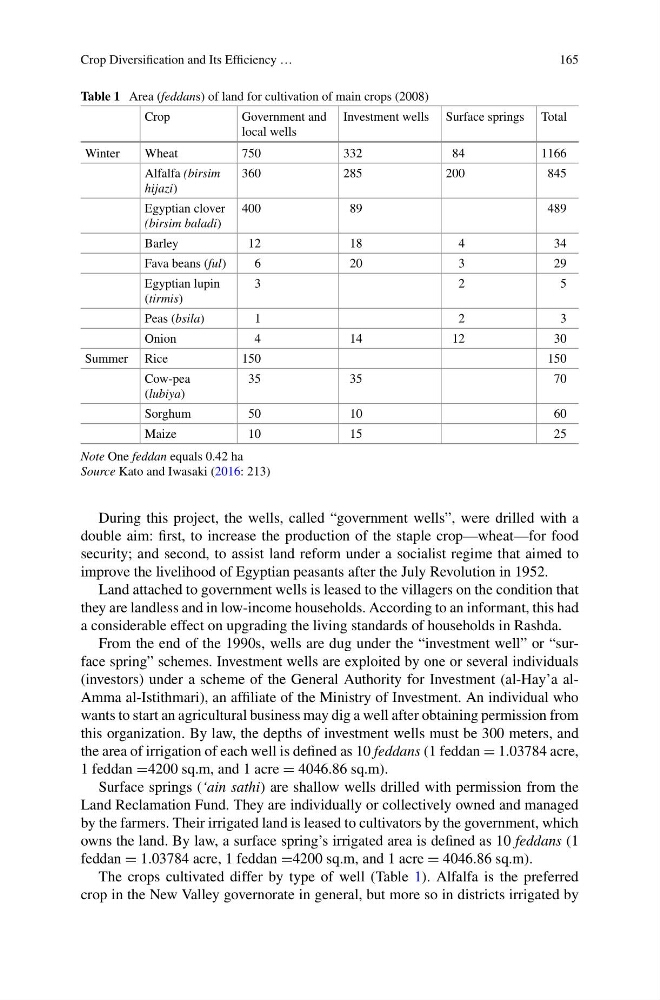
Table 1 Area (feddans) of land for cultivation of main crops (2008)
Crop
Government and
local wells
Investment wells Surface springs Total
Winter
Wheat
750
332
84
1166
Alfalfa (birsim
hijazi)
360
285
200
845
Egyptian clover
(birsim baladi)
400
89
489
Barley
12
18
4
34
Fava beans (ful)
6
20
3
29
Egyptian lupin
(tirmis)
3
2
5
Peas (bsila)
1
2
3
Onion
4
14
12
30
Summer Rice
150
150
Cow-pea
(lubiya)
35
35
70
Sorghum
50
10
60
Maize
10
15
25
Note One feddan equals 0.42 ha
Source Kato and Iwasaki (2016: 213)
During this project, the wells, called “government wells”, were drilled with a
double aim: first, to increase the production of the staple crop—wheat—for food
security; and second, to assist land reform under a socialist regime that aimed to
improve the livelihood of Egyptian peasants after the July Revolution in 1952.
Land attached to government wells is leased to the villagers on the condition that
they are landless and in low-income households. According to an informant, this had
a considerable effect on upgrading the living standards of households in Rashda.
From the end of the 1990s, wells are dug under the “investment well” or “surface spring” schemes. Investment wells are exploited by one or several individuals
(investors) under a scheme of the General Authority for Investment (al-Hay’a alAmma al-Istithmari), an affiliate of the Ministry of Investment. An individual who
wants to start an agricultural business may dig a well after obtaining permission from
this organization. By law, the depths of investment wells must be 300 meters, and
the area of irrigation of each well is defined as 10 feddans (1 feddan = 1.03784 acre,
1 feddan =4200 sq.m, and 1 acre = 4046.86 sq.m).
Surface springs (‘ain sathi) are shallow wells drilled with permission from the
Land Reclamation Fund. They are individually or collectively owned and managed
by the farmers. Their irrigated land is leased to cultivators by the government, which
owns the land. By law, a surface spring’s irrigated area is defined as 10 feddans (1
feddan = 1.03784 acre, 1 feddan =4200 sq.m, and 1 acre = 4046.86 sq.m).
The crops cultivated differ by type of well (Table 1). Alfalfa is the preferred
crop in the New Valley governorate in general, but more so in districts irrigated by
165
Table 1 Area (feddans) of land for cultivation of main crops (2008)
Crop
Government and
local wells
Investment wells Surface springs Total
Winter
Wheat
750
332
84
1166
Alfalfa (birsim
hijazi)
360
285
200
845
Egyptian clover
(birsim baladi)
400
89
489
Barley
12
18
4
34
Fava beans (ful)
6
20
3
29
Egyptian lupin
(tirmis)
3
2
5
Peas (bsila)
1
2
3
Onion
4
14
12
30
Summer Rice
150
150
Cow-pea
(lubiya)
35
35
70
Sorghum
50
10
60
Maize
10
15
25
Note One feddan equals 0.42 ha
Source Kato and Iwasaki (2016: 213)
During this project, the wells, called “government wells”, were drilled with a
double aim: first, to increase the production of the staple crop—wheat—for food
security; and second, to assist land reform under a socialist regime that aimed to
improve the livelihood of Egyptian peasants after the July Revolution in 1952.
Land attached to government wells is leased to the villagers on the condition that
they are landless and in low-income households. According to an informant, this had
a considerable effect on upgrading the living standards of households in Rashda.
From the end of the 1990s, wells are dug under the “investment well” or “surface spring” schemes. Investment wells are exploited by one or several individuals
(investors) under a scheme of the General Authority for Investment (al-Hay’a alAmma al-Istithmari), an affiliate of the Ministry of Investment. An individual who
wants to start an agricultural business may dig a well after obtaining permission from
this organization. By law, the depths of investment wells must be 300 meters, and
the area of irrigation of each well is defined as 10 feddans (1 feddan = 1.03784 acre,
1 feddan =4200 sq.m, and 1 acre = 4046.86 sq.m).
Surface springs (‘ain sathi) are shallow wells drilled with permission from the
Land Reclamation Fund. They are individually or collectively owned and managed
by the farmers. Their irrigated land is leased to cultivators by the government, which
owns the land. By law, a surface spring’s irrigated area is defined as 10 feddans (1
feddan = 1.03784 acre, 1 feddan =4200 sq.m, and 1 acre = 4046.86 sq.m).
The crops cultivated differ by type of well (Table 1). Alfalfa is the preferred
crop in the New Valley governorate in general, but more so in districts irrigated by