

Soil Conditions of Dakhla Oasis, Western Desert, Egypt
135
5 Soil Characteristics of Dakhla Oasis
Hamed and Khalafallah (2017) studied available nutrients and some soil properties
of Qasr Village in Dakhla Oasis. The study stated that the texture class was varied
from loamy sand to clay texture. Sand content ranged from 28 to 89 while silt from 4
to 37 and clay from 7 to 47%. The bulk density was ranged from 1.22 to 1.73 g/cm
3
with a mean of 1.42 g/cm
3 . The saturation percentage was ranged from 16 to 76%,
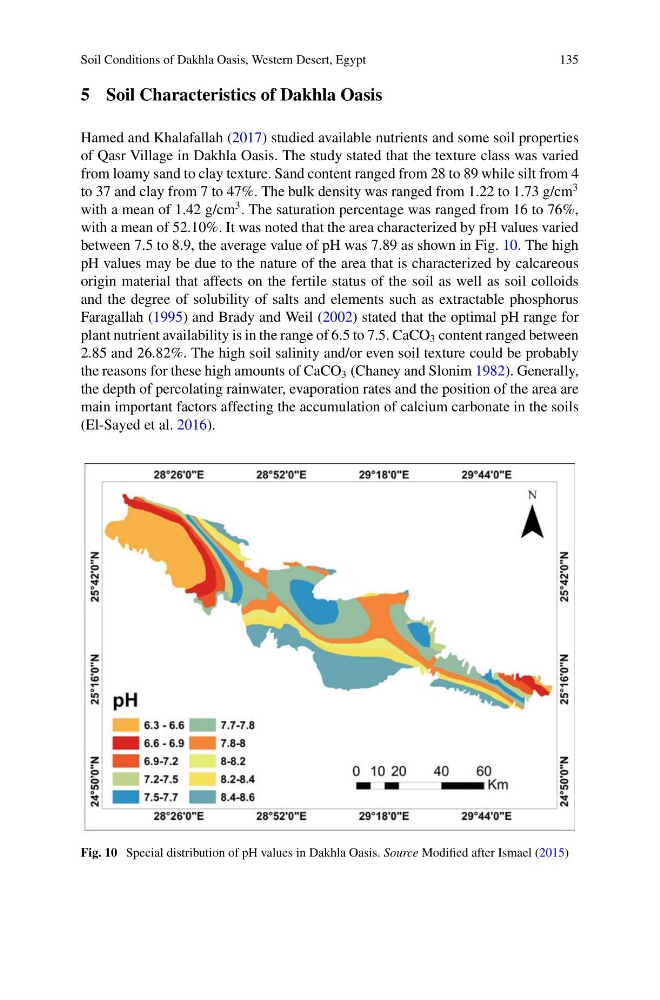
with a mean of 52.10%. It was noted that the area characterized by pH values varied
between 7.5 to 8.9, the average value of pH was 7.89 as shown in Fig. 10. The high
pH values may be due to the nature of the area that is characterized by calcareous
origin material that affects on the fertile status of the soil as well as soil colloids
and the degree of solubility of salts and elements such as extractable phosphorus
Faragallah (1995) and Brady and Weil (2002) stated that the optimal pH range for
plant nutrient availability is in the range of 6.5 to 7.5. CaCO 3 content ranged between
2.85 and 26.82%. The high soil salinity and/or even soil texture could be probably
the reasons for these high amounts of CaCO 3 (Chaney and Slonim 1982). Generally,
the depth of percolating rainwater, evaporation rates and the position of the area are
main important factors affecting the accumulation of calcium carbonate in the soils
(El-Sayed et al. 2016).
Fig. 10 Special distribution of pH values in Dakhla Oasis. Source Modified after Ismael (2015)
135
5 Soil Characteristics of Dakhla Oasis
Hamed and Khalafallah (2017) studied available nutrients and some soil properties
of Qasr Village in Dakhla Oasis. The study stated that the texture class was varied
from loamy sand to clay texture. Sand content ranged from 28 to 89 while silt from 4
to 37 and clay from 7 to 47%. The bulk density was ranged from 1.22 to 1.73 g/cm
3
with a mean of 1.42 g/cm
3 . The saturation percentage was ranged from 16 to 76%,
with a mean of 52.10%. It was noted that the area characterized by pH values varied
between 7.5 to 8.9, the average value of pH was 7.89 as shown in Fig. 10. The high
pH values may be due to the nature of the area that is characterized by calcareous
origin material that affects on the fertile status of the soil as well as soil colloids
and the degree of solubility of salts and elements such as extractable phosphorus
Faragallah (1995) and Brady and Weil (2002) stated that the optimal pH range for
plant nutrient availability is in the range of 6.5 to 7.5. CaCO 3 content ranged between
2.85 and 26.82%. The high soil salinity and/or even soil texture could be probably
the reasons for these high amounts of CaCO 3 (Chaney and Slonim 1982). Generally,
the depth of percolating rainwater, evaporation rates and the position of the area are
main important factors affecting the accumulation of calcium carbonate in the soils
(El-Sayed et al. 2016).
Fig. 10 Special distribution of pH values in Dakhla Oasis. Source Modified after Ismael (2015)