

118
A. M. Sharaky
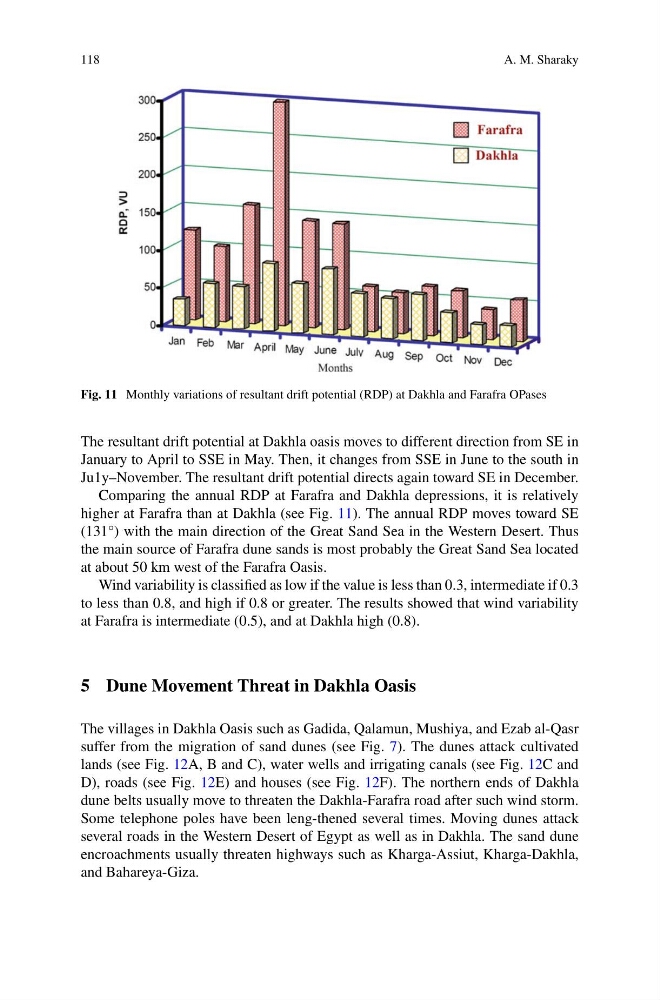
Fig. 11 Monthly variations of resultant drift potential (RDP) at Dakhla and Farafra OPases
The resultant drift potential at Dakhla oasis moves to different direction from SE in
January to April to SSE in May. Then, it changes from SSE in June to the south in
Ju1y–November. The resultant drift potential directs again toward SE in December.
Comparing the annual RDP at Farafra and Dakhla depressions, it is relatively
higher at Farafra than at Dakhla (see Fig. 11). The annual RDP moves toward SE
(131°) with the main direction of the Great Sand Sea in the Western Desert. Thus
the main source of Farafra dune sands is most probably the Great Sand Sea located
at about 50 km west of the Farafra Oasis.
Wind variability is classified as low if the value is less than 0.3, intermediate if 0.3
to less than 0.8, and high if 0.8 or greater. The results showed that wind variability
at Farafra is intermediate (0.5), and at Dakhla high (0.8).
5 Dune Movement Threat in Dakhla Oasis
The villages in Dakhla Oasis such as Gadida, Qalamun, Mushiya, and Ezab al-Qasr
suffer from the migration of sand dunes (see Fig. 7). The dunes attack cultivated
lands (see Fig. 12A, B and C), water wells and irrigating canals (see Fig. 12C and
D), roads (see Fig. 12E) and houses (see Fig. 12F). The northern ends of Dakhla
dune belts usually move to threaten the Dakhla-Farafra road after such wind storm.
Some telephone poles have been leng-thened several times. Moving dunes attack
several roads in the Western Desert of Egypt as well as in Dakhla. The sand dune
encroachments usually threaten highways such as Kharga-Assiut, Kharga-Dakhla,
and Bahareya-Giza.
A. M. Sharaky
Fig. 11 Monthly variations of resultant drift potential (RDP) at Dakhla and Farafra OPases
The resultant drift potential at Dakhla oasis moves to different direction from SE in
January to April to SSE in May. Then, it changes from SSE in June to the south in
Ju1y–November. The resultant drift potential directs again toward SE in December.
Comparing the annual RDP at Farafra and Dakhla depressions, it is relatively
higher at Farafra than at Dakhla (see Fig. 11). The annual RDP moves toward SE
(131°) with the main direction of the Great Sand Sea in the Western Desert. Thus
the main source of Farafra dune sands is most probably the Great Sand Sea located
at about 50 km west of the Farafra Oasis.
Wind variability is classified as low if the value is less than 0.3, intermediate if 0.3
to less than 0.8, and high if 0.8 or greater. The results showed that wind variability
at Farafra is intermediate (0.5), and at Dakhla high (0.8).
5 Dune Movement Threat in Dakhla Oasis
The villages in Dakhla Oasis such as Gadida, Qalamun, Mushiya, and Ezab al-Qasr
suffer from the migration of sand dunes (see Fig. 7). The dunes attack cultivated
lands (see Fig. 12A, B and C), water wells and irrigating canals (see Fig. 12C and
D), roads (see Fig. 12E) and houses (see Fig. 12F). The northern ends of Dakhla
dune belts usually move to threaten the Dakhla-Farafra road after such wind storm.
Some telephone poles have been leng-thened several times. Moving dunes attack
several roads in the Western Desert of Egypt as well as in Dakhla. The sand dune
encroachments usually threaten highways such as Kharga-Assiut, Kharga-Dakhla,
and Bahareya-Giza.