

106
A. M. Sharaky
2 Sand Dunes in Africa
Sand dune sand occupies more than 18% of the drylands in Africa. The major sand
dune types in Africa are linear and crescentic with some star dunes.
2.1 Sahara Dunes
The Sahara is the largest non-polar desert in the world, with a total size of 9.4 million
km
2 (Lancaster 1996). The rainfall in the Sahara is very low in the northern and
southern fringes, and nearly non-existent over the central and the eastern part. Most
of the areas in Sahara have rainfall below 20 mm. The Sahara Desert constitutes more
than 86% of the African deserts with high temperature and strong winds. Drifting
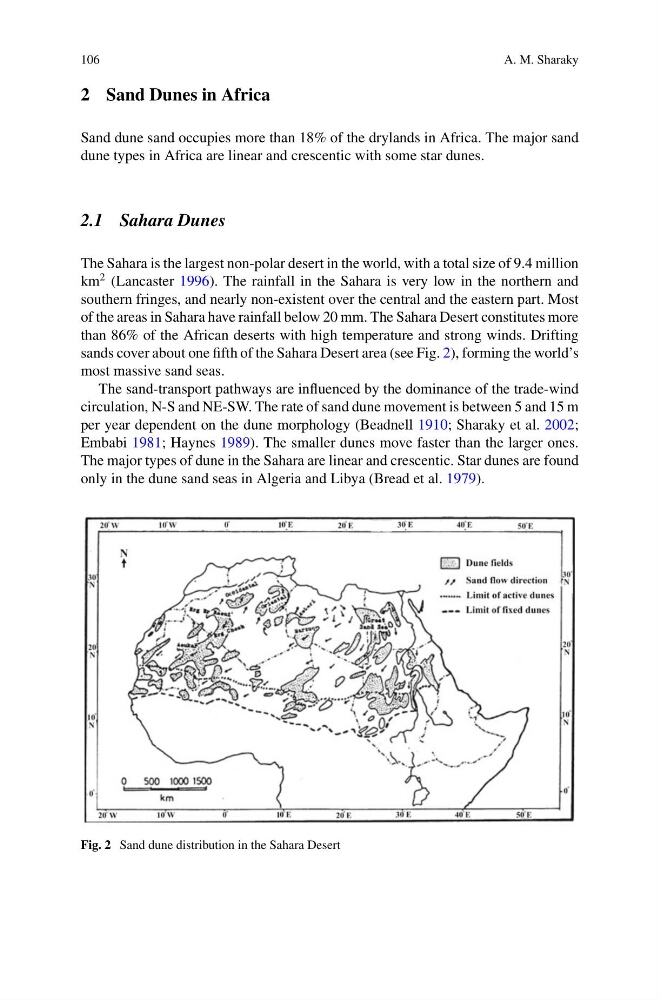
sands cover about one fifth of the Sahara Desert area (see Fig. 2), forming the world’s
most massive sand seas.
The sand-transport pathways are influenced by the dominance of the trade-wind
circulation, N-S and NE-SW. The rate of sand dune movement is between 5 and 15 m
per year dependent on the dune morphology (Beadnell 1910; Sharaky et al. 2002;
Embabi 1981; Haynes 1989). The smaller dunes move faster than the larger ones.
The major types of dune in the Sahara are linear and crescentic. Star dunes are found
only in the dune sand seas in Algeria and Libya (Bread et al. 1979).
Fig. 2 Sand dune distribution in the Sahara Desert
A. M. Sharaky
2 Sand Dunes in Africa
Sand dune sand occupies more than 18% of the drylands in Africa. The major sand
dune types in Africa are linear and crescentic with some star dunes.
2.1 Sahara Dunes
The Sahara is the largest non-polar desert in the world, with a total size of 9.4 million
km
2 (Lancaster 1996). The rainfall in the Sahara is very low in the northern and
southern fringes, and nearly non-existent over the central and the eastern part. Most
of the areas in Sahara have rainfall below 20 mm. The Sahara Desert constitutes more
than 86% of the African deserts with high temperature and strong winds. Drifting
sands cover about one fifth of the Sahara Desert area (see Fig. 2), forming the world’s
most massive sand seas.
The sand-transport pathways are influenced by the dominance of the trade-wind
circulation, N-S and NE-SW. The rate of sand dune movement is between 5 and 15 m
per year dependent on the dune morphology (Beadnell 1910; Sharaky et al. 2002;
Embabi 1981; Haynes 1989). The smaller dunes move faster than the larger ones.
The major types of dune in the Sahara are linear and crescentic. Star dunes are found
only in the dune sand seas in Algeria and Libya (Bread et al. 1979).
Fig. 2 Sand dune distribution in the Sahara Desert