

48
S. Iftekhar et al.
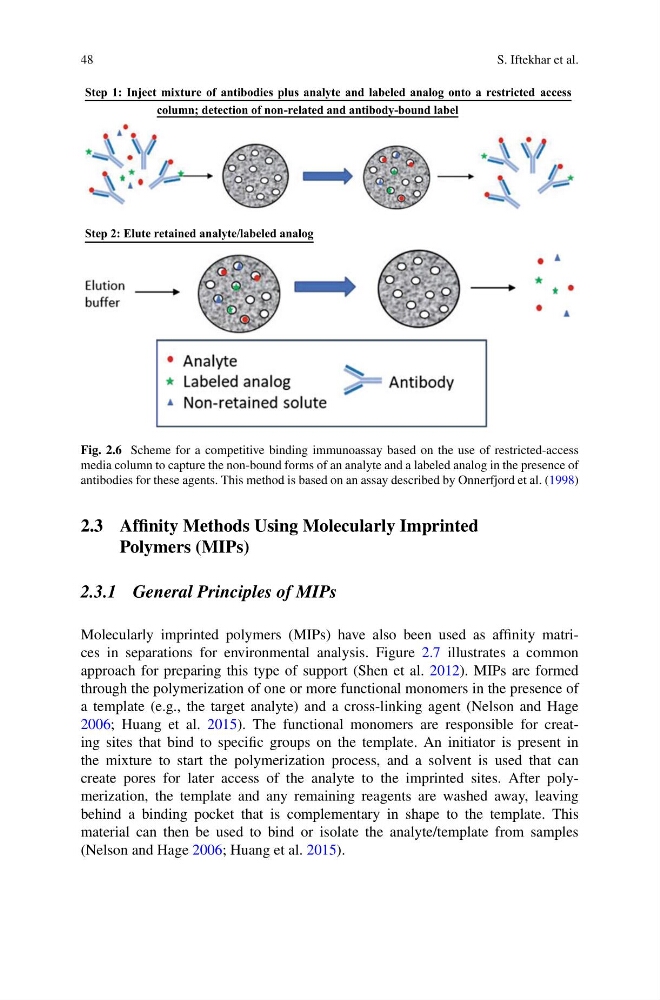
Step 1: Inject mixture of antibodies plus analyte and labeled analog onto a restricted access
column; detection of non-related and antibody-bound label
Step 2: Elute retained analyte/labeled analog
Fig. 2.6 Scheme for a competitive binding immunoassay based on the use of restricted-access
media column to capture the non-bound forms of an analyte and a labeled analog in the presence of
antibodies for these agents. This method is based on an assay described by Onnerfjord et al. (1998)
2.3 Affinity Methods Using Molecularly Imprinted
Polymers (MIPs)
2.3.1 General Principles of MIPs
Molecularly imprinted polymers (MIPs) have also been used as affinity matrices in separations for environmental analysis. Figure 2.7 illustrates a common
approach for preparing this type of support (Shen et al. 2012). MIPs are formed
through the polymerization of one or more functional monomers in the presence of
a template (e.g., the target analyte) and a cross-linking agent (Nelson and Hage
2006; Huang et al. 2015). The functional monomers are responsible for creating sites that bind to specific groups on the template. An initiator is present in
the mixture to start the polymerization process, and a solvent is used that can
create pores for later access of the analyte to the imprinted sites. After polymerization, the template and any remaining reagents are washed away, leaving
behind a binding pocket that is complementary in shape to the template. This
material can then be used to bind or isolate the analyte/template from samples
(Nelson and Hage 2006; Huang et al. 2015).
S. Iftekhar et al.
Step 1: Inject mixture of antibodies plus analyte and labeled analog onto a restricted access
column; detection of non-related and antibody-bound label
Step 2: Elute retained analyte/labeled analog
Fig. 2.6 Scheme for a competitive binding immunoassay based on the use of restricted-access
media column to capture the non-bound forms of an analyte and a labeled analog in the presence of
antibodies for these agents. This method is based on an assay described by Onnerfjord et al. (1998)
2.3 Affinity Methods Using Molecularly Imprinted
Polymers (MIPs)
2.3.1 General Principles of MIPs
Molecularly imprinted polymers (MIPs) have also been used as affinity matrices in separations for environmental analysis. Figure 2.7 illustrates a common
approach for preparing this type of support (Shen et al. 2012). MIPs are formed
through the polymerization of one or more functional monomers in the presence of
a template (e.g., the target analyte) and a cross-linking agent (Nelson and Hage
2006; Huang et al. 2015). The functional monomers are responsible for creating sites that bind to specific groups on the template. An initiator is present in
the mixture to start the polymerization process, and a solvent is used that can
create pores for later access of the analyte to the imprinted sites. After polymerization, the template and any remaining reagents are washed away, leaving
behind a binding pocket that is complementary in shape to the template. This
material can then be used to bind or isolate the analyte/template from samples
(Nelson and Hage 2006; Huang et al. 2015).