

2 Affinity-Based Methods for the Analysis of Emerging …
47
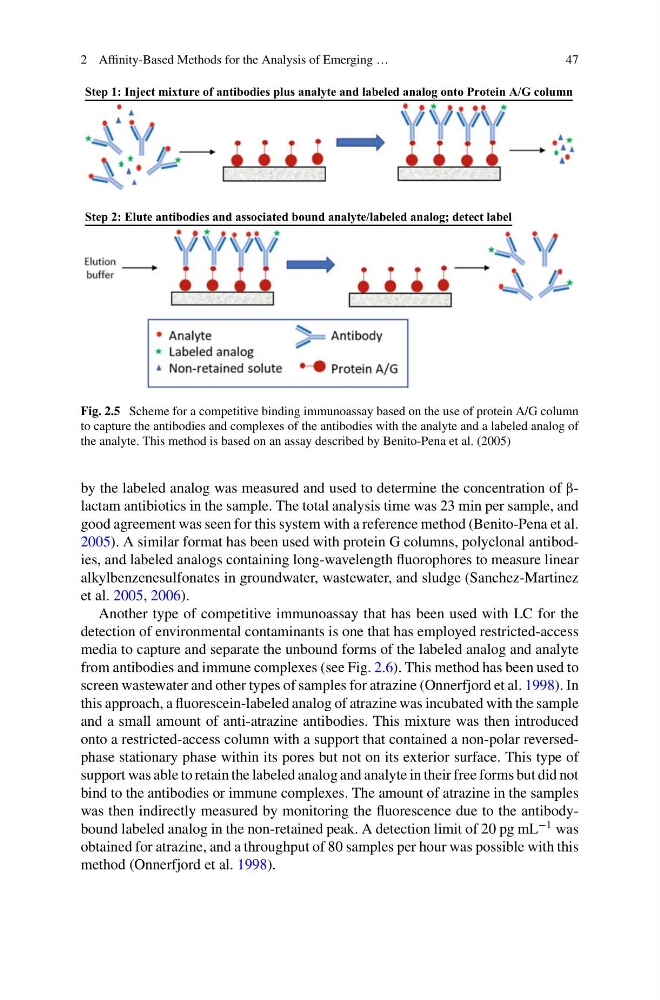
Step 1: Inject mixture of antibodies plus analyte and labeled analog onto Protein A/G column
Step 2: Elute antibodies and associated bound analyte/labeled analog; detect label
Fig. 2.5 Scheme for a competitive binding immunoassay based on the use of protein A/G column
to capture the antibodies and complexes of the antibodies with the analyte and a labeled analog of
the analyte. This method is based on an assay described by Benito-Pena et al. (2005)
by the labeled analog was measured and used to determine the concentration of βlactam antibiotics in the sample. The total analysis time was 23 min per sample, and
good agreement was seen for this system with a reference method (Benito-Pena et al.
2005). A similar format has been used with protein G columns, polyclonal antibodies, and labeled analogs containing long-wavelength fluorophores to measure linear
alkylbenzenesulfonates in groundwater, wastewater, and sludge (Sanchez-Martinez
et al. 2005, 2006).
Another type of competitive immunoassay that has been used with LC for the
detection of environmental contaminants is one that has employed restricted-access
media to capture and separate the unbound forms of the labeled analog and analyte
from antibodies and immune complexes (see Fig. 2.6). This method has been used to
screen wastewater and other types of samples for atrazine (Onnerfjord et al. 1998). In
this approach, a fluorescein-labeled analog of atrazine was incubated with the sample
and a small amount of anti-atrazine antibodies. This mixture was then introduced
onto a restricted-access column with a support that contained a non-polar reversedphase stationary phase within its pores but not on its exterior surface. This type of
support was able to retain the labeled analog and analyte in their free forms but did not
bind to the antibodies or immune complexes. The amount of atrazine in the samples
was then indirectly measured by monitoring the fluorescence due to the antibodybound labeled analog in the non-retained peak. A detection limit of 20 pg mL
−1 was
obtained for atrazine, and a throughput of 80 samples per hour was possible with this
method (Onnerfjord et al. 1998).
47
Step 1: Inject mixture of antibodies plus analyte and labeled analog onto Protein A/G column
Step 2: Elute antibodies and associated bound analyte/labeled analog; detect label
Fig. 2.5 Scheme for a competitive binding immunoassay based on the use of protein A/G column
to capture the antibodies and complexes of the antibodies with the analyte and a labeled analog of
the analyte. This method is based on an assay described by Benito-Pena et al. (2005)
by the labeled analog was measured and used to determine the concentration of βlactam antibiotics in the sample. The total analysis time was 23 min per sample, and
good agreement was seen for this system with a reference method (Benito-Pena et al.
2005). A similar format has been used with protein G columns, polyclonal antibodies, and labeled analogs containing long-wavelength fluorophores to measure linear
alkylbenzenesulfonates in groundwater, wastewater, and sludge (Sanchez-Martinez
et al. 2005, 2006).
Another type of competitive immunoassay that has been used with LC for the
detection of environmental contaminants is one that has employed restricted-access
media to capture and separate the unbound forms of the labeled analog and analyte
from antibodies and immune complexes (see Fig. 2.6). This method has been used to
screen wastewater and other types of samples for atrazine (Onnerfjord et al. 1998). In
this approach, a fluorescein-labeled analog of atrazine was incubated with the sample
and a small amount of anti-atrazine antibodies. This mixture was then introduced
onto a restricted-access column with a support that contained a non-polar reversedphase stationary phase within its pores but not on its exterior surface. This type of
support was able to retain the labeled analog and analyte in their free forms but did not
bind to the antibodies or immune complexes. The amount of atrazine in the samples
was then indirectly measured by monitoring the fluorescence due to the antibodybound labeled analog in the non-retained peak. A detection limit of 20 pg mL
−1 was
obtained for atrazine, and a throughput of 80 samples per hour was possible with this
method (Onnerfjord et al. 1998).