

24
K. Kuroda and J. Kobayashi
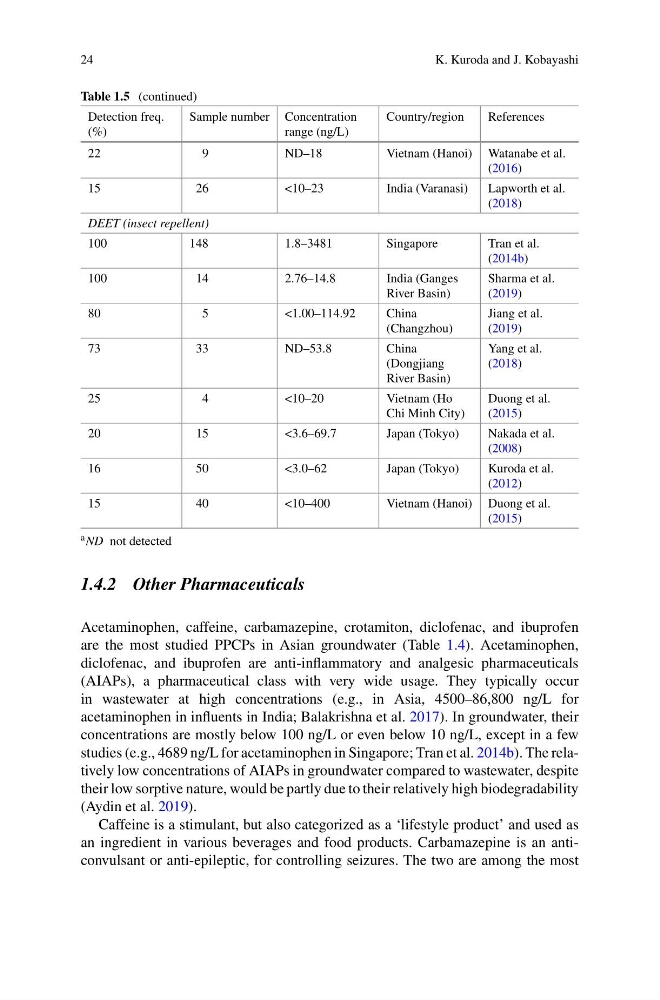
Table 1.5 (continued)
Detection freq.
(%)
Sample number Concentration
range (ng/L)
Country/region
References
22
9
ND–18
Vietnam (Hanoi) Watanabe et al.
(2016)
15
26
<10–23
India (Varanasi)
Lapworth et al.
(2018)
DEET (insect repellent)
100
148
1.8–3481
Singapore
Tran et al.
(2014b)
100
14
2.76–14.8
India (Ganges
River Basin)
Sharma et al.
(2019)
80
5
<1.00–114.92
China
(Changzhou)
Jiang et al.
(2019)
73
33
ND–53.8
China
(Dongjiang
River Basin)
Yang et al.
(2018)
25
4
<10–20
Vietnam (Ho
Chi Minh City)
Duong et al.
(2015)
20
15
<3.6–69.7
Japan (Tokyo)
Nakada et al.
(2008)
16
50
<3.0–62
Japan (Tokyo)
Kuroda et al.
(2012)
15
40
<10–400
Vietnam (Hanoi) Duong et al.
(2015)
a ND not detected
1.4.2 Other Pharmaceuticals
Acetaminophen, caffeine, carbamazepine, crotamiton, diclofenac, and ibuprofen
are the most studied PPCPs in Asian groundwater (Table 1.4). Acetaminophen,
diclofenac, and ibuprofen are anti-inflammatory and analgesic pharmaceuticals
(AIAPs), a pharmaceutical class with very wide usage. They typically occur
in wastewater at high concentrations (e.g., in Asia, 4500–86,800 ng/L for
acetaminophen in influents in India; Balakrishna et al. 2017). In groundwater, their
concentrations are mostly below 100 ng/L or even below 10 ng/L, except in a few
studies (e.g., 4689 ng/L for acetaminophen in Singapore; Tran et al. 2014b). The relatively low concentrations of AIAPs in groundwater compared to wastewater, despite
their low sorptive nature, would be partly due to their relatively high biodegradability
(Aydin et al. 2019).
Caffeine is a stimulant, but also categorized as a ‘lifestyle product’ and used as
an ingredient in various beverages and food products. Carbamazepine is an anticonvulsant or anti-epileptic, for controlling seizures. The two are among the most
K. Kuroda and J. Kobayashi
Table 1.5 (continued)
Detection freq.
(%)
Sample number Concentration
range (ng/L)
Country/region
References
22
9
ND–18
Vietnam (Hanoi) Watanabe et al.
(2016)
15
26
<10–23
India (Varanasi)
Lapworth et al.
(2018)
DEET (insect repellent)
100
148
1.8–3481
Singapore
Tran et al.
(2014b)
100
14
2.76–14.8
India (Ganges
River Basin)
Sharma et al.
(2019)
80
5
<1.00–114.92
China
(Changzhou)
Jiang et al.
(2019)
73
33
ND–53.8
China
(Dongjiang
River Basin)
Yang et al.
(2018)
25
4
<10–20
Vietnam (Ho
Chi Minh City)
Duong et al.
(2015)
20
15
<3.6–69.7
Japan (Tokyo)
Nakada et al.
(2008)
16
50
<3.0–62
Japan (Tokyo)
Kuroda et al.
(2012)
15
40
<10–400
Vietnam (Hanoi) Duong et al.
(2015)
a ND not detected
1.4.2 Other Pharmaceuticals
Acetaminophen, caffeine, carbamazepine, crotamiton, diclofenac, and ibuprofen
are the most studied PPCPs in Asian groundwater (Table 1.4). Acetaminophen,
diclofenac, and ibuprofen are anti-inflammatory and analgesic pharmaceuticals
(AIAPs), a pharmaceutical class with very wide usage. They typically occur
in wastewater at high concentrations (e.g., in Asia, 4500–86,800 ng/L for
acetaminophen in influents in India; Balakrishna et al. 2017). In groundwater, their
concentrations are mostly below 100 ng/L or even below 10 ng/L, except in a few
studies (e.g., 4689 ng/L for acetaminophen in Singapore; Tran et al. 2014b). The relatively low concentrations of AIAPs in groundwater compared to wastewater, despite
their low sorptive nature, would be partly due to their relatively high biodegradability
(Aydin et al. 2019).
Caffeine is a stimulant, but also categorized as a ‘lifestyle product’ and used as
an ingredient in various beverages and food products. Carbamazepine is an anticonvulsant or anti-epileptic, for controlling seizures. The two are among the most