

22
K. Kuroda and J. Kobayashi
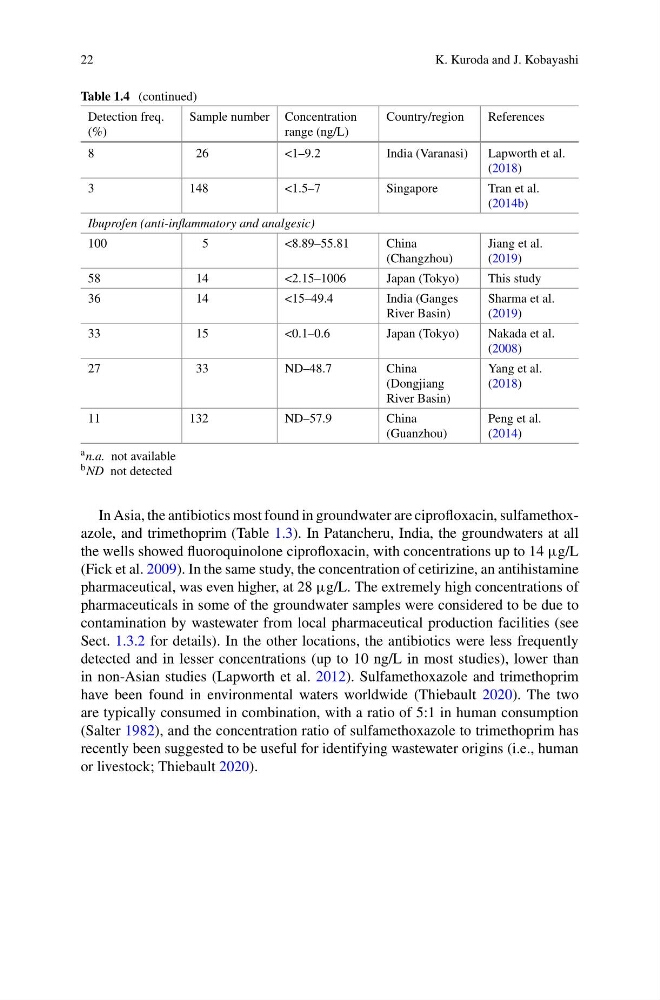
Table 1.4 (continued)
Detection freq.
(%)
Sample number Concentration
range (ng/L)
Country/region
References
8
26
<1–9.2
India (Varanasi)
Lapworth et al.
(2018)
3
148
<1.5–7
Singapore
Tran et al.
(2014b)
Ibuprofen (anti-inflammatory and analgesic)
100
5
<8.89–55.81
China
(Changzhou)
Jiang et al.
(2019)
58
14
<2.15–1006
Japan (Tokyo)
This study
36
14
<15–49.4
India (Ganges
River Basin)
Sharma et al.
(2019)
33
15
<0.1–0.6
Japan (Tokyo)
Nakada et al.
(2008)
27
33
ND–48.7
China
(Dongjiang
River Basin)
Yang et al.
(2018)
11
132
ND–57.9
China
(Guanzhou)
Peng et al.
(2014)
a n.a. not available
b ND not detected
In Asia, the antibiotics most found in groundwater are ciprofloxacin, sulfamethoxazole, and trimethoprim (Table 1.3). In Patancheru, India, the groundwaters at all
the wells showed fluoroquinolone ciprofloxacin, with concentrations up to 14 μg/L
(Fick et al. 2009). In the same study, the concentration of cetirizine, an antihistamine
pharmaceutical, was even higher, at 28 μg/L. The extremely high concentrations of
pharmaceuticals in some of the groundwater samples were considered to be due to
contamination by wastewater from local pharmaceutical production facilities (see
Sect. 1.3.2 for details). In the other locations, the antibiotics were less frequently
detected and in lesser concentrations (up to 10 ng/L in most studies), lower than
in non-Asian studies (Lapworth et al. 2012). Sulfamethoxazole and trimethoprim
have been found in environmental waters worldwide (Thiebault 2020). The two
are typically consumed in combination, with a ratio of 5:1 in human consumption
(Salter 1982), and the concentration ratio of sulfamethoxazole to trimethoprim has
recently been suggested to be useful for identifying wastewater origins (i.e., human
or livestock; Thiebault 2020).
K. Kuroda and J. Kobayashi
Table 1.4 (continued)
Detection freq.
(%)
Sample number Concentration
range (ng/L)
Country/region
References
8
26
<1–9.2
India (Varanasi)
Lapworth et al.
(2018)
3
148
<1.5–7
Singapore
Tran et al.
(2014b)
Ibuprofen (anti-inflammatory and analgesic)
100
5
<8.89–55.81
China
(Changzhou)
Jiang et al.
(2019)
58
14
<2.15–1006
Japan (Tokyo)
This study
36
14
<15–49.4
India (Ganges
River Basin)
Sharma et al.
(2019)
33
15
<0.1–0.6
Japan (Tokyo)
Nakada et al.
(2008)
27
33
ND–48.7
China
(Dongjiang
River Basin)
Yang et al.
(2018)
11
132
ND–57.9
China
(Guanzhou)
Peng et al.
(2014)
a n.a. not available
b ND not detected
In Asia, the antibiotics most found in groundwater are ciprofloxacin, sulfamethoxazole, and trimethoprim (Table 1.3). In Patancheru, India, the groundwaters at all
the wells showed fluoroquinolone ciprofloxacin, with concentrations up to 14 μg/L
(Fick et al. 2009). In the same study, the concentration of cetirizine, an antihistamine
pharmaceutical, was even higher, at 28 μg/L. The extremely high concentrations of
pharmaceuticals in some of the groundwater samples were considered to be due to
contamination by wastewater from local pharmaceutical production facilities (see
Sect. 1.3.2 for details). In the other locations, the antibiotics were less frequently
detected and in lesser concentrations (up to 10 ng/L in most studies), lower than
in non-Asian studies (Lapworth et al. 2012). Sulfamethoxazole and trimethoprim
have been found in environmental waters worldwide (Thiebault 2020). The two
are typically consumed in combination, with a ratio of 5:1 in human consumption
(Salter 1982), and the concentration ratio of sulfamethoxazole to trimethoprim has
recently been suggested to be useful for identifying wastewater origins (i.e., human
or livestock; Thiebault 2020).