

18 Perfluorooctanesulfonate (PFOS), Its Occurrence, Fate …
415
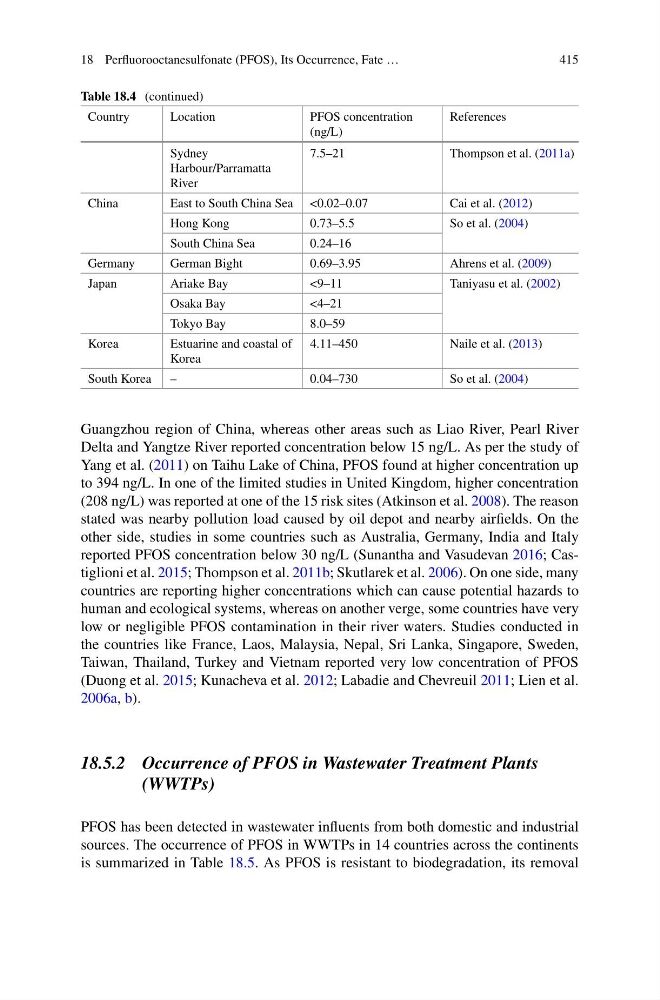
Table 18.4 (continued)
Country
Location
PFOS concentration
(ng/L)
References
Sydney
Harbour/Parramatta
River
7.5–21
Thompson et al. (2011a)
China
East to South China Sea <0.02–0.07
Cai et al. (2012)
Hong Kong
0.73–5.5
So et al. (2004)
South China Sea
0.24–16
Germany
German Bight
0.69–3.95
Ahrens et al. (2009)
Japan
Ariake Bay
<9–11
Taniyasu et al. (2002)
Osaka Bay
<4–21
Tokyo Bay
8.0–59
Korea
Estuarine and coastal of
Korea
4.11–450
Naile et al. (2013)
South Korea –
0.04–730
So et al. (2004)
Guangzhou region of China, whereas other areas such as Liao River, Pearl River
Delta and Yangtze River reported concentration below 15 ng/L. As per the study of
Yang et al. (2011) on Taihu Lake of China, PFOS found at higher concentration up
to 394 ng/L. In one of the limited studies in United Kingdom, higher concentration
(208 ng/L) was reported at one of the 15 risk sites (Atkinson et al. 2008). The reason
stated was nearby pollution load caused by oil depot and nearby airfields. On the
other side, studies in some countries such as Australia, Germany, India and Italy
reported PFOS concentration below 30 ng/L (Sunantha and Vasudevan 2016; Castiglioni et al. 2015; Thompson et al. 2011b; Skutlarek et al. 2006). On one side, many
countries are reporting higher concentrations which can cause potential hazards to
human and ecological systems, whereas on another verge, some countries have very
low or negligible PFOS contamination in their river waters. Studies conducted in
the countries like France, Laos, Malaysia, Nepal, Sri Lanka, Singapore, Sweden,
Taiwan, Thailand, Turkey and Vietnam reported very low concentration of PFOS
(Duong et al. 2015; Kunacheva et al. 2012; Labadie and Chevreuil 2011; Lien et al.
2006a, b).
18.5.2 Occurrence of PFOS in Wastewater Treatment Plants
(WWTPs)
PFOS has been detected in wastewater influents from both domestic and industrial
sources. The occurrence of PFOS in WWTPs in 14 countries across the continents
is summarized in Table 18.5. As PFOS is resistant to biodegradation, its removal
415
Table 18.4 (continued)
Country
Location
PFOS concentration
(ng/L)
References
Sydney
Harbour/Parramatta
River
7.5–21
Thompson et al. (2011a)
China
East to South China Sea <0.02–0.07
Cai et al. (2012)
Hong Kong
0.73–5.5
So et al. (2004)
South China Sea
0.24–16
Germany
German Bight
0.69–3.95
Ahrens et al. (2009)
Japan
Ariake Bay
<9–11
Taniyasu et al. (2002)
Osaka Bay
<4–21
Tokyo Bay
8.0–59
Korea
Estuarine and coastal of
Korea
4.11–450
Naile et al. (2013)
South Korea –
0.04–730
So et al. (2004)
Guangzhou region of China, whereas other areas such as Liao River, Pearl River
Delta and Yangtze River reported concentration below 15 ng/L. As per the study of
Yang et al. (2011) on Taihu Lake of China, PFOS found at higher concentration up
to 394 ng/L. In one of the limited studies in United Kingdom, higher concentration
(208 ng/L) was reported at one of the 15 risk sites (Atkinson et al. 2008). The reason
stated was nearby pollution load caused by oil depot and nearby airfields. On the
other side, studies in some countries such as Australia, Germany, India and Italy
reported PFOS concentration below 30 ng/L (Sunantha and Vasudevan 2016; Castiglioni et al. 2015; Thompson et al. 2011b; Skutlarek et al. 2006). On one side, many
countries are reporting higher concentrations which can cause potential hazards to
human and ecological systems, whereas on another verge, some countries have very
low or negligible PFOS contamination in their river waters. Studies conducted in
the countries like France, Laos, Malaysia, Nepal, Sri Lanka, Singapore, Sweden,
Taiwan, Thailand, Turkey and Vietnam reported very low concentration of PFOS
(Duong et al. 2015; Kunacheva et al. 2012; Labadie and Chevreuil 2011; Lien et al.
2006a, b).
18.5.2 Occurrence of PFOS in Wastewater Treatment Plants
(WWTPs)
PFOS has been detected in wastewater influents from both domestic and industrial
sources. The occurrence of PFOS in WWTPs in 14 countries across the continents
is summarized in Table 18.5. As PFOS is resistant to biodegradation, its removal